الضوء والذرات: كيف يتحكم التباين الاتجاهي في الحرارة سريع
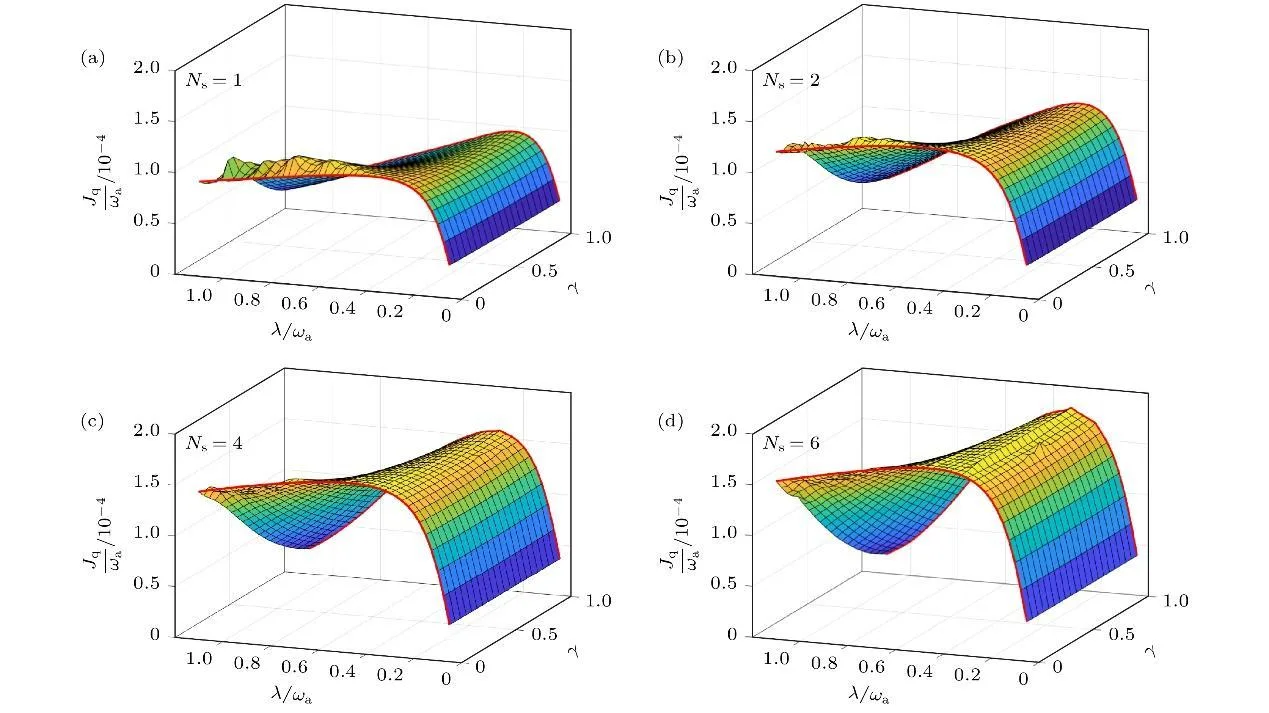
الضوء والذرات، مثل راقصين، يمكن أن يتحركا بتناغم أو بشكل متفرق. عندما يكون تفاعلهما اتجاهيًا — أي يعتمد على الاتجاه — يصبح الرقص أكثر تعقيدًا. في العمل الجديد، نظر الفيزيائيون في نموذج حيث تتفاعل مجموعة من الذرات (كيوبتات) بشكل جماعي مع مجال ضوئي اتجاهي، وكل مكوّن متصل بمستودع حراري. اتضح أن التباين الاتجاهي يمكن أن يغير جذريًا تدفق الحرارة عبر النظام.
يلعب عدد الذرات دور المضخم: مع زيادته، تصبح قمم تدفق الحرارة أعلى، والقيعان أعمق. في حد العدد اللانهائي من الذرات (الحد الديناميكي الحراري)، أمكن اشتقاق صيغ بسيطة تحدد الحد الأعلى لتدفق الحرارة للأنظمة المحدودة. تصف هذه الصيغ عملية تشبه النفق الجماعي — حيث تنتقل الحرارة ليس بشكل فردي، بل بكميات منسقة.
الصمام الثنائي الحراري — جهاز يمرر الحرارة في اتجاه واحد أفضل من الآخر — يعتمد أيضًا على التباين الاتجاهي. ضبط تفاعل الضوء مع الذرات يفتح الطريق للتحكم في الحرارة على المستوى الكمومي، مما قد يكون مفيدًا في الإلكترونيات الدقيقة المستقبلية.
الملخص الأصلي
كما كتبه المؤلفون، بالإنجليزية arXiv:2603.29180
Nonequilibrium heat transport and quantum thermodynamics in light-matter interacting systems have received increasing attention. Quantum thermal devices, e.g., heat valve and head diode, have been realized. Recently, it has been discovered that the anisotropic light-matter interactions can greatly modify the eigenvalues and eigenvectors of hybrid quantum systems, leading to nontrivial quantum phase transitions, quantum metrology, and nonclassicality of photons. To explore the influences of anisotropic light-matter interactions on quantum transport, we investigate heat flow in the nonequilibrium anisotropic Dicke model. In this model, an ensemble of qubits collectively interacts with an anisotropic photon field. Each component interacts with bosonic thermal reservoirs. Quantum dressed master equation (DME) is included to properly study dissipative dynamics of the anisotropic Dicke model. Within the eigenbasis of the reduced anisotropic Dicke system, strong qubit-photon couplings can be properly handled. Our results demonstrate that anisotropic qubit-photon interactions are crucial for modulating steady-state heat flow. In particular, it is found that under strong coupling the heat flow is dramatically suppressed by a large anisotropic qubit-photon factor. While under moderate coupling, the anisotropic qubit-photon interactions enhance the heat flow. Moreover, the increase in the number of qubits amplifies the flow characteristics, with the peaks increasing and the valleys decreasing. Besides, we derive two analytical expressions of heat flows in thermodynamic limit approximation with limiting anisotropic factors. These heat currents exhibit the cotunneling heat transport pictures. They also serve as the upper boundaries for the heat flows in the finite-size anisotropic Dicke model. We also analyze the thermal rectification effect in the anisotropic Dicke model.
في نموذج ديك، يمكن أن يؤدي التباين الاتجاهي في التفاعل إلى انتقالات طورية كمومية غير عادية، حيث تتغير خصائص النظام قفزة واحدة عند تغيير المعاملات بشكل تدريجي.