التيارات الخفية في الكون سريع
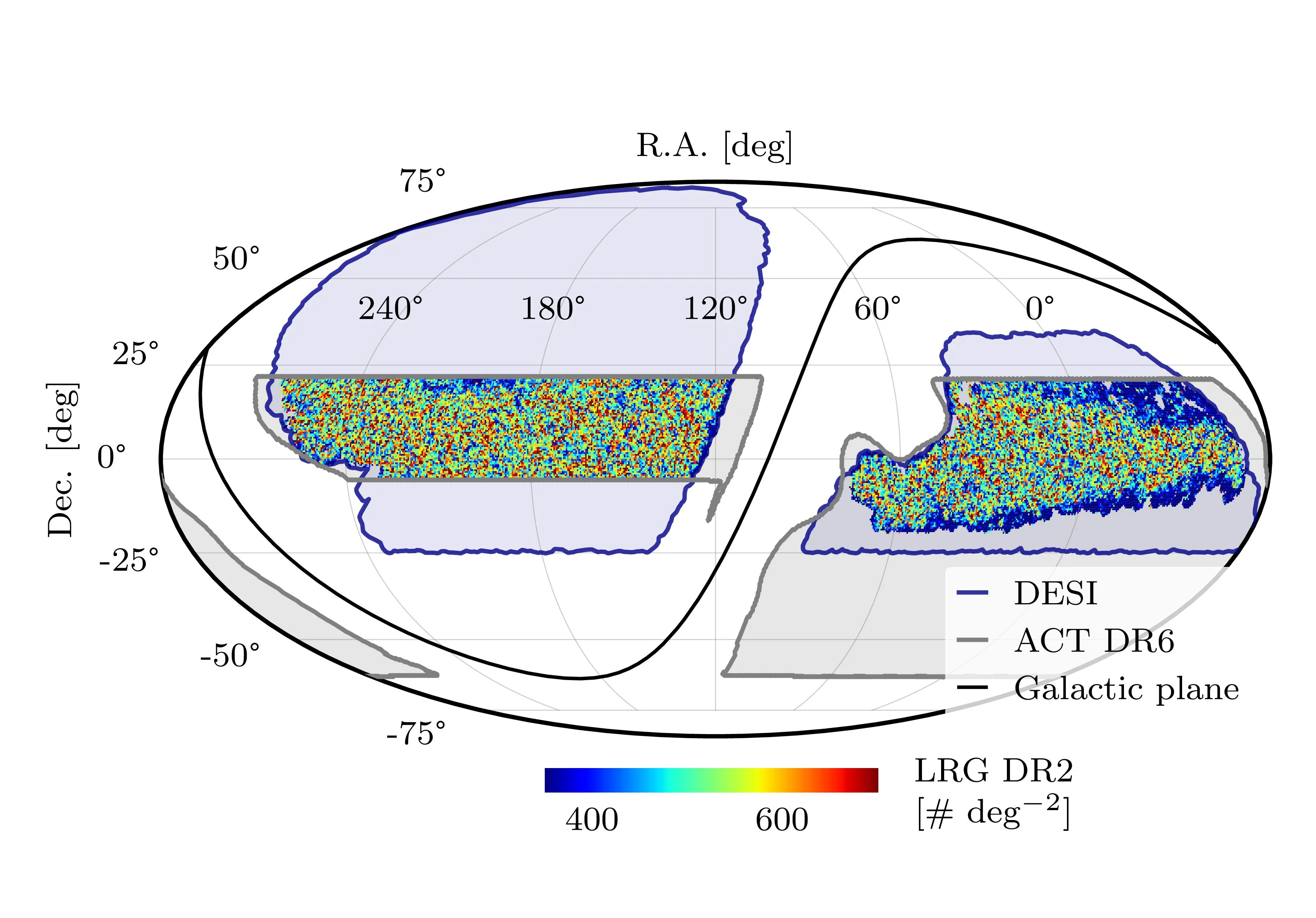
في صحراء أتاكاما التشيلية، يقف تلسكوب لا ينظر إلى النجوم، بل إلى أقدم ضوء في الكون - الخلفية الكونية الميكروية. هذا الضوء سافر إلينا لما يقرب من 14 مليار سنة، منذ أن أصبح الكون شفافًا. وفي طريقه، مر عبر سحب من الغاز الساخن حول المجرات. الإلكترونات في هذا الغاز تدفع الفوتونات قليلاً - مثل الرياح التي تهب على حبوب اللقاح الطائرة. ونتيجة لذلك، تتغير درجة حرارة الضوء قليلاً: في مكان ما يصبح أكثر دفئًا بأجزاء من المليون من الدرجة، وفي مكان آخر أكثر برودة.
إذا وضعنا خريطة درجات الحرارة هذه على خريطة توزيع المجرات، يظهر نمط. حيث توجد مجرات كثيرة، يتحرك الغاز نحوها بفعل جاذبيتها - ويصل الضوء من هناك مع تحول طفيف بالكاد يُلاحظ. أخذ علماء الفلك بيانات من تلسكوب ACT ومن المسح الجديد DESI، الذي قاس المسافات إلى ملايين المجرات والكوازارات. وبدمجها، رأوا لأول مرة هذه التيارات ليس فقط حول المجرات الحمراء الضخمة، ولكن أيضًا حول المجرات الزرقاء الأخف والكوازارات الساطعة.
مثل هذه الخريطة للتيارات هي أداة جديدة. في السابق، كان علماء الفلك يستطيعون رؤية فقط أين تراكمت المادة، وليس كيف تتحرك. الآن يمكن رؤية الحركة أيضًا. هذا يساعد في وزن المادة المظلمة غير المرئية، التي تسحب كل شيء بجاذبيتها، والتحقق من عدم وجود تفاوتات في البداية، بقيت من الانفجار العظيم. القياسات الأولى أعطت بالفعل أدق حد لهذه التفاوتات حتى اليوم.
التلسكوب في الصحراء ينظر إلى الماضي، وخريطة المجرات تنظر إلى الحاضر. دمجهما يظهر كيف تدفق الكون ويتدفق، وكيف تواصل الأنهار غير المرئية من الغاز والمجرات مسارها تحت تأثير الجاذبية.
الملخص الأصلي
كما كتبه المؤلفون، بالإنجليزية arXiv:2604.04867
Joint analyses of high-resolution CMB temperature maps with galaxy surveys provide a unique way to reconstruct the radial velocity field of the underlying matter distribution via the kinematic Sunyaev-Zeldovich (kSZ) effect. Using data from the Atacama Cosmology Telescope (ACT) DR6 and the Dark Energy Spectroscopic Instrument (DESI) DR2, we present radial velocity reconstructions for luminous red galaxies (LRGs), emission-line galaxies (ELGs), and quasars (QSOs). Leveraging the spectroscopic data, we are able to reliably model the foreground contamination and report a negligible impact on our main observables. We detect the velocity-galaxy cross-correlation at $$17.0\sigma$$ for LRGs, and for the first time, at $$8.3\sigma$$ for ELGs and $$6.8\sigma$$ for QSOs. We further report the first detection of the velocity-velocity correlation using LRGs at $$3.1\sigma$$, as well as the highest cumulative detection of the kSZ effect to date at $$20.8 \sigma$$. Similarly to previous results, we find a lower amplitude of the kSZ signal compared to our fiducial halo model prediction and electron profile assuming a Battaglia profile. Combining these new observables, we obtain constraints on local-type primordial non-Gaussianity (PNG): $$f_{\rm NL}^{\rm loc} = 15.9_{-34.4}^{+34.6}$$ at 68\% confidence, which represents the tightest constraint to date derived from the velocity field. The measurements presented here already exhibit lower noise on a per-mode basis than the galaxy auto-correlation on the largest scales, $$k<0.004~\rm{Mpc^{-1}}$$, highlighting the key role these observables will play in the context of future CMB experiments such as the Simons Observatory.
الخلفية الكونية الميكروية هي إشعاع متبقٍ من الانفجار العظيم. إنها تملأ السماء بأكملها بشكل موحد، ودرجة حرارتها حوالي 2.7 درجة فوق الصفر المطلق.
في رواية "الاتصال" لكارل ساغان، تستمع البطلة إلى إشارات من الفضاء، وتصبح التموجات الخلفية للإشعاع الميكروي مفتاحًا للحل - هنا أيضًا، من خلال تموجات بالكاد ملحوظة، يقرأ العلماء تاريخ الكون.