D. Kirkby

5 articles · 30 co-authors · latest: 2026-04-06
4,833 citations · h-index 26 · 157 papersData: Semantic Scholar

We have retold 5 papers by this author. most often about: baryon acoustic oscillations, expansion of the universe, large-scale structure of the universe. 30 co-authors across our retellings.

Links in the knowledge graph
Cosmology2026-01-091 minarXiv:2601.05967express
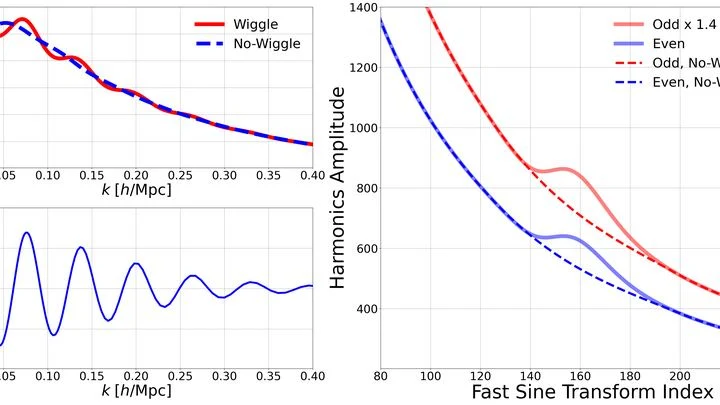
Cosmic Ruler: Inflection Point Instead of Peak
There's no tool to measure distances to faraway galaxies, but nature left a clue: after the Big Bang, sound waves created rhythmic clumps of matter. Today, this is noticeable as a slight preference for galaxies to be at a certain distance from each other — a built-in ruler.
Cosmology2026-01-131 minarXiv:2601.08103express
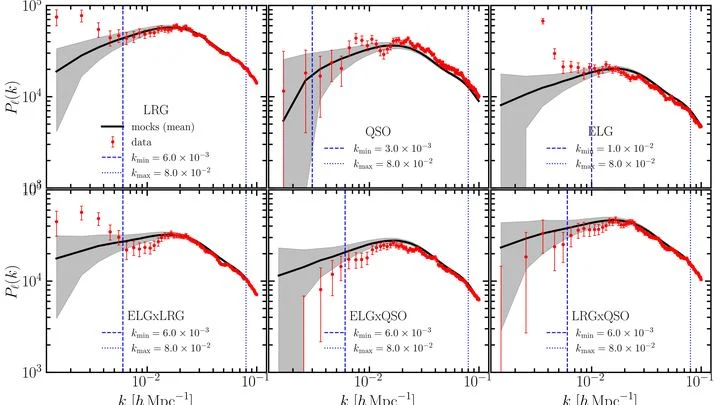
Echoes of the Early Universe in the Light of Quasars
The early universe was a hot soup of particles and light. In this soup, sound waves, fluctuations in density, spread outward from clumps of matter like ripples on a pond. When the universe cooled, these waves froze, leaving an imprint in the distribution of galaxies: they are slightly more abundant at a certain distance from each other.
Cosmology2026-02-182 minarXiv:2602.16134express
Galaxies Line Up: How We Measure the Expansion of the Universe
In the early universe, when it was just a few hundred thousand years old, matter had not yet gathered into stars and galaxies; it was a hot soup of particles and light. Sound waves rippled through this soup — compressions and rarefactions, like ripples from a stone thrown into water.
Cosmology2026-04-062 minarXiv:2604.04867express
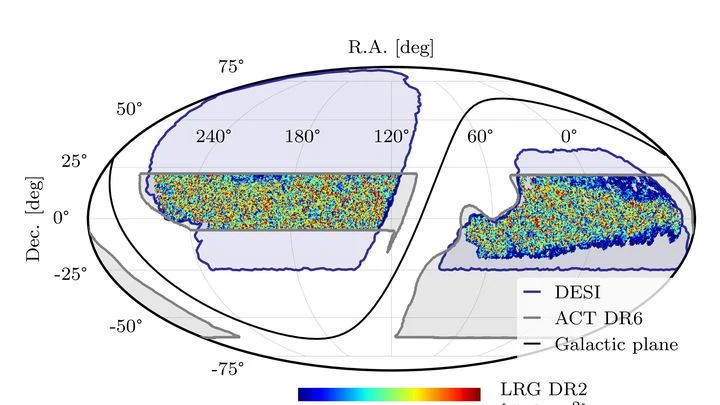
The Universe's Hidden Currents
In Chile's Atacama Desert stands a telescope that doesn't look at stars, but at the oldest light in the Universe — the cosmic microwave background. This light has been traveling to us for nearly 14 billion years, ever since the Universe became transparent. On its way, it passed through clouds of hot gas around galaxies.
Cosmology2026-04-061 minarXiv:2604.05213express
How Ripples in a Glass Reveal the Shape of the Universe
If you toss a handful of sand into calm water, the ripples spread out evenly. Likewise, matter after the Big Bang should have flown out equally in all directions. But in reality, the galaxy map shows a slight ripple — here a few more, there a few less. This ripple is the imprint of those first moments, when space had not yet become perfectly smooth.