جدار يخمد الاضطراب سريع
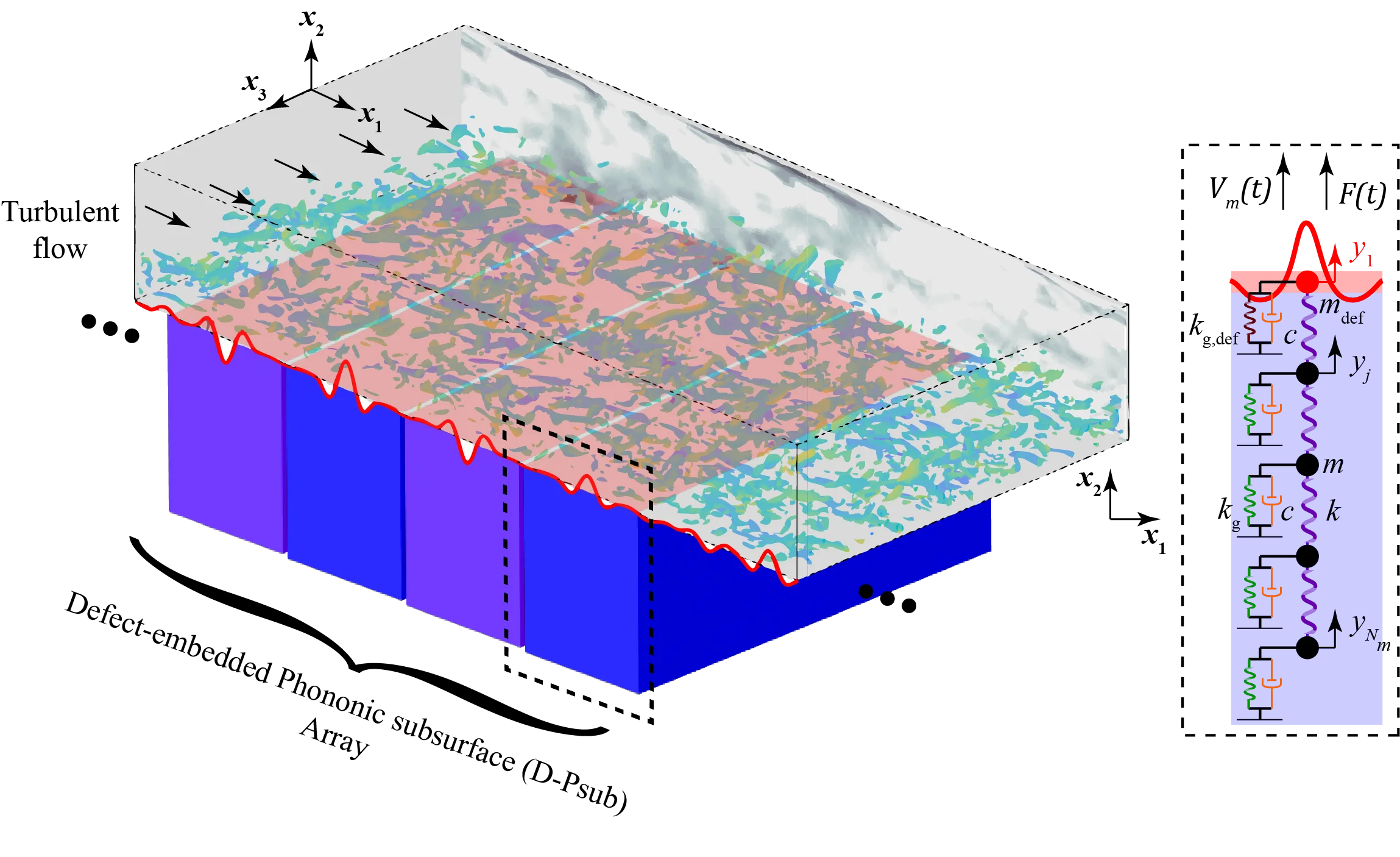
يشبه التدفق المضطرب بالقرب من الجدار حشدًا يدفع فيه كل شخص في اتجاه مختلف. تنشأ الدوامات وتتفكك، مما يخلق هزات فوضوية. إذا تم دمج طبقة صوتية ذات عيب في الجدار، مثل شوكة رنانة تصدر نغمة واحدة فقط، فإنها تبدأ في الاستجابة فقط لنطاق ضيق من الترددات.
في الدراسة الجديدة، وُضعت هذه الطبقة في قاع قناة بها ماء مضطرب. يضرب ضغط التدفق الجدار بطيف واسع، لكن الطبقة تستجيب بنطاق ضيق. ونتيجة لذلك، يتغير نمط التدفق بالقرب من الجدار: تضعف تذبذبات السرعة، وتصبح الخطوط الطولية أكثر تماسكًا، وتنخفض مقاومة الاحتكاك.
المفاجأة الكبرى هي أن النظام لا يتصرف كما لو كان الجدار مجبرًا على الاهتزاز بتردد معين. بسبب التفاعل بين السائل والبنية، ينزاح التردد الطبيعي، وتُحدد المرحلة بين الألواح من خلال انتقال الدوامات. وبالتالي، فإن الطبقة لا تخمد الاضطرابات فحسب، بل تعيد توزيع طاقة الاضطراب، محولة الفوضى إلى حركة أكثر انتظامًا.
الملخص الأصلي
كما كتبه المؤلفون، بالإنجليزية arXiv:2604.10430
We investigate the interaction between wall-bounded turbulence and defect-embedded phononic subsurface (D-Psub) using a weakly coupled fluid--structure framework, in which the flow and structure are advanced sequentially without sub-iterations. The D-Psub subsurface is modeled as a dynamic wall with a resonance introduced via a localized structural defect, driven by spatially averaged wall-pressure fluctuations from a turbulent channel flow. This configuration enables a controlled study of how a narrow-band structural response interacts with the broadband forcing of near-wall turbulence. Despite broadband turbulent forcing, the D-Psub exhibits a narrow-band response that modifies near-wall dynamics, with representative cases showing suppression of velocity fluctuations, increased coherence of streamwise streaks, and a measurable reduction in turbulent drag. Crucially, the coupled system displays behavior that cannot be replicated by prescribed wall motion: the dominant oscillation frequency shifts away from the designed resonance due to fluid--structure interaction. Additionally, the phase between panels is shown to be governed by the convection of turbulent structures. These results reveal a mechanism by which phononic subsurfaces filter and reorganize turbulent energy through frequency-selective coupling, distinct from conventional compliant or actively forced walls. The findings provide a physical basis for designing passive resonant surfaces that exploit turbulence-structure coupling for flow control.
حتى السطح الرنان السلبي يمكن أن يقلل مقاومة الاحتكاك بنسبة عدة بالمائة، دون إنفاق واط واحد من الطاقة.
فكرة سطح يهدئ التدفق بنفسه تذكرنا بكسوة السفن في رواية "الكثيب"، التي تستجيب لاهتزازات الصحراء.