أنماط ضوء عشوائية بدلًا من المسح الطويل سريع
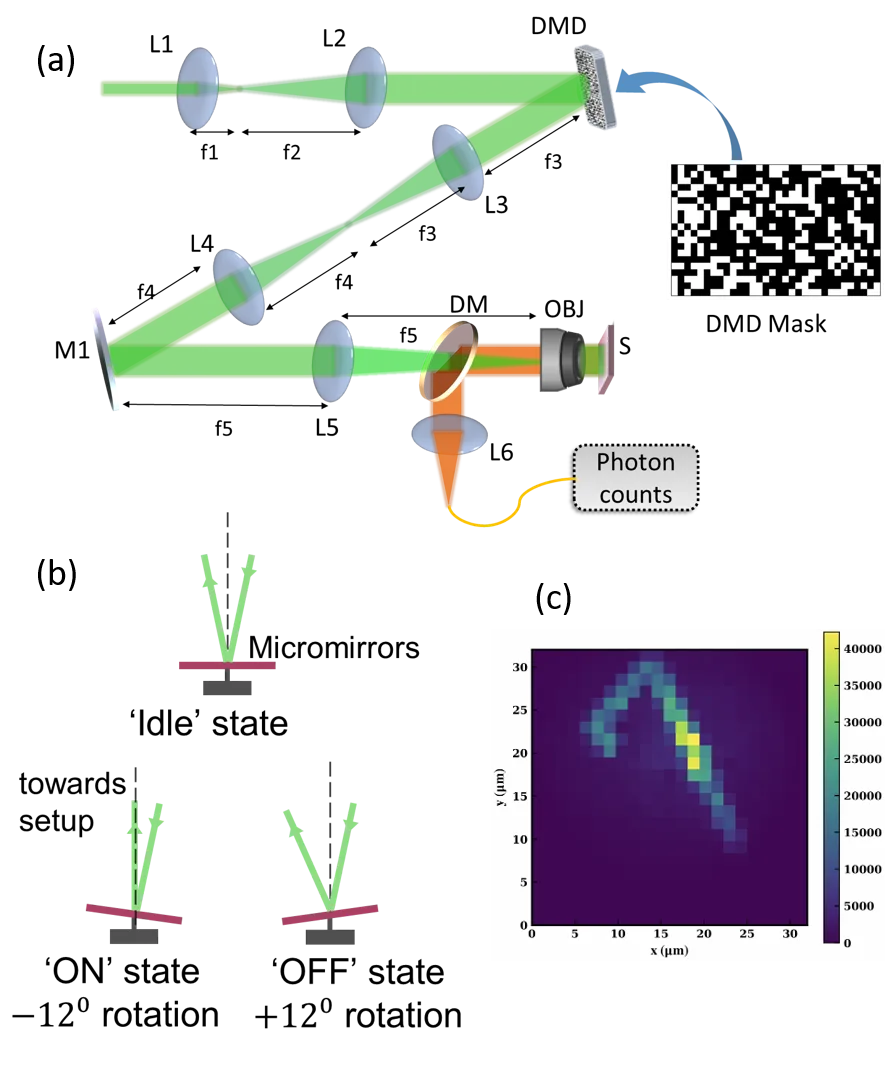
البحث عن نقطة مضيئة مفردة في عينة مظلمة يشبه محاولة إيجاد إبرة في كومة قش: شعاع المجهر يزحف سطرًا بعد سطر، مضيِّعًا الوقت والضوء. استبدل الفيزيائيون هذا المسح البطيء بأنماط ضوء عشوائية. تُضاء العينة بحقل واسع في كل مرة، لكن بنمط جديد من البقع المضيئة والمظلمة، كما لو كانت تُسقط عليها ظلال عشوائية من شبكة. تسجّل الكاميرا كمية الضوء القادمة من المساحة كلها، ثم يجمع الخوارزم الصورة من هذه الشظايا.
في التجربة، استُخدمت عيوب النيتروجين في الألماس — عيوب صغيرة في الشبكة البلورية تتوهج كذرات مفردة. اتضح أنه للحصول على صورة واضحة، يكفي حوالي 20% من القياسات مقارنة بالمسح السطري التقليدي. هذا يشبه تجميع أحجية بأخذ خُمس القطع فقط، لكن باختيارها من أماكن عشوائية وليس بالتتابع.
تجاوزت الطريقة التوهج البسيط. تعلّم العلماء استعادة خريطة الخصائص الكمومية للضوء — كيف تصل الفوتونات منفردة وليس في أزواج. تتيح هذه "خريطة العزلة" تمييز مصدر الضوء المفرد الحقيقي عن تجمع عدة مصادر، وتتطلب أيضًا بيانات أقل بخمس مرات. يمكن الآن العثور على المنارات الكمومية النادرة بشكل أسرع، دون حرق العينة بشعاع طويل.
الملخص الأصلي
كما كتبه المؤلفون، بالإنجليزية arXiv:2604.10463
Optical imaging of quantum emitters is essential for a wide range of quantum applications. Conventional confocal imaging relies on point-by-point raster scanning, which is inherently time-consuming and photon-inefficient, particularly for sparse emitter distributions and photon-limited samples. Here, we demonstrate a compressive sensing-based imaging approach, where spatially structured wide-field excitation replaces raster scanning, enabling reconstruction of sparse emitters. In our implementation, random binary patterns are used to acquire compressive measurements, from which the spatial fluorescence distribution is reconstructed using a GPSR-BB algorithm. We experimentally demonstrate this approach using nitrogen-vacancy (NV) centers in diamond as a representative platform, with high-fidelity image reconstruction achieved using only approximately $$20\%$$ of the measurements required for conventional raster scanning. In addition to intensity reconstruction, we extend this framework to reconstruct spatial maps of the second-order correlation function $$g^{(2)}(0)$$ from compressive measurements. This enables identification of single-photon emitters through antibunching signatures using significantly reduced data.
عيب النيتروجين في الألماس هو ذرة نيتروجين حلت محل ذرة كربون، وفراغ بجانبها. يتوهج هذا العيب باستقرار كبير لدرجة أنه يُستخدم كبوصلة صغيرة لقياس المجالات المغناطيسية.