شعاع كربون تحت السيطرة: كيف نلتقط وميض غاما سريع
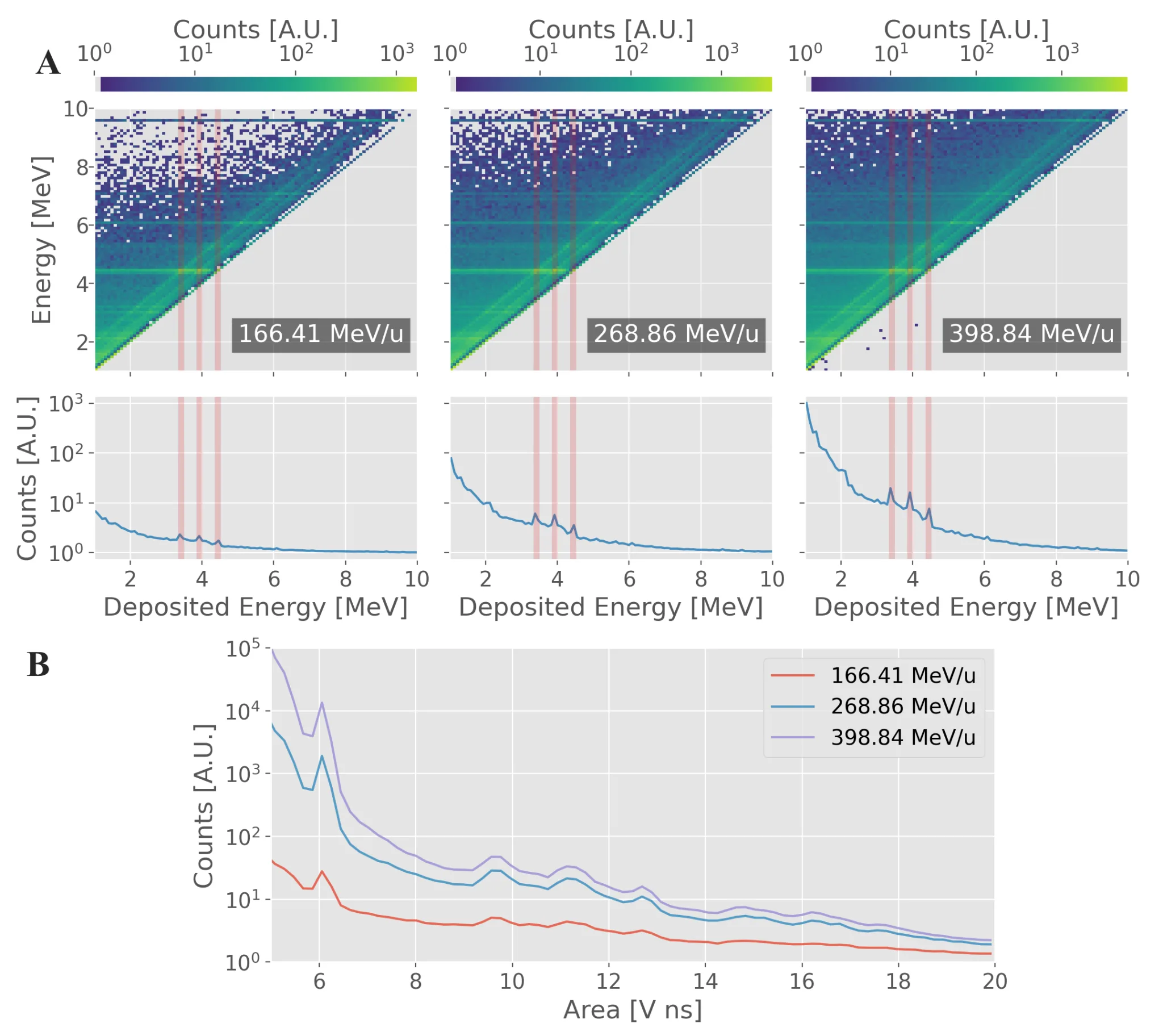
عندما تدخل حزمة أيونات الكربون إلى الجسم، فإنها لا تطلق طاقتها فورًا، بل في نهاية مسارها، مثل عداء يبذل قصارى جهده في الأمتار الأخيرة. يحتاج الأطباء إلى معرفة نقطة النهاية هذه لتجنب إتلاف الأنسجة السليمة. ولكن كيف ننظر داخل الجسم دون إجراء شق جراحي؟ الفيزياء نفسها تقدم الإجابة: عند اصطدام الأيونات بأنوية الذرات، تنشأ ومضات قصيرة من أشعة غاما.
الفكرة بسيطة: إذا قمنا بتسجيل لحظة دخول الأيون ولحظة وصول وميض غاما، فإن الفارق الزمني سيخبرنا عن العمق الذي حدث فيه الاصطدام. هذا يشبه صدى الصوت في الجبال، حيث يمكن من خلال تأخر الصوت تقدير بُعد الجرف. اختبر العلماء هذه الطريقة لأول مرة على حزمة أيونات كربون في المركز الإيطالي CNAO. قاموا بتشعيع هدف بلاستيكي بسمك 30 سنتيمترًا والتقطوا أشعة غاما بكاشف موضوع جانبًا من الحزمة.
أظهرت التجارب عند ثلاث طاقات مختلفة للحزمة أن الحساب والواقع يتطابقان بشكل شبه مثالي. لأدنى طاقة، لم يكن هناك أي انحراف؛ للطاقة المتوسطة، أقل من واحد في المئة؛ وللطاقة العالية، حتى ثمانية في المئة في أسوأ الحالات. علاوة على ذلك، كانت الإشارة نقية: فهي في الأساس كمات غاما وليست نيوترونات مزعجة أو شظايا نووية. هذا يعني أن الطريقة جديرة بالثقة.
لماذا هذا مهم؟ اليوم، في العلاج بحزم الجسيمات، يعتمد الأطباء على الحسابات، لكن جسم المريض ليس متجانسًا تمامًا، وقد تتوقف الحزمة أبكر أو لاحقًا قليلًا. إذا تعلمنا مراقبة العمق في الوقت الفعلي، سيصبح العلاج أدق وأكثر أمانًا. هذه تجربة مخبرية في الوقت الحالي، لكنها تثبت أن صدى ومضات غاما يمكن أن يصبح بوصلة موثوقة للعلاج الإشعاعي.
الملخص الأصلي
كما كتبه المؤلفون، بالإنجليزية arXiv:2604.16131
Prompt Gamma Timing (PGT) is a promising technique for in vivo range verification in particle therapy, exploiting the time-of-flight between primary particles and prompt gamma rays emitted by nuclear interactions. PGT distribution is highly sensitive to beam energy and target density, which, under controlled detector positioning, enables real-time monitoring of particle range, detection of morphological changes, and support for adaptive treatment strategies. This study investigates for the first time the application of PGT in carbon ion therapy. Measurements were performed using a dedicated detection system composed of a silicon strip sensor for primary ion timing and a LaBr3(Ce) read out by a SiPM for secondary radiation. Carbon ion beams with energies of 166.41, 268.86, and 398.84 MeV/u irradiated a homogeneous 30.0 cm PMMA target at CNAO. The secondary radiation detector was positioned at four off-beam positions to assess the robustness of the PGT technique. Simulations based on Geant4 were conducted for all configurations to evaluate agreement and predictive capability. A bin-by-bin comparison of experimental and simulated PGT intensities demonstrated strong agreement within the 95% confidence interval, with no incompatible bins at 166.41 MeV/u, at most 1% at 268.86 MeV/u, and up to 8% at 398.84 MeV/u, depending on detector position. Photons were identified as the dominant contribution to the detected signals, particularly for detector positions upstream with respect to the primary particle beam, minimizing signal contamination from neutrons and charged fragments. The validated experimental-simulation framework confirms the capability of the proposed PGT system to resolve energy-dependent differences and highlights its potential for detecting clinically relevant changes in the particle beam range, supporting further development toward real-time monitoring in carbon ion therapy.
تحدث ومضات غاما عند التشعيع بالكربون خلال أجزاء من المليار من الثانية بعد دخول الأيون، أسرع من طرفة عين.