ميزان يسمع صدى في قطرة سريع
الموازين الدقيقة الكوارتزية هي صفيحة رقيقة تهتز بتردد خمسة ملايين مرة في الثانية. إذا سقطت عليها قطرة سائل، يتغير الاهتزاز: من هذه التغيرات يمكن معرفة كتلة القطرة ومرونتها. لكن في القطرات الصغيرة يظهر تأثير غير متوقع: الصوت الذي ترسله الصفيحة إلى السائل ينعكس عن الحد العلوي للقطرة ويعود إليها. فيتكون صدى يهز الصفيحة ويشوش القراءات.
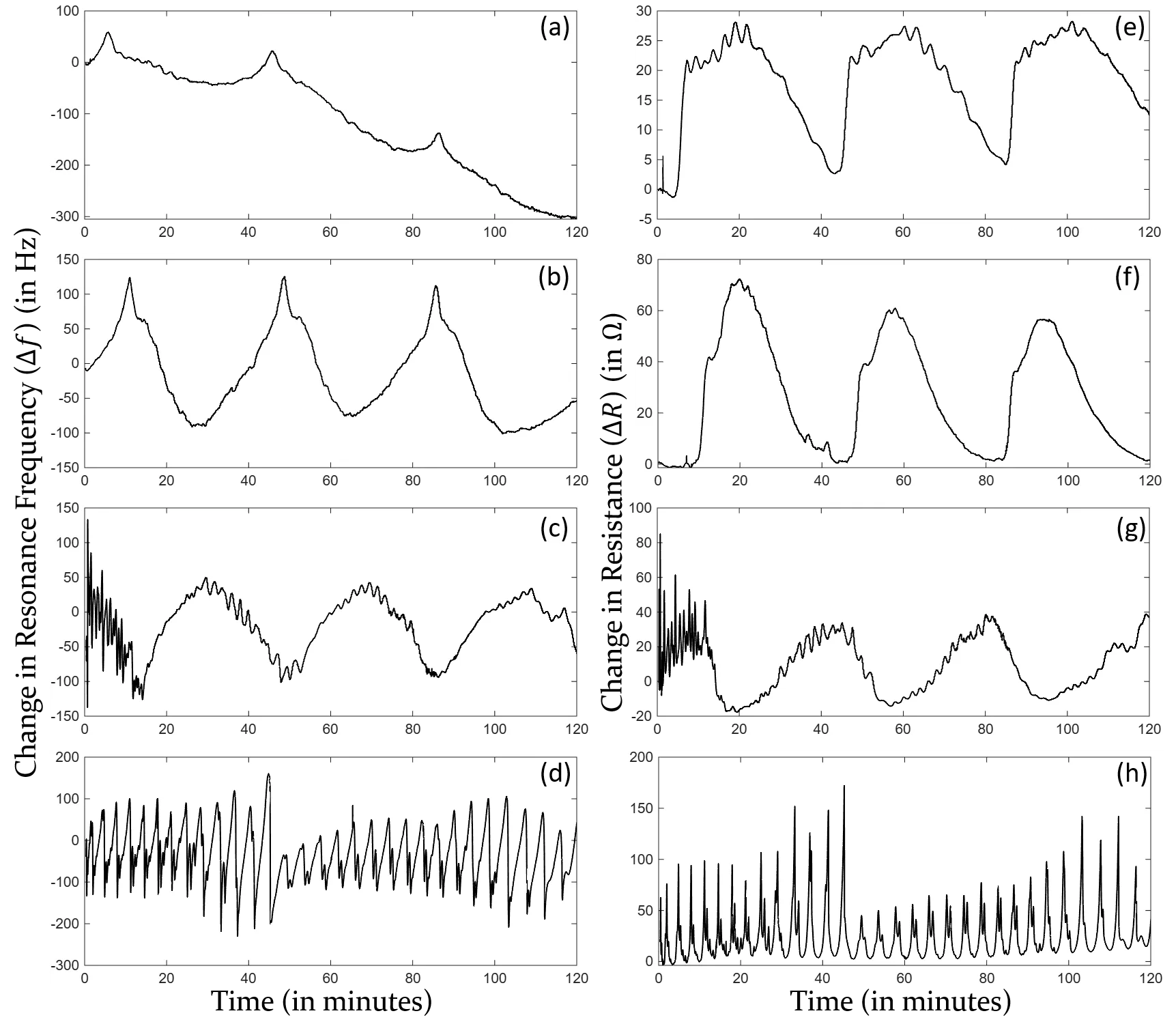
أخذ العلماء سائلين شائعين لزراعة الخلايا — DMEM وRPMI-1640 — وأسقطوهما على الميزان بأحجام مختلفة. اتضح أن الصدى يعتمد على الحجم: في القطرات الصغيرة (حوالي 40 دقيقة لدورة الصدى الواحدة) يكون بطيئًا، وفي الكبيرة سريعًا (حوالي 5 دقائق). تتغير سعة الاهتزاز بمقدار 100–150 هرتز في التردد و40–60 أوم في المقاومة. هناك إزاحة زمنية بين تذبذبات التردد والمقاومة تبلغ حوالي 10 دقائق.
الآن يستطيع علماء الأحياء الذين يراقبون الخلايا باستخدام هذه الموازين أن يطرحوا الصدى من قياساتهم مسبقًا. وإلا فقد يخلطون بين الصوت المنعكس وإشارة الخلايا نفسها ويستنتجون نتائج خاطئة.
الملخص الأصلي
كما كتبه المؤلفون، بالإنجليزية arXiv:2604.17403
Quartz Crystal Microbalance (QCM) sensors are widely used to study biological and soft-matter interfaces due to their exceptional sensitivity to mass loading and interfacial mechanical properties. While classical QCM theory assumes predominantly shear-wave coupling into a semi-infinite Newtonian liquid, finite liquid thickness and acoustic reflections give rise to pronounced compressional (longitudinal) wave effects that strongly modulate both resonance frequency and motional resistance. Such compressional acoustic-wave responses should be properly accounted for when sensing in the liquid phase, for instance when working with cell suspensions. In this work, we systematically investigate compressional-wave responses in cell culture media including DMEM and RPMI-1640 across varying droplet volumes using a 5 MHz AT-cut QCM. Time-resolved measurements are analyzed using four parameters: the time period of compressional acoustic waves (Tca), the time associated with a phase shift between resonance frequency and resistance oscillations (Tp), the peak-to-peak shifts in frequency ({\Delta}fpp) and resistance ({\Delta}Rpp). DMEM and RPMI-1640 both exhibit strong volume-dependent periodic oscillations. At lower volumes, they exhibit low-frequency oscillations with a time period of approximately 40 minutes. However, as volume increases, the oscillations gradually evolve into high-frequency oscillations with a time period Tca of approximately 5 minutes. The peak-to-peak shifts ({\Delta}fpp) and ({\Delta}Rpp) are approximately 100-150 Hz and 40-60 {\Omega}, respectively. The resonance frequency and resistance oscillations also exhibit a phase shift Tp of approximately 10 minutes. These results highlight that compressional-wave artifacts occur even in simple cell culture media, necessitating their explicit consideration when interpreting QCM data in the presence of cells.
الموازين الدقيقة الكوارتزية حساسة للغاية لدرجة أنها تستطيع رصد جزء من مليار من الجرام — أي ما يعادل وزن بكتيريا واحدة تقريبًا.