بلورات تقود الضوء سريع
الضوء الذي يمر عبر بلورة شفافة قد يغيّر لونه دون أن نلاحظ ذلك. هكذا تعمل العديد من الليزرات: إضافة ضئيلة من معدن أرضي نادر تجعل البلورة تتوهج. لكن المعدن نفسه يتصرف بشكل مختلف في بلورات مختلفة — وقد درس الفيزيائيون هذا التقلب من خلال الإيتربيوم.
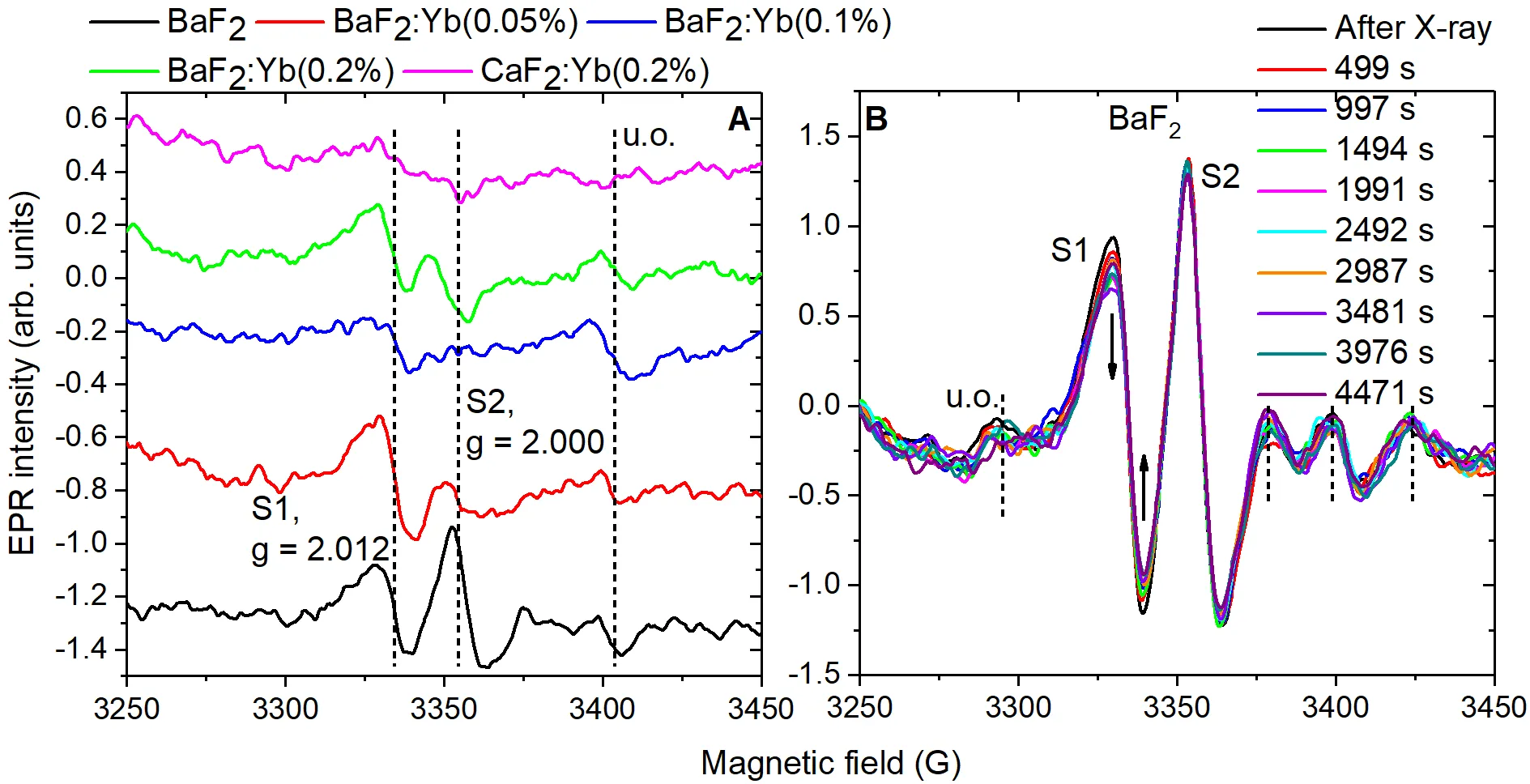
أخذوا بلورتين متشابهتين جدًا — فلوريد الباريوم وفلوريد الكالسيوم — وأضافوا إلى كل منهما كمية ضئيلة من الإيتربيوم (أقل من 0.2%). أظهرت الأشعة السينية أن كلتا البلورتين بقيتا مستويتين تمامًا، دون شقوق أو اعوجاج. لكن عندما استُخدمت أجهزة أكثر حساسية، تبيّن أن الإيتربيوم فيهما لا يشعر بنفس الطريقة. في إحدى البلورتين يفضل التخلي عن إلكترونين والبقاء هادئًا كهربائيًا، بينما في الأخرى يفضل التخلي عن ثلاثة إلكترونات وخلق توتر كهربائي خفيف حوله.
الفرق لم يكن في القوة العامة للشبكة البلورية، بل في كيفية تعايش ذرات الباريوم أو الكالسيوم مع أيونات الإيتربيوم. مضيفان يستقبلان ضيفًا واحدًا: في أحد المنازل يشعر الضيف بالضيق ويصطدم بالأثاث باستمرار، بينما في الآخر يجد مساحة واسعة ويجلس بهدوء. هكذا هنا أيضًا: أيون الباريوم أكبر ويخلق حول الإيتربيوم "حركة" أكثر، بينما أيون الكالسيوم يخلق حركة أقل. هذا يؤثر على كيفية امتصاص البلورة للضوء وإصدارها له. في البلورة التي تحتوي على الكالسيوم، تنقسم موجات الضوء قليلًا — مثل شعاع أبيض يمر عبر منشور — بينما في بلورة الباريوم لا يحدث ذلك تقريبًا. فهم هذا الضبط الدقيق يسمح باختيار البلورة المناسبة مسبقًا لمهمة محددة — سواء كان مشرطًا ليزريًا أو كاشفًا لأصغر الجسيمات.
الملخص الأصلي
كما كتبه المؤلفون، بالإنجليزية arXiv:2605.10160
Lanthanide-doped fluorides are promising materials for advanced photonic and quantum applications due to their wide bandgap, low phonon energy, and chemical stability. In this work, we present a systematic comparative study of ytterbium incorporation at low doping levels (0.05--0.2 mol\%) in BaF$$_2$$ and CaF$$_2$$ single crystals, focusing on the interplay between host lattice properties, charge-state stabilization, and defect formation mechanisms. Using a combination of X-ray diffraction (XRD), X-ray photoelectron spectroscopy (XPS), electron paramagnetic resonance (EPR), transmittance, and infrared photoluminescence (IR PL), we explore how host lattice properties affect the stabilization of Yb$$^{3+}$$ and Yb$$^{2+}$$ ions. XRD confirmed cubic phase purity and lattice parameter stability in both hosts, while XPS revealed surface chemical composition variations associated with charge-compensating defects and trace impurities. EPR spectra indicated that BaF$$_2$$ favored perturbed Yb$$^{3+}$$ environments with increasing dopant levels, while CaF$$_2$$ maintained predominantly unperturbed sites, suggesting a more favorable ionic match for Yb$$^{2+}$$. Photothermal deflection spectroscopy (PDS) and IR PL results showed host-specific optical responses, with CaF$$_2$$ exhibiting crystal-field splitting and broader local field effects. These results reveal a clear decoupling between long-range structural stability and local lattice perturbations, and demonstrate that host cation identity governs the balance between Yb$$^{2+}$$ and Yb$$^{3+}$$ stabilization as well as defect-driven optical behavior. This offers valuable insights for optimizing rare-earth-doped fluoride crystals in laser, scintillator, and quantum device applications.
سُمي الإيتربيوم على اسم قرية إيتربي السويدية، حيث وُجد في منجم واحد أربعة عناصر أرضية نادرة: الإتريوم، التربيوم، الإربيوم، والإيتربيوم نفسه.