كيف نعلّم الشبكة العصبية قراءة الجزيئات من ورقة؟ سريع
البحث عن الجزيء المناسب بين مليارات الخيارات يشبه البحث عن حبة واحدة في كيس أرز. ولتجنب الفحص اليدوي الشامل، يستدعي الكيميائيون بشكل متزايد الشبكات العصبية للمساعدة. لكن النماذج الكبيرة تتطلب أجهزة كمبيوتر قوية، بينما تفتقر النماذج الصغيرة غالبًا إلى الاتساع المعرفي.
يحل GLACIER هذه المشكلة، مثل تلميذ قدير يتعلم من عدة مرشدين في وقت واحد. أولاً، تنظر «عيون» النموذج الثلاثة إلى الجزيء من زوايا مختلفة: واحدة تراه كرسم بياني (مخطط من الذرات كرؤوس والروابط كحواف)، وثانية تقرؤه كسلسلة نصية SMILES (نوع من الرمز الشريطي الجزيئي)، وثالثة تقيّم الخصائص الفيزيائية والكيميائية — الحجم، الشحنة، الذوبان. ثم تندمج هذه النظرات الثلاث في صورة موحدة للجزيء باستخدام أداة رياضية مستوحاة من هندسة فينسلر (وهي كقياس المسافات ليس في خط مستقيم بل عبر مسار جبلي متعرج).
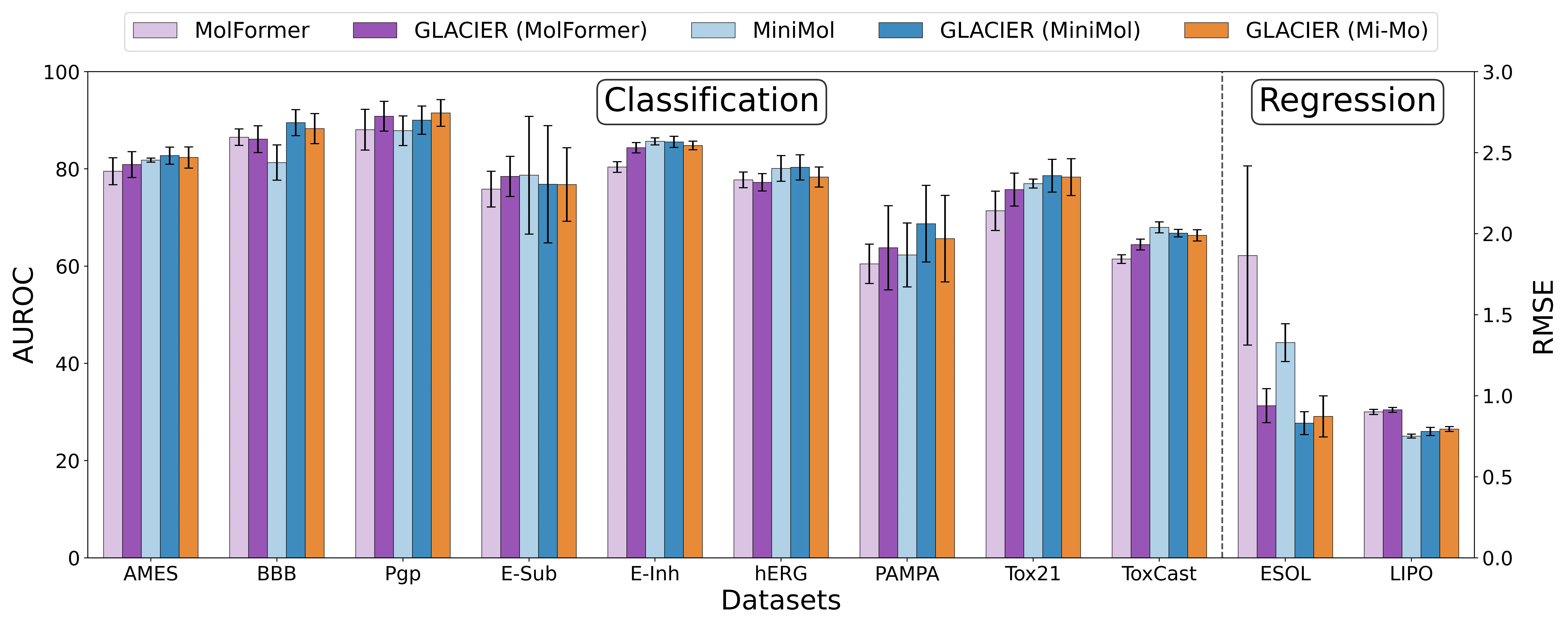
في المرحلة الأخيرة، يدخل المعلمون — النماذج الكبيرة MiniMol وMolFormer، المدربة مسبقًا على مجموعات بيانات ضخمة. لا يكتفي التلميذ GLACIER بنسخ إجاباتهم، بل من خلال آلية التعلم التبايني يتعلم تقريب الجزيئات المتشابهة جوهريًا في فضاءه الداخلي، وإبعاد تلك المختلفة. هكذا يولد نموذج مدمج لكنه دقيق جدًا، قادر على التنبؤ بخصائص المواد دون حسابات ثقيلة.
في النهاية، أداة واحدة خفيفة تحل محل مجموعة برامج ضخمة، مما يسرع البحث عن مواد وأدوية جديدة. يمكن الآن العثور على الحبة في كيس الأرز ليس عن طريق اللمس، بل عن طريق وصف دقيق.
الملخص الأصلي
كما كتبه المؤلفون، بالإنجليزية arXiv:2606.11382
Deep learning models facilitate the discovery of molecules with tailored properties among billions of candidate compounds. However, the computational burden to develop and deploy state-of-the-art models continuously increases, limiting their scalability. Most large-scale models are unimodal in nature and overlook the potential to leverage complementary molecular data modalities. To address these shortcomings, this paper introduces the Graph-Language Alignment for Chemical Inference and Exploration using Representations (GLACIER) model, a student-teacher framework that integrates molecular graphs, SMILES strings, and physicochemical descriptors to learn rich molecular embeddings. Our framework consists of three stages: (1) we pretrain three student encoders on 100,000 drug-like molecules: a message-passing neural network for molecular graphs, a transformer-based encoder for SMILES strings, and a multilayer perceptron for physicochemical descriptors, (2) we fuse these student modalities using a novel Finsler geometry-aware module, and (3) distill complementary knowledge from large teacher models, including MiniMol and MolFormer, into a single lightweight model via contrastive learning. We demonstrate that GLACIER is a robust framework that delivers high predictive performance and computational efficiency in complex molecular property prediction tasks. Our code is publicly available at https://github.com/eemokey/glacier.
سلسلة SMILES للماء العادي تبدو ببساطة «O»، وللأسبرين «CC(=O)OC1=CC=CC=C1C(=O)O». في الأساس، هذا هو الجزيء مكتوبًا بحروف وأرقام، مثل كلمة في لغة كيميائية.