كيف تشيخ كل خلية: رحلة عبر مشهد المثيلة سريع
مثيلة الحمض النووي (DNA methylation) هي علامات كيميائية صغيرة على جيناتنا. مع مرور السنين، تتغير هذه العلامات وفق جدول زمني صارم إلى حد ما. الساعات الإبيجينية التقليدية تنظر إلى هذه العلامات وتُخرج رقمًا واحدًا: العمر البيولوجي. لكن الرقم لا يروي كيف أعيد ترتيب نمط العلامات يومًا بعد يوم، عامًا بعد عام. قرر مؤلفو الدراسة تحويل الصورة الثابتة إلى فيلم متواصل.
للقيام بذلك، جمعوا بيانات المثيلة من آلاف الأشخاص من مختلف الأعمار — من الرضع إلى المعمّرين. ثم بنوا مشهدًا رياضيًا. كل نقطة فيه تقابل نمطًا معينًا من العلامات، والعمر يحدد اتجاه الحركة. أولاً، قام تشفير ذاتي خاص (autoencoder) — وهو خوارزمية تضغط البيانات المعقدة في خريطة بسيطة — بتحويل النمط المتنوع إلى مخطط مدمج، مع الحفاظ على إمكانية فك التشفير العكسي. ثم قام نموذج النقل الأمثل (optimal transport) بحساب المسار الأكثر طبيعية للشيخوخة عبر هذا المشهد. أخذ في الاعتبار كلاً من التجوال العشوائي والفقدان الحتمي للخلايا مع تقدم العمر.
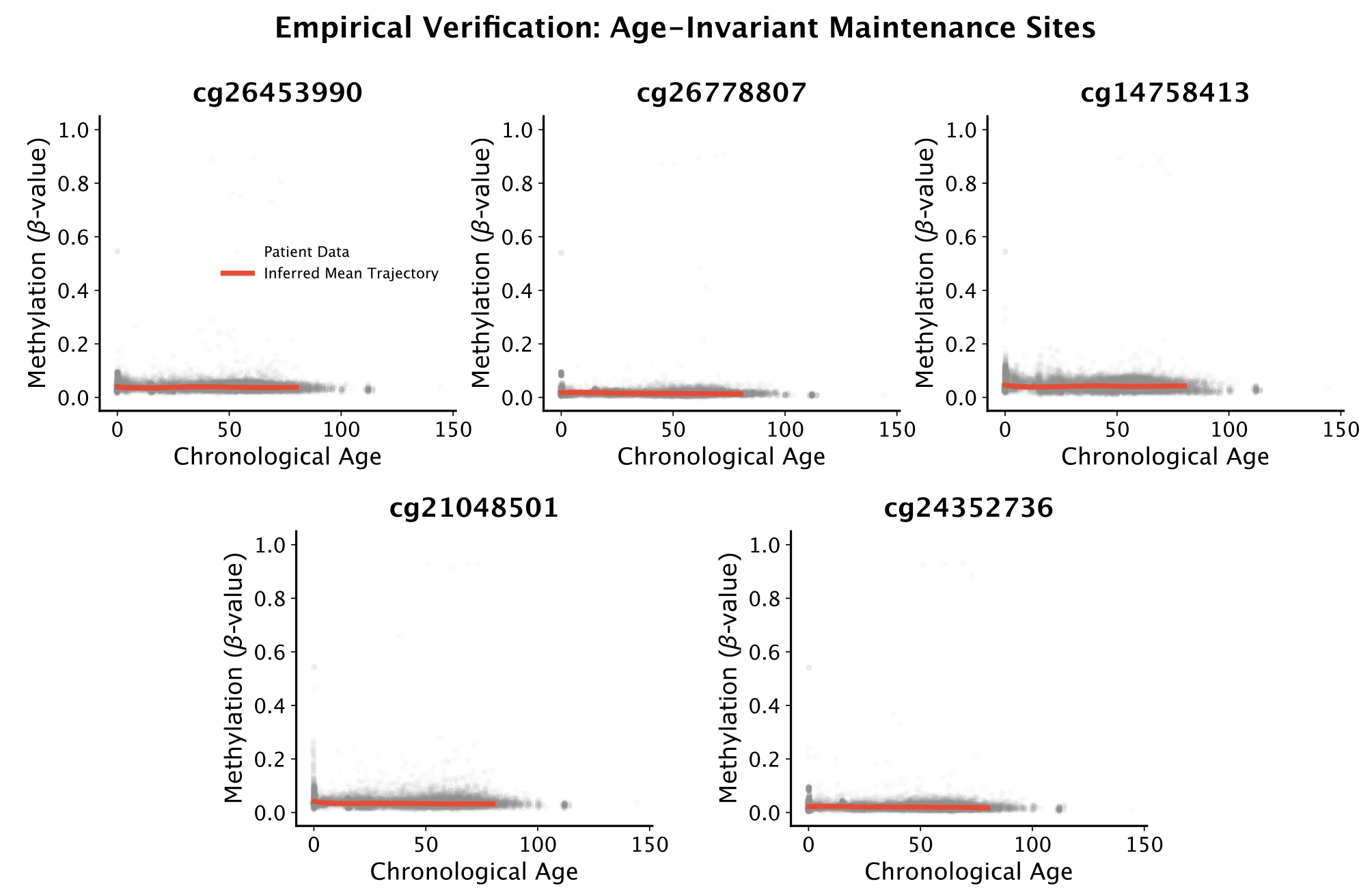
أبرز نتيجة ظهرت بعد عمر 60–70 سنة. سرعة التغيرات العشوائية تقفز فجأة. يبدو مشهد الشيخوخة وكأنه يصبح أكثر «رخاوة»، وتتباعد مسارات الأشخاص المختلفين بشكل متزايد. أظهر فك التشفير العكسي أن هذه الاختلافات ليست فوضوية. إنها تتجمع في عدة سيناريوهات نموذجية — أشبه بنماذج أصلية للشيخوخة. الآن يمكن دراستها بشكل منفصل.
وهكذا، ينتقل العلم من رقم ثابت على «الساعة» إلى رسم خرائط للحياة الجزيئية. ولأول مرة، تظهر لهذه الخريطة تضاريس — مع تسارعات وتباطؤات ومفترقات طرق. ولا يزال يتعين استكشافها.
الملخص الأصلي
كما كتبه المؤلفون، بالإنجليزية arXiv:2607.06583
DNA methylation (DNAm) serves as one of the most robust molecular biomarkers of biological aging. While conventional epigenetic clocks accurately predict chronological age from high-dimensional CpG profiles, they treat aging as a static regression task, meaning they can only output a single score rather than simulating how an entire profile continuously changes over time. To reconstruct these continuous dynamics, we frame lifelong human epigenetic aging as a trajectory inference problem across discrete age snapshots derived from widely available cross-sectional data. We introduce a two-stage computational pipeline: first, an age-regularized Variational Autoencoder (VAE) maps high-dimensional CpG profiles onto a chronologically ordered latent manifold while preserving a generative decoder bridge back to the original methylation space. Second, we model the continuous movement across this latent space via Regularized Unbalanced Optimal Transport (RUOT) that unifies deterministic drift, random diffusion, and non-conservative mass changes. By resolving this RUOT formulation using the DeepRUOT framework, our model fluidly accommodates population-level density shifts like survivorship bias and cellular attrition without requiring rigid biological priors. Evaluated on a large-scale, 80-year pan-tissue dataset, our model demonstrates robust distribution interpolation and uncovers a prominent late-life surge in the learned growth field that mathematically captures the variance expansion driven by stochastic epigenetic drift. Finally, by decoding continuous latent paths back to individual CpG sites, we reconstruct and empirically verify distinct biological aging archetypes, offering a rigorous, generative paradigm for simulating human molecular aging.
عند الأطفال حديثي الولادة، يكون نمط مثيلة الحمض النووي متشابهًا تقريبًا، لكن بحلول سن 80 تصبح الاختلافات بين الأشخاص كبيرة جدًا لدرجة أنه يمكن التمييز بين شخص وآخر بشكل موثوق من خلال هذه العلامات — مثل بصمات الأصابع، لكن على المستوى الجزيئي.
في مسلسل «الكربون المعدل» (Altered Carbon)، يخزن الأثرياء نسخًا احتياطية من وعيهم على «ستاك»، لكنهم لا يستطيعون إيقاف شيخوخة الغلاف البيولوجي. النموذج من هذه الدراسة هو خطوة نحو تعلم ليس فقط قياس تآكل الغلاف، بل التنبؤ بمساره وتصحيحه.