كيف قاسوا سرعات النفاثات في الثقوب السوداء البعيدة سريع
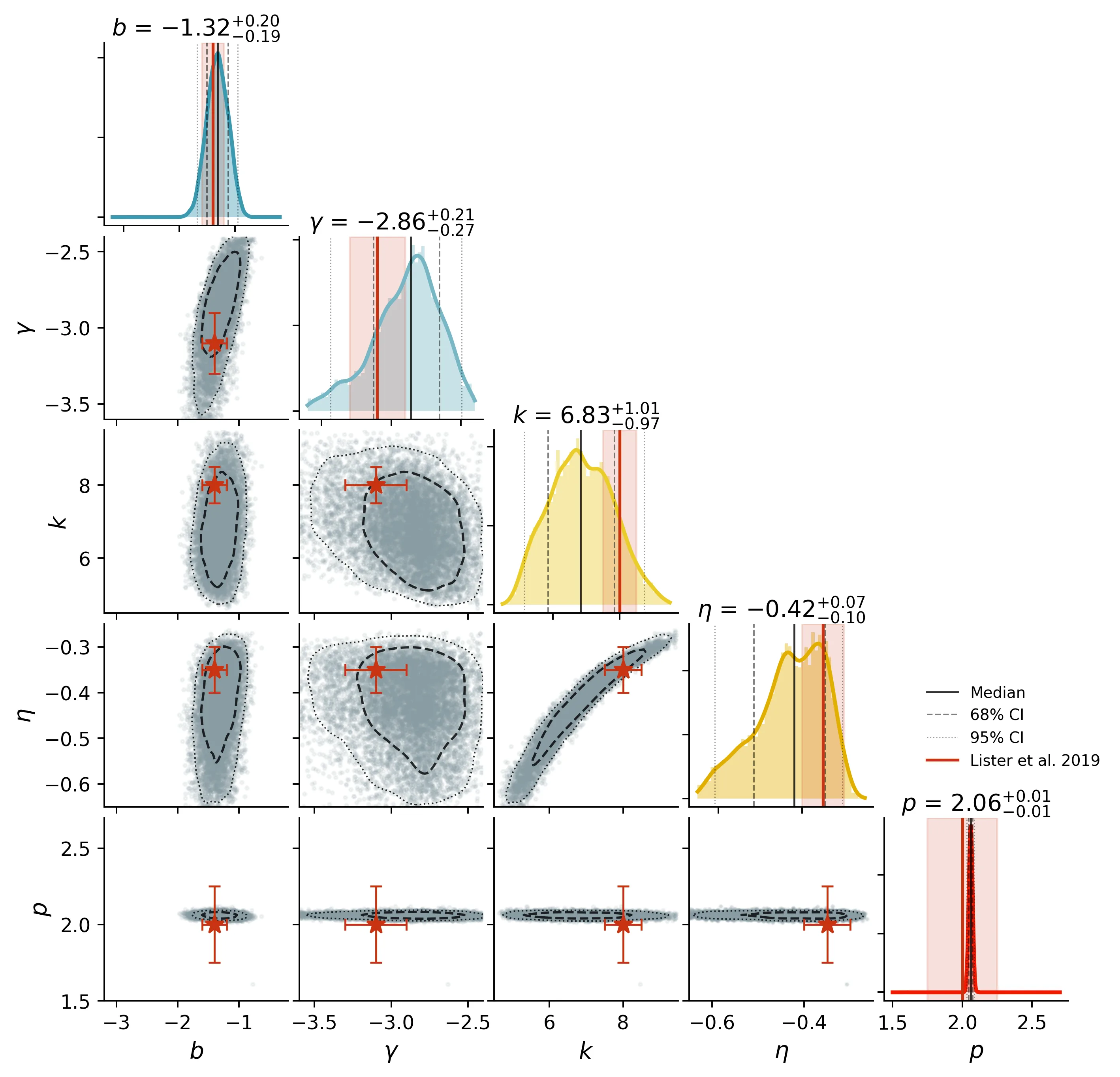
الثقوب السوداء فائقة الكتلة في مراكز المجرات تقذف أحيانًا تدفقات ضيقة من المادة — نفاثات تطير بسرعة تقارب سرعة الضوء. لفترة طويلة، لم يتمكن علماء الفلك من تحديد مدى سرعة هذه النفاثات بدقة لدى مختلف الثقوب السوداء. في العمل الجديد، جمع العلماء بيانات عن مئات من هذه النفاثات وطبقوا طريقة كانت تُستخدم سابقًا في مجالات علمية أخرى.
الطريقة تسمى «الاستدلال بدون معقولية». بدلاً من محاولة حساب احتمال كل سيناريو مباشرة، يتعلم الكمبيوتر من مجموعة كبيرة من الأمثلة المحاكاة ثم يقارنها بالملاحظات الحقيقية. وقد سمح ذلك بمراعاة التشوهات الناتجة عن حد السطوع: النفاثات الخافتة ببساطة غير مرئية، وإذا لم يؤخذ ذلك في الاعتبار، فإن تقديرات السرعة تكون خاطئة. أظهر النهج الجديد أن الأخطاء السابقة كانت أقل من الواقع بكثير، وأن توزيع السرعات لا يشبه منحنى بسيطًا.
النتيجة: سرعة معظم النفاثات قريبة من 99% من سرعة الضوء، لكن هناك أيضًا نفاثات أبطأ. تبين أن توزيع السرعات يشبه ما يُلاحظ في الثقوب السوداء ذات الكتلة النجمية — تلك التي تنشأ عن انفجارات النجوم الضخمة. وهذا يعني أن آلية إطلاق النفاثات قد تكون نفسها بالنسبة للثقوب السوداء مهما كانت كتلتها.
الملخص الأصلي
كما كتبه المؤلفون، بالإنجليزية arXiv:2608.08733v1
We present the most complete modelling of the MOJAVE 1.5 Jansky Quarter Century active galactic nuclei (AGN) jet population, using likelihood-free simulation-based inference. Due to the complex impact of a flux-limit on observed AGN data sets, careful modelling of the parent population is required. In particular, when observing and fitting to multiple data distributions likelihoods become non-intuitive. Parameter degeneracies further complicate the problem and make it suitable for likelihood-free, simulation-based inference. This method relies on a normalising flow learning the likelihood surface or posteriors directly. We extensively validate the flow to show that previous parameter estimates for the AGN jet speed distributions underestimated parameter errors significantly and do not capture the non-gaussianity of the parameter posteriors. The new results enable a better statistical comparison to other AGN population studies, but also a more accurate comparison of supermassive black hole jets with their lower mass counterparts, X-ray binaries (XRB). We find that the AGN follow a Lorentz factor distribution of the shape $$N(\Gamma) \propto \Gamma^b$$ with $$b= -1.32_{-0.19}^{+0.20}$$. This slope is consistent with the XRB Lorentz factor distribution at $$2\sigma$$. Simulation-based inference as a method is generally well-suited to many astrophysical problems, and this paper shows the convenient applicability of this methodology to parent population studies of jetted AGN with multiple observables specifically.
يمكن أن تكون النفاثات الصادرة عن الثقوب السوداء فائقة الكتلة أطول من المسافة بين الأرض والمجرة المجاورة.