انفجار البروتين تحت الأشعة السينية سريع
كرة تنس تضرب قلعة رملية. تنهار القلعة، لكن من خلال اتجاه ومسافة تطاير حبيبات الرمل، يمكن تخمين شكل القلعة. هذه هي الفكرة تقريبًا وراء طريقة تفجير البروتينات بالأشعة السينية. شعاع الليزر قوي جدًا لدرجة أن جزيء البروتين يفقد إلكتروناته ويتطاير إلى شظايا مشحونة — تمامًا مثل القلعة تحت ضربة الكرة.
الصعوبة تكمن في أن حساب مثل هذا الانفجار لبروتين يتكون من آلاف الذرات ليس ممكنًا بالطرق الكمومية التقليدية. البرنامج الجديد MolDStruct يجمع بين نهجين: العمليات العشوائية للتأين (مثل رمي النرد) والفيزياء الكلاسيكية لحركة الذرات (مثل حساب مسارات كرات البلياردو). أولاً، يقوم البرنامج بـ«رمي النرد» — يقرر أي ذرة ستفقد إلكترونًا تحت الشعاع. ثم يحسب كيف تتنافر الذرات المشحونة المتبقية وتتطاير.
بعد ذلك، تم اختبار MolDStruct على بروتين مكون من 16 حمضًا أمينيًا. يمكن للبروتين أن يطوى إلى أشكال مختلفة، مثل حبل ملتوي بطرق مختلفة. أظهر البرنامج أنه من خلال خريطة الشظايا المتطايرة يمكن التمييز بين هذه الأشكال. وهذا يعني أن انفجار البروتين ليس مجرد تدمير، بل وسيلة للنظر إلى بنيته.
الطريقة لا تزال حديثة، لكن من الواضح بالفعل: شعاع الأشعة السينية الذي كان في السابق يفسد العينات فقط، أصبح الآن يساعد في رؤية ما هو غير مرئي. كما يمكن من الحبيبات المتطايرة استعادة شكل القلعة، كذلك من شظايا البروتين يمكن استعادة بنيته.
الملخص الأصلي
كما كتبه المؤلفون، بالإنجليزية arXiv:2608.17460v1
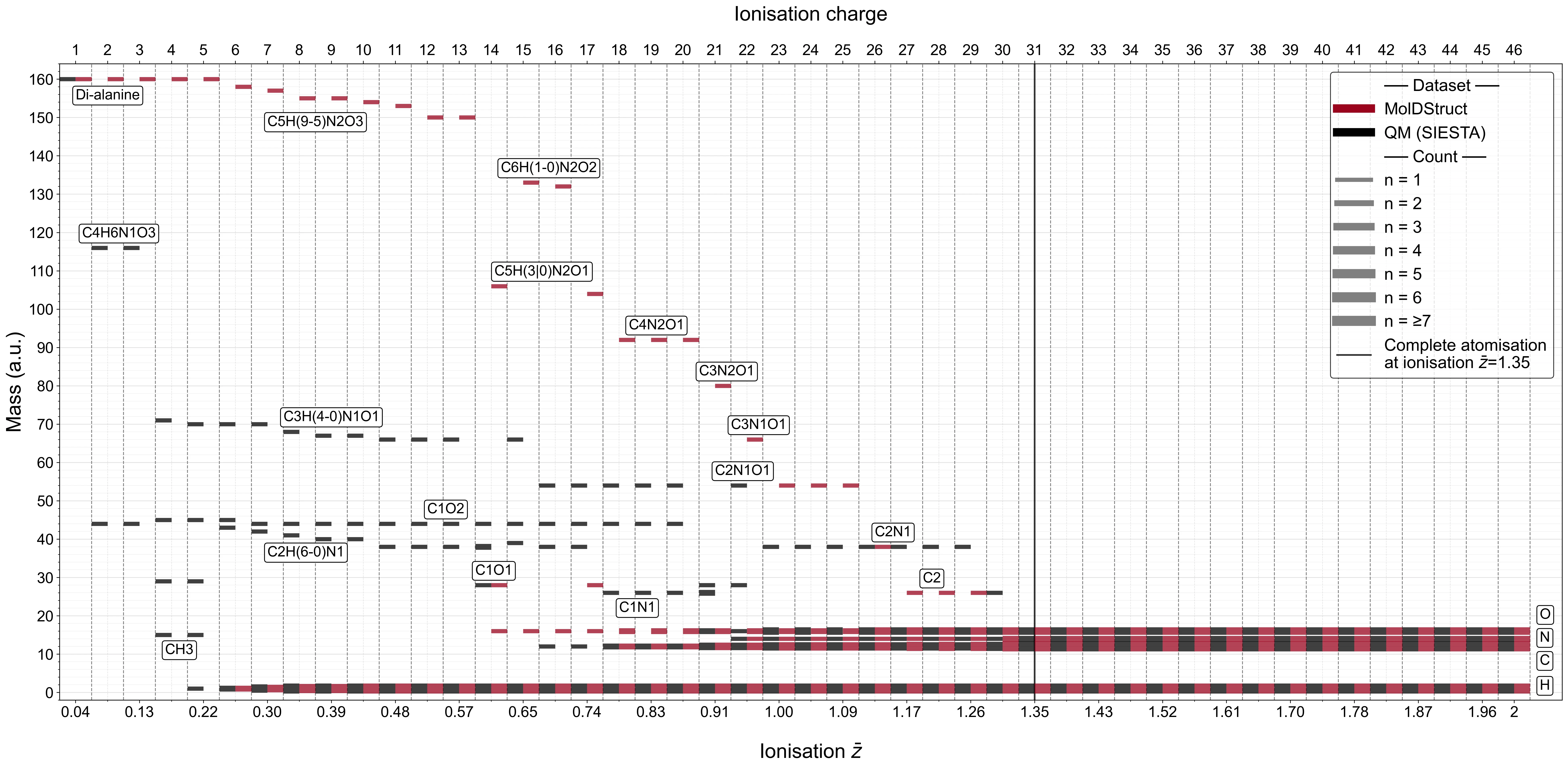
Single Particle Imaging with intense X-ray free-electron laser pulses requires modelling of the resulting ionisation and Coulomb explosion dynamics of biomolecules to optimise experimental parameters and enable correct structural reconstruction, yet simulating the complete dynamics at protein scale is beyond the reach of quantum-mechanical methods. To address this, we developed \moldstruct, a hybrid Monte Carlo/Molecular Dynamics code built on GROMACS that couples high intense X-ray ionisation dynamics modelled through a Monte Carlo module with classical Molecular Dynamics for atomic propagation. Benchmarked against quantum mechanical calculations for di-alanine, MolDStruct agrees in fragmentation patterns above a mean charge per atom of $$\bar{z} \approx 1.35$$. Compared with Coulomb explosion imaging experimental data for 2-iodopyridine, simulated momentum distributions reproduce the experimental Newton plots in fragment direction and fall within the range of experimental absolute momenta, with a moderate overestimation. We further apply MolDStruct to Protein Explosion Imaging, a method that classifies molecular structures from explosion ion maps recorded on a detector, demonstrating via dimensionality reduction that conformers of the 16-residue peptide $$\mathrm{Ala}_16$$ and five chromophore-labelled ubiquitin mutants are distinguishable. These results establish MolDStruct as a practical tool for simulating radiation damage and Coulomb explosion dynamics of biomolecules at protein scale, where quantum-mechanical methods are computationally infeasible.
ليزر الأشعة السينية قوي جدًا لدرجة أنه يدمر البروتين في أجزاء من المليون من الثانية — أسرع من أن «تشعر» الجزيء بالصدمة.