How a Neural Network Learns from a Few Images: Experience and a Vocabulary ✛
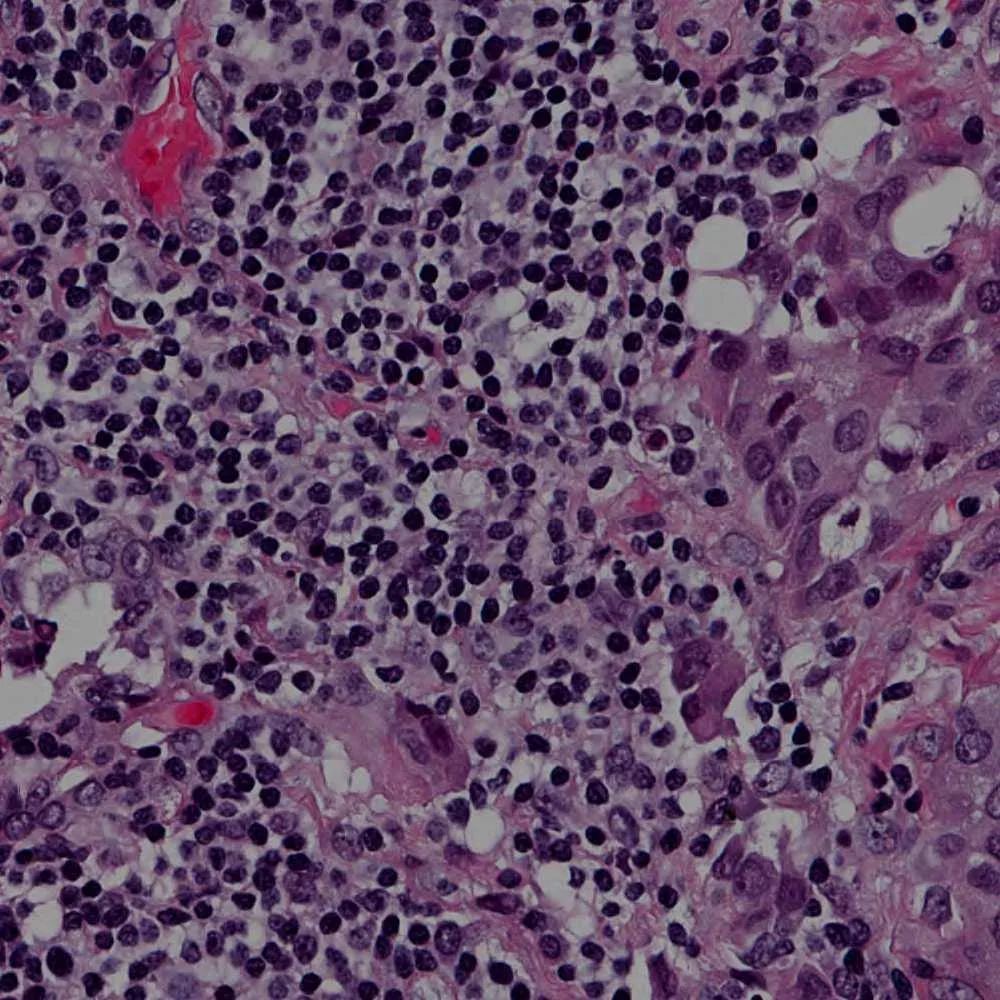
A translator who consults both years of experience and a pocket dictionary translates more accurately than one who relies on only one of the two. The Exemplar method for examining microscopic images works the same way. The experience is a pretrained neural network, DINOv3, which has seen millions of images and knows how to find important details. The vocabulary is a set of simple rules that highlight edges, thin lines, and bright spots directly in the image. When you need to segment cells or vessels in a new set of images, Exemplar combines both sources and learns from a few labeled masks.
Previously, a biologist had to choose: either spend a long time labeling hundreds of images for a specialized model, or manually point out objects in a program each time. Exemplar does it differently. It takes a frozen neural network, meaning its knowledge does not change, and adds a small trainable head on top. The head looks at the image in two ways: as a whole and in patches, so as not to miss either large or small details. In parallel, 35 classical filters are computed on the image; they are not trained but simply provide hints about structure. All these signals are combined, and the head outputs a map where the foreground is separated from the background.
The method already helps to quickly label new images when only one or a few masks are available. It runs 16–77 times faster than training another model from scratch. In the future, it could be made even more convenient: it could retrain in seconds as each new mask is added and suggest which image to label next.
The classical filter bank, which is frozen and not trained in this work, originally served as a standalone segmenter in a previous paper by the same authors. Now it acts as a 'prior' providing structural information, and its contribution is especially noticeable on retinal vessels: there it adds 0.225 to the centreline Dice metric.
The idea of combining the 'frozen' knowledge of a large model with simple, interpretable rules echoes the approach in Ted Chiang's story 'The Lifecycle of Software Objects', where digital beings learn from a small number of examples by combining innate instincts and acquired experience.