A neural network is a computational system inspired by the structure of the brain, consisting of interconnected nodes (neurons) that process information in parallel. In the context of the provided titles, neural networks are used as powerful pattern recognizers and function approximators, capable of learning complex mappings from data. They are applied to tasks like predicting quantum foam interactions, improving climate models, and analyzing brain activity.
History
The concept dates back to the 1940s with the McCulloch-Pitts neuron model, but practical training algorithms emerged in the 1980s with backpropagation. The recent explosion in capabilities is due to deep learning, which uses many layers of neurons, enabled by powerful GPUs and large datasets.
How it works
A neural network is trained by adjusting the strengths (weights) of connections between neurons. During training, the network is fed examples of input-output pairs, and the weights are iteratively updated to minimize the difference between the network's output and the desired output. Once trained, the network can generalize to new, unseen inputs, making it a fast and flexible tool for modeling complex systems.
In practice
Neural networks are used for image and speech recognition, natural language processing, and increasingly in scientific research to accelerate simulations, analyze experimental data, and discover patterns in large datasets.
Fun fact
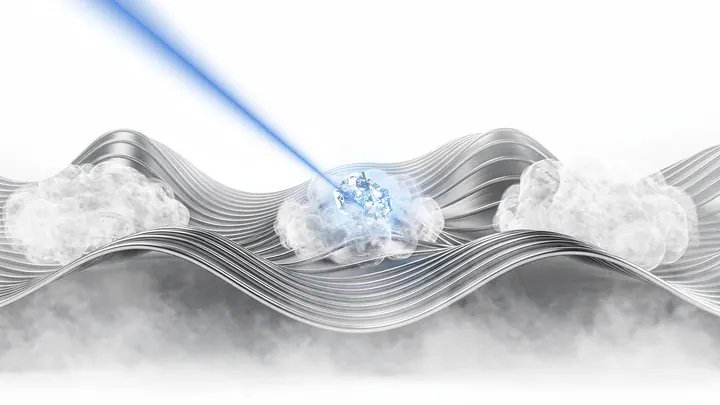
The 'quantum foam' is a hypothetical frothy structure of spacetime at the Planck scale, and neural networks are now being used to simulate its behavior, which is computationally intractable with traditional methods.
A jazz trio plays in the dim light of a club. The pianist leads the melody, the bassist holds the rhythm, and the drummer sprinkles out rolls. If you listen only to pairs of musicians, you can catch how the pianist adjusts to the bass or the bass to the drums.
A stadium packed with fans hears the announcer’s voice for the first time, and instantly the whole place erupts. The message sounds again and again. Only a handful of people in nearby rows respond. That’s roughly how neural networks behave in brain organoids — tiny lab-grown replicas of the brain.
A neuron receives thousands of signals on its branching processes — the dendrites. Some signals push the cell toward firing (excitation), others hold it back (inhibition). For a long time, it was thought that the neuron simply adds up all the 'fors' and 'againsts.' But in real dendrites, inhibition works differently: it can not subtract but divide the excitatory signal.
An artist makes a quick charcoal sketch, and the face in the portrait is already recognizable. Astrophysicists face a similar challenge: the spectrum of a star is its individual portrait, revealing temperature, composition, and gravity.
The meditating brain is an orchestra, and attention is the conductor. When you're focused on your breath, all instruments play in harmony. But suddenly, a thought-cello plays a false note: that's mind wandering. An experienced conductor doesn't panic: they instantly catch the dissonance and gently guide the orchestra back to the main melody — the breath.
A base station emits radio waves. Without a special nozzle, the antenna acts like a garden hose opened full blast: water flies everywhere, but only a little reaches the flower beds. Researchers created a system with two neural networks.
Imagine an old theater in the damp fog. On the stage, a scattering of actors, but only one is caught by the spotlight beam, made to freeze in the bright patch. The rest billow in the dim light, ready to dissolve at any moment.
The classical neuron is a chamber musician, drawing only one note from each string: it takes a weighted sum of inputs, adds a bias, and passes it through a nonlinearity.
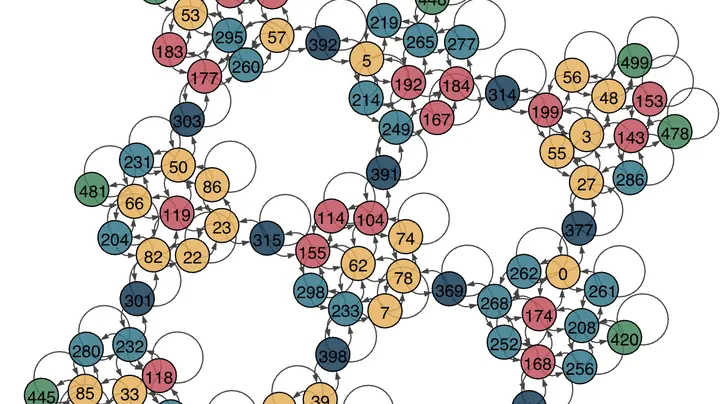
Why do some systems, from gene networks to air travel, preserve imprints of the past longer than others? For a long time, network science blamed topology: the number of connections, modularity, spectrum. But two networks with the same skeleton can remember and forget in completely different ways.
An orchestra plays without a conductor, and you hear the tempo speeding up and slowing down. All you have is a recording of the sound, not the score. Can you tell from that recording which string to pluck to make the whole orchestra play more steadily?
A supermarket cashier at rush hour doesn't memorize every scanned item: they keep the running total in their head and watch the queue. The brain allocates its resources similarly: the expensive, precise cortex (responsible for deliberation) and the simpler, economical subcortical nuclei (where habits live) work in tandem.
A smartphone camera captures everything indiscriminately, but the eye immediately picks out what matters. The retina doesn't just pass the image to the brain: it highlights contours on the spot, suppresses noise, and adjusts to brightness.
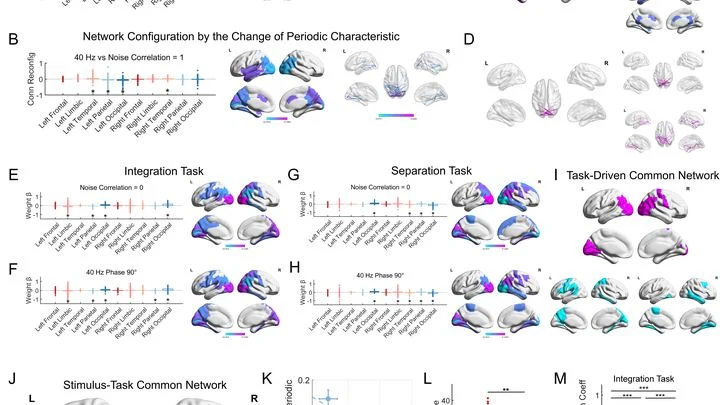
In a grand courtroom, a meeting is in session. Hundreds of translator-neurons simultaneously hear fragments of phrases, and must piece them into a single coherent picture. This is exactly how large brain networks turn scattered signals from the eyes into a unified object image.
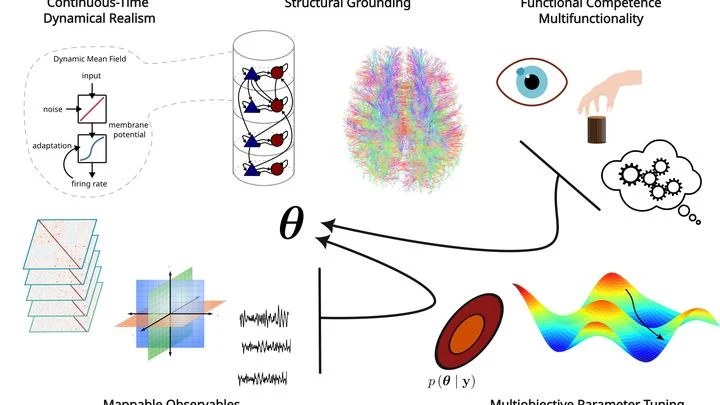
Engineers are building a car. Some assemble an exact replica of the engine, every piston and spark plug, but the car doesn't move: there's no steering wheel or wheels. Others build a fast self-driving go-kart, but its engine is made of playdough and doesn't resemble a real one. This is roughly the situation in brain science.
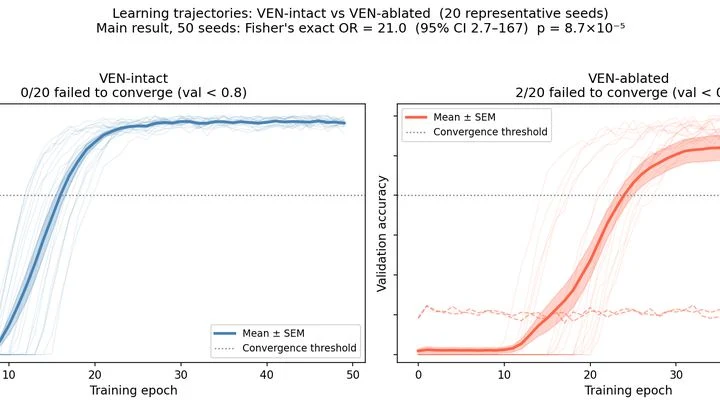
An orchestra at its first rehearsal without a conductor. Violins come in at the wrong time, brass is late, and instead of a symphony, you get cacophony. That's roughly how a computer model of the brain behaves when you remove special cells — von Economo neurons.
You can feel an unfamiliar object along its length, across its width, or diagonally: each time gaining new information. But what if one way of feeling tells you absolutely nothing about what another would reveal? That's exactly how mutually unbiased bases work in quantum mechanics: measuring in one of them leaves you completely in the dark about the outcome in another.
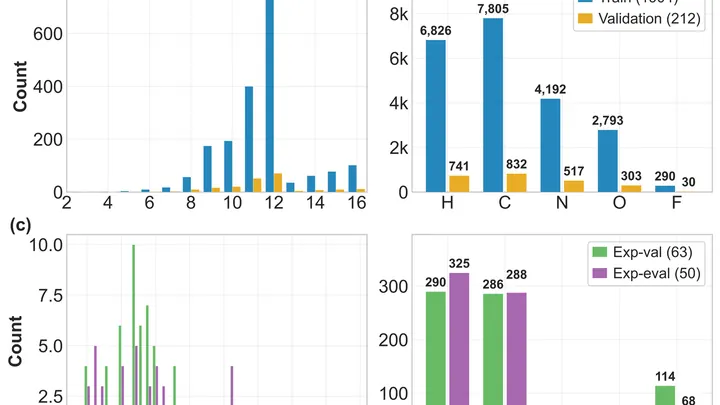
Every carbon atom in a molecule carries a passport — the energy with which its deepest electrons sit in their orbitals. This energy is sensitive to neighbors: add an oxygen nearby or a double bond, and the number in the passport changes. Chemists have long measured such energies with X-rays, but calculating each new molecule takes hours of machine time.
The brain constantly juggles tasks: it reacts to a sharp sound, solves an equation, or drifts into daydreams. Scientists have long suspected that switches between different "scenarios" of neural network activity underlie this, but extracting them from the chaos of electrical signals was difficult.
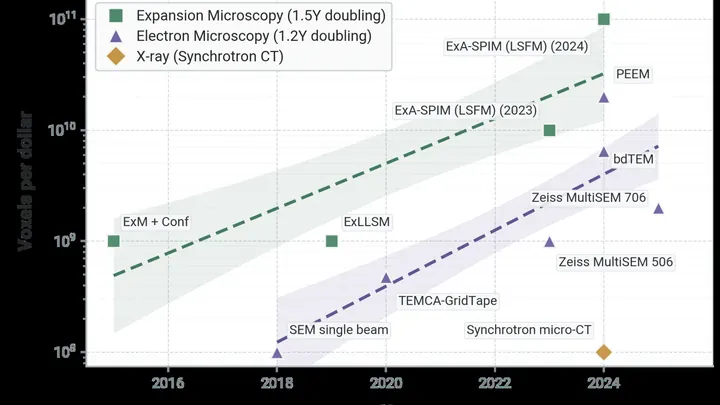
Modern microscopes see the brain in exquisite detail: not just the synapses themselves, the contact points between neurons, but also the molecules they are made of. Such images are becoming more common and cheaper to produce.
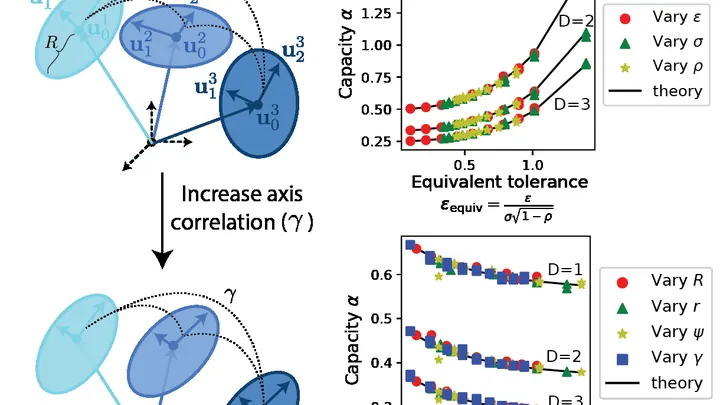
Neurons in the brain and nodes in artificial neural networks don't just fire with simple yes/no signals; they also handle smoothly varying quantities, like where an object is and how big it is. But neural responses are finicky: the same stimulus triggers slightly different bursts of activity each time.
Microbial communities are like a noisy orchestra: thousands of instruments, and it's hard to tell who's playing the lead. In the gut, ocean, or soil, millions of bacterial species live, and scientists need to figure out which ones truly matter for human health or soil fertility.
The new approach works like smart laundry sorting.
The brain is like a sprawling city: districts-regions communicate via streets-neural pathways. If traffic lights at an intersection fail, traffic grinds to a halt. Similarly, in the brain, when bundles of nerve fibers (white matter) malfunction, distant regions stop working in concert, and thought stalls.
For years, an X-ray telescope in orbit recorded how binary systems shine, where an ordinary star orbits a black hole or a neutron star. Matter from the companion falls onto the compact object, heats up to millions of degrees, and emits X-rays.
When moving to a new apartment, a person doesn't relearn how to open doors or turn on lights. Experience from the old home transfers automatically: a kitchen is a place with a stove and a sink, a bedroom is a place with a bed. The brain doesn't store an exact map but a flexible schema that it overlays onto unfamiliar space.
Scientists have built a computer model of this transfer. It has two levels.
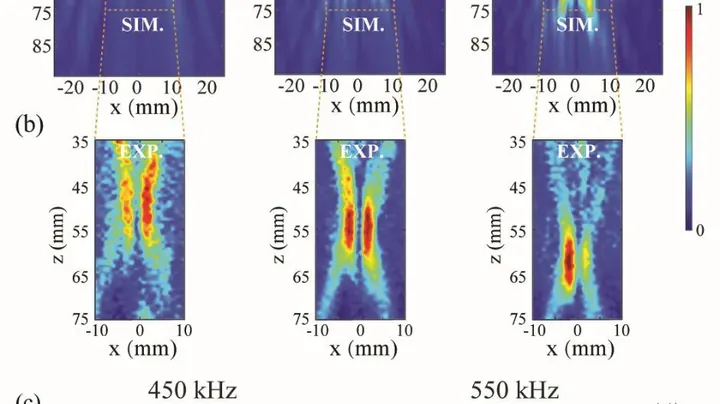
Sound can do more than be heard: it can push. An ultrasound vortex is a sound wave twisted like a whirlpool in a shell: silence at the center, rotating pressure at the edges. Such a whirlpool can grab tiny particles and carry them without a touch.
In 1935, Erwin Schrödinger, peering into the equations of quantum mechanics, saw something strange: two particles could be linked so tightly that the state of one instantly determines the state of the other, even if they are separated by kilometers.
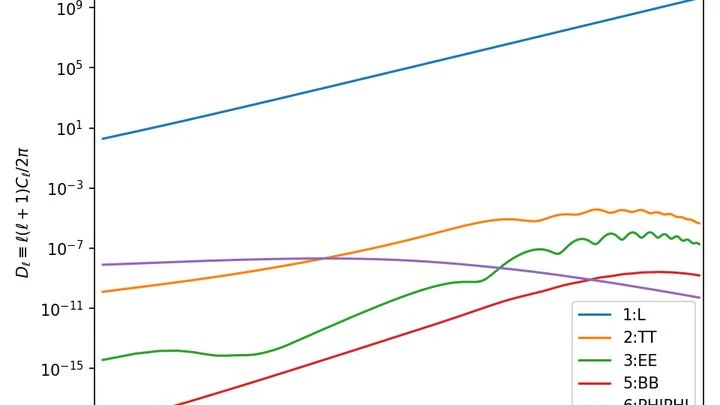
In 2008, a group of physicists spent months of supercomputer time to compute a single quantity in quantum gravity theory. This is the vertex amplitude of spinfoam, a number that sets the probability of a local quantum transition of spacetime.
A translator at negotiations picks up not only the words but also the tone in which they are spoken. If they focus only on vocabulary, they might miss sarcasm or fatigue in the voice. If only on intonation, they could mistranslate the details of the contract.