Background is the unwanted signal that a detector picks up from sources other than the target phenomenon being studied. It is the 'noise floor' that competes with the genuine signal of interest. In physics experiments, background can arise from cosmic rays, radioactive decay in the detector materials, thermal noise, electromagnetic interference, or stray light, among other sources. The challenge is to distinguish the faint signal of the target from this pervasive background.
History
The concept of background has been central to experimental physics since the early 20th century, particularly in the development of particle detectors and radio astronomy, where distinguishing signal from noise became a systematic practice.
How it works
Background is characterized by measuring the detector output when the target is known to be absent, or by modeling its expected contribution. To extract a signal, researchers often use techniques like background subtraction, where the measured background is subtracted from the total signal, or event selection, where only events matching the expected signature of the target are kept. In gravitational wave detectors like LIGO, background noise from seismic activity, thermal motion, and quantum fluctuations must be carefully characterized and reduced to allow detection of tiny ripples in spacetime. Similarly, in cosmology, background from galactic dust and other sources can obscure the faint cosmic microwave background radiation.
In practice
Background reduction is critical in particle physics (e.g., at the Large Hadron Collider), astrophysics (e.g., detecting exoplanets or gravitational waves), and medical imaging (e.g., PET scans), where it directly determines the sensitivity and reliability of the measurements.
Fun fact
In the search for gravitational waves, the background noise from quantum fluctuations of light is so fundamental that researchers use 'squeezed light' to reduce it, effectively making the detector quieter than the standard quantum limit.
Imagine a lottery where instead of money, you win black holes. Each ticket is a random spot on the sky, and the prize is a gravitational wave from the merger of two giants. The chance of hitting the jackpot is minuscule, but if you do, the wave is heard across the entire universe.
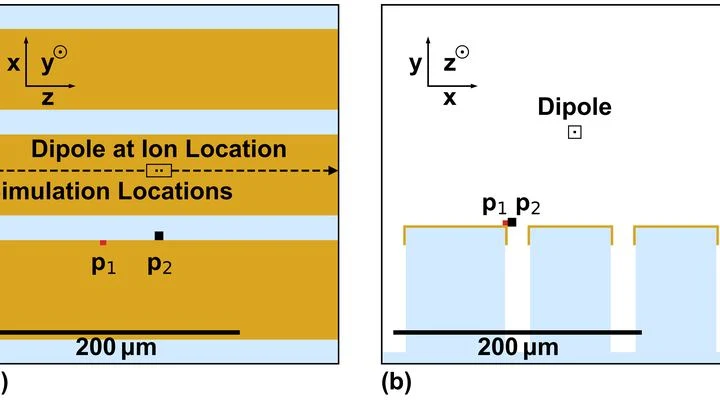
A tiny defect in a diamond crystal is like a sensitive microphone picking up the faintest magnetic fields. That's how sensors based on nitrogen-vacancy centers work (where a nitrogen atom and a neighboring vacancy form a quantum system). To hear the whispers of individual molecules, the sensor is placed right at the surface.
A noisy café. You're trying to make out two quiet conversations: one from the table by the window (black hole mergers), the other a barely audible whisper from the far corner (echoes of the universe's birth). But the hiss of the espresso machine and street noise (detector jitter) drown everything out. New work teaches a computer to separate these sounds.
In 1960, the Tatel radio telescope spent weeks listening to emptiness around Tau Ceti and Epsilon Eridani. Project Ozma was searching for technosignatures — traces of another mind at work.
In the late 1990s, the night sky delivered a surprise: Saul Perlmutter and Adam Riess found that the expansion of the Universe is accelerating. Ever since, the greatest riddle has been dark energy — a substance making up nearly 70% of the cosmos, yet evading laboratory study.
Two sensitive microphones are listening to the Universe. One hears a low hum, the other hears almost nothing. It's not a malfunction: it's about how they are oriented.
Gravitational-wave observatories like LIGO don't just catch loud bursts from black hole mergers.
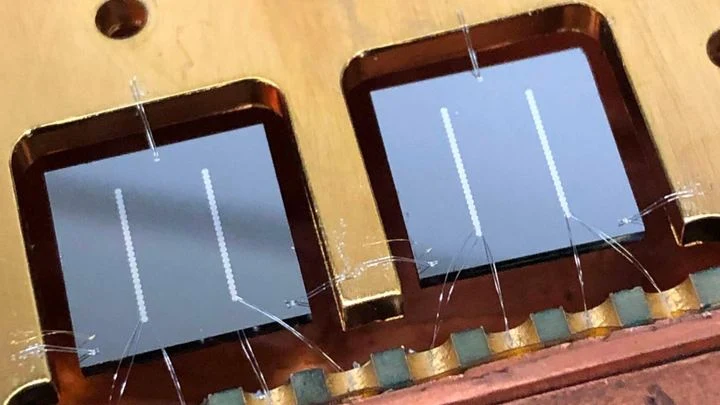
A quantum computer is like an orchestra where each ion is a musician and laser pulses are the conductor's baton. But if someone in the audience rustles, the delicate melody of quantum states goes off key.
Astronomers listen to the cosmos like an old radio: they twist the knob not to find a particular station, but to catch any unusual noise. This approach breaks the mold: instead of hunting for gravitational waves using memorized patterns, they catch everything — without bias.
Gravitational waves are the trembling of spacetime itself. Usually we only catch their overall hum, but each wave also has a direction of oscillation – polarization. Old maps were built only from signal loudness, which led to errors. It's like trying to see the bottom of a pond through sun glare.
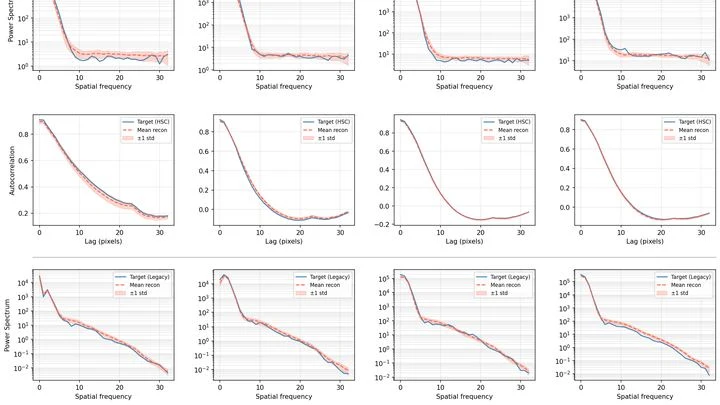
If you photograph the same mountain with a film camera and a modern smartphone, you get different images: colors are brighter in one, details are blurrier in the other. The same goes for telescopes: each instrument sees the sky in its own way, adding its own distortions to the true light of galaxies, like a filter through which we look.
The light from a distant star is never steady. It shimmers like heat over hot asphalt. When astronomers pointed JWST at the star TOI 700, they saw this shimmer especially clearly: every 16 minutes, the brightness changed by a tiny fraction, just 46 parts per million.For comparison: if you placed a light bulb a kilometer away, this change would be…
Particle detectors such as resistive plate chambers (RPCs) work like sensitive traps: when a charged particle flies through, it generates an electrical signal. But sometimes the chamber fires a false hit, as if an invisible hand pressed a doorbell. These spurious signals muddy the picture and make it harder to pinpoint the particle's path.
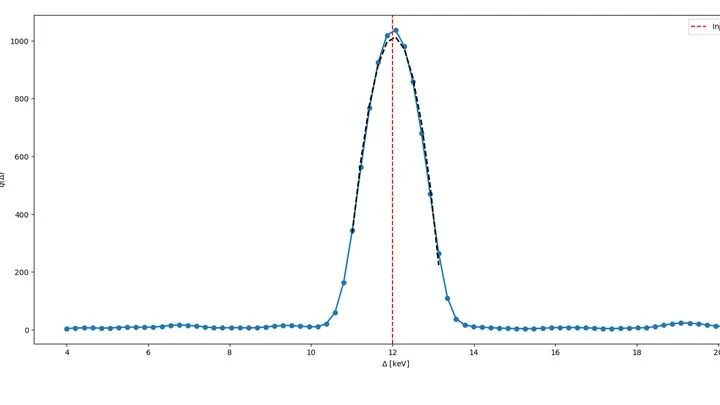
A gamma-ray spectrum looks like a picket fence: each line is the precise energy a nucleus released as a photon. But sometimes ghosts appear in that fence — faint lines shifted by the same amount from the main ones. Such a shift could mean that part of the energy went into creating a light particle we cannot yet see directly.
A dark matter detector is like a super-sensitive microphone listening for silence. It picks up tiny heat jolts, phonons, that occur when a particle grazes a crystal. But instead of silence, the instruments have been hearing noise for years: a slew of weak signals below a few hundred electronvolts.
A dark matter detector is like a room where you're trying to hear a whisper while static electricity crackles nearby. This crackle is produced by radon atoms — a radioactive gas that seeps out from materials and air.