La sorpresa del muón se desvanece exprés
El muón es el hermano pesado del electrón, que vive solo dos millonésimas de segundo. En un campo magnético gira como una peonza, pero un poco más rápido de lo que predicen las fórmulas. Hace veinte años, en Brookhaven, notaron ese 'un poco más rápido', y desde entonces los físicos han debatido: o los instrumentos mienten, o en el vacío se esconden partículas desconocidas.
Ahora, en Fermilab, han medido la rotación del muón con cuatro veces más precisión, y de nuevo resultó ser 'demasiado rápida'. Pero en paralelo, los teóricos, usando supercomputadoras, recalcularon la contribución del vacío: resultó que el vacío no está vacío, sino que hierve de partículas virtuales que retuercen ligeramente al muón. Los nuevos cálculos, que tienen en cuenta la mezcla de dos tipos de partículas, elevaron el valor teórico casi hasta el experimental. La discrepancia se desvaneció.
El Modelo Estándar ha resistido de nuevo. No explica la materia oscura ni las diminutas masas de los neutrinos, pero para el muón sus predicciones ahora coinciden con el experimento. Esto no es un fracaso, sino un triunfo de la precisión: hemos aprendido a calcular mejor el vacío.
Resumen original
tal como lo escribieron los autores, en inglés arXiv:2601.08101
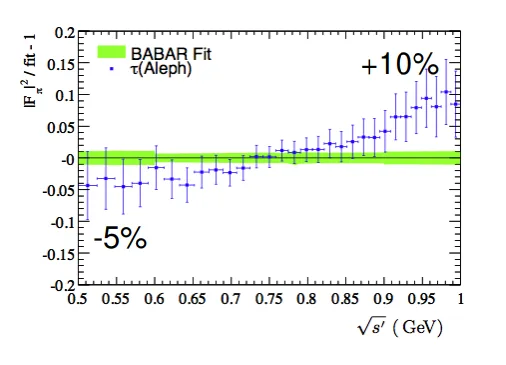
Recently, the exciting new Fermilab (FNAL) Muon g-2 measurement impressively confirmed the final Brookhaven (BNL) result from 2004, and with a result four times more precise, has launched a new serious attack on the Standard Model (SM). On the theoretical side, ab initio lattice QCD (LQCD) calculations of hadronic vacuum polarization have made remarkable progress. They are now the new standard for studying the leading non-perturbative contributions, which have previously hindered matching with the precision required for full exploitation of the experimental results. The lattice results affected both leading hadronic contributions the hadronic vacuum polarization (HVP) and the hadronic light-by-light (HLbL) contributions by increasing the previously generally accepted $$e^+e^-$$ to hadrons based dispersion relation results. The shifts reduced the discrepancy between theory and experiment, leaving nothing missing. One of the most prominent signs of Beyond the Standard Model (BSM) physics has disappeared: the SM appears validated more than ever, in agreement with what other searches at the Large Hadron Collider (LHC) at CERN tell us! A triumph of the SM, even though the SM cannot explain known cosmological puzzles like dark matter or baryogenesis, and why neutrino masses are so tiny, the absence of strong CP violation, for example. I also argue that the discrepancy between the data-driven dispersive result and the lattice QCD results for the hadronic vacuum polarization can be largely explained by correcting the $$e^+e^-$$ data for 'rho-gamma' mixing effects.
El muón es tan pesado que en el Gran Colisionador de Hadrones su nacimiento se registra como una 'lluvia' de decenas de partículas, pero vive menos de lo que tarda la luz en cruzar un grano de arena.