Rejilla de radiación contra tumores grandes exprés
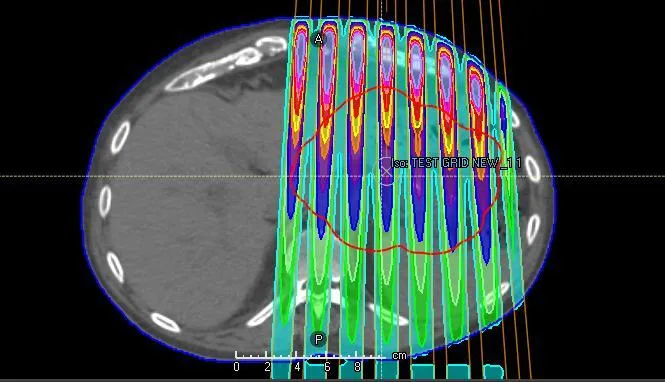
Al tratar tumores grandes, un haz de radiación continuo puede dañar los tejidos sanos circundantes. Los médicos idearon dividir el haz en múltiples chorros finos, como el agua de una regadera con agujeros pequeños. Este método se denomina radioterapia espacialmente fraccionada, o terapia GRID.
Para aplicar la terapia GRID, es necesario calcular con precisión cómo atravesarán los haces el cuerpo del paciente. Para ello se utilizan programas informáticos especiales: sistemas de planificación del tratamiento. Los autores del trabajo fueron los primeros en configurar un sistema llamado RayStation para trabajar con la terapia GRID. Utilizaron una placa de plomo con agujeros, un bloque GRID, que se coloca delante del paciente y convierte el haz continuo en una rejilla de haces finos.
La precisión se verificó con detectores especiales que miden la dosis en diferentes puntos. Además, los científicos desarrollaron una forma de estandarizar la configuración del bloque GRID en RayStation para que otras clínicas puedan repetir el método sin largos experimentos. Este es un paso hacia que el tratamiento de tumores grandes sea más seguro y predecible.
Resumen original
tal como lo escribieron los autores, en inglés arXiv:2604.03967
Spatially Fractionated Radiation Therapy (SFRT) or GRID therapy has been in existence for more than a century. GRID therapy was invented as an approach to address the challenges posed by bulky tumors. To treat patients with GRID therapy, the protocol needs to be implemented within the Treatment Planning System (TPS) software. Also, the dose needed for treatment must be validated. A few TPS software vendors such as Elekta and Varian have protocols for treating patients with GRID therapy. However, we are the first to implement the protocols within RayStation TPS. To achieve these, we used the .decimal GRID block applicator to create conformal treatment plans. For the beam modeling, several dosimetry data, and measurements such as percentage depth dose (PDD), beam profile, output, and GRID factors, were obtained for different field sizes and energies. The dose distribution from the GRID openings covered the Planning Target Volume (PTV), with the QA plan having a 98% agreement with the planned dose. Also, we used the Mapcheck2 results to verify the adjustments made to the script variables such as aperture size (hole and spacing). We developed a robust way to validate the dose needed for patient treatment using the GRID block applicator. Also, we have proposed a novel approach to standardize the clinical implementation of the GRID block in RayStation TPS.
La terapia GRID apareció hace más de un siglo, pero solo ahora se está integrando en los sistemas modernos de planificación informática de la radiación.