Stellar chemical evolution is the process by which stars synthesize heavier elements from lighter ones through nuclear fusion and then release these elements into space, enriching the interstellar medium. Over successive generations of stars, this gradual enrichment builds up the abundance of elements like carbon, oxygen, and iron that we observe in stars, gas clouds, and planets today. It is the central mechanism that connects the Big Bang's primordial hydrogen and helium to the chemically diverse universe we inhabit, including the rocky planets and life itself.
Historia
The concept was developed in the mid-20th century, with key contributions from Fred Hoyle, who in 1954 showed how heavy elements could be built up inside massive stars, and later by Burbidge, Burbidge, Fowler, and Hoyle in their landmark 1957 paper.
Cómo funciona
Inside a star's core, nuclear fusion fuses hydrogen into helium, and in more massive stars, proceeds to fuse helium into carbon, oxygen, and heavier elements up to iron. When such stars die, either by shedding their outer layers or exploding as supernovae, they eject these newly synthesized elements into space. Subsequent star formation incorporates this enriched material, so each new generation of stars is born with a higher metallicity than the previous one.
En la práctica
Stellar chemical evolution models are used to interpret stellar spectra and to date stellar populations, and they guide searches for stars with element abundances favorable for hosting habitable planets.
Dato curioso
The iron in your blood and the calcium in your bones were synthesized in massive stars that exploded billions of years ago, making stellar chemical evolution the ultimate source of most elements in our bodies.
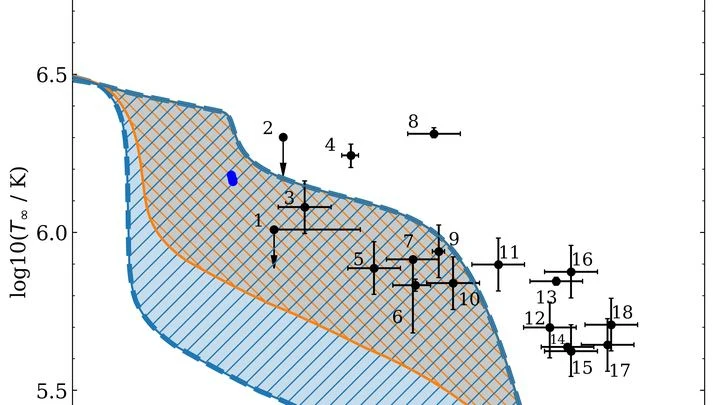
Una estrella de neutrones es el remanente de una estrella que ha explotado, comprimido hasta el tamaño de una ciudad. En su núcleo, la materia está tan densamente empaquetada que una cucharadita de ese material pesaría como una montaña. A esa densidad, según predice la teoría de las interacciones fuertes, las partículas adquieren 'gemelas': compañeras de paridad.