La radio révèle la naissance des étoiles dans l'Univers primordial express
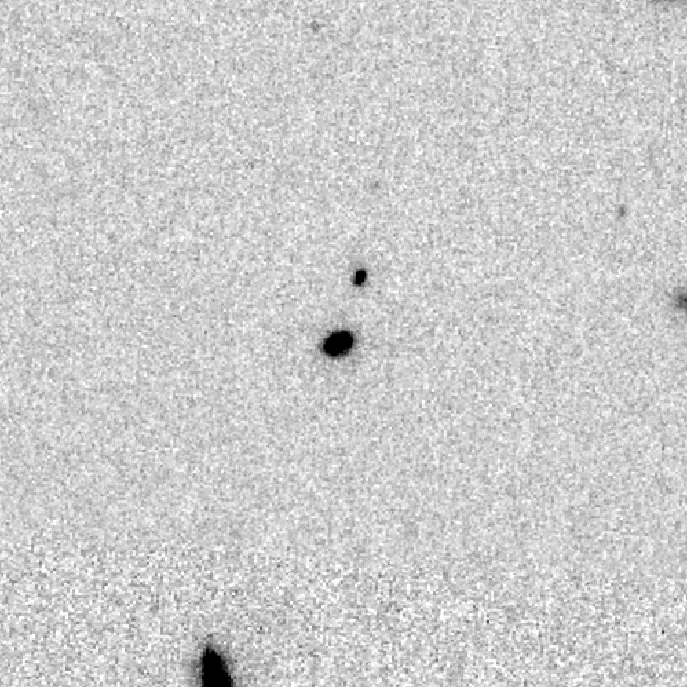
Un radiotélescope a capté un signal provenant de trois galaxies qui existaient lorsque l'Univers avait moins d'un milliard d'années. Leur émission radio est si puissante qu'on dirait que chacune a donné naissance à mille soleils par an pendant une courte période. Pour comparaison, notre Voie lactée ne produit que deux ou trois étoiles par an.
Ces galaxies ont d'abord été repérées sur les images des télescopes spatiaux Hubble et James Webb : elles paraissaient inhabituellement rouges en raison de leur distance immense. Ensuite, le spectrographe a confirmé que leur lumière avait voyagé pendant 12,8 à 13,1 milliards d'années. Puis les radiotélescopes sont entrés en jeu et ont montré que toute l'émission est produite par des étoiles, et non par un trou noir central.
Deux des trois galaxies ont une forme irrégulière et fragmentée. On dirait qu'elles viennent de subir une collision avec une voisine, et cette collision a comprimé le gaz, déclenchant une avalanche de formation d'étoiles. C'est ainsi que se sont allumés les premiers grands amas d'étoiles dans l'Univers primordial.
Résumé original
tel que rédigé par les auteurs, en anglais arXiv:2602.05808
Radio observations offer a dust-independent probe of star formation and active galactic nucleus (AGN) activity, but sufficiently deep data are required to access the crossover luminosity between these processes at high redshift ($$z>4.5$$). We present three spectroscopically confirmed high-redshift radio sources (HzRSs) detected at 1.3 GHz at $$z=4.9$$-$$5.6$$, with radio luminosities spanning $$L_{\rm 1.3 \, GHz}\approx2$$-$$5\times10^{24} \, \rm W \, Hz^{-1}$$. These sources were first identified as high-redshift candidates through spectral energy distribution (SED) fitting of archival Hubble, JWST NIRCam+MIRI, and ground-based photometry, and then spectroscopically confirmed via the $$\rm H\,\alpha$$ emission line using wide-field slitless spectroscopy from JWST COSMOS-3D. The star formation rates (SFRs) measured from SED fitting, the $$\rm H\,\alpha$$ flux, and the 1.3 GHz luminosity, span $$\sim100$$-$$1800\, M_{\odot} \, \rm yr^{-1}$$, demonstrating broad agreement between these SFR tracers. We find that these three sources lie either on or $$0.5$$-1.0 dex above the star-forming main sequence at $$z=4$$-6 and have undergone a recent burst of star formation. The sources have extended rest-UV/optical morphologies with no evidence for a dominant point source component, indicating that an AGN is unlikely to dominate their rest-UV and optical emission. Two of the sources have complex, multi-component rest-frame UV/optical morphologies, suggesting that their starbursts may be triggered by merging activity. These HzRSs open up a new window towards probing radio emission powered by star formation alone at $$z> 4.5$$, representing a remarkable opportunity to begin tracing star formation, independent of dust, in the early Universe.
La lumière de ces galaxies a voyagé pendant près de 13 milliards d'années, soit trois fois l'âge de la Terre.