La chaleur dévie sous l'effet du champ magnétique express
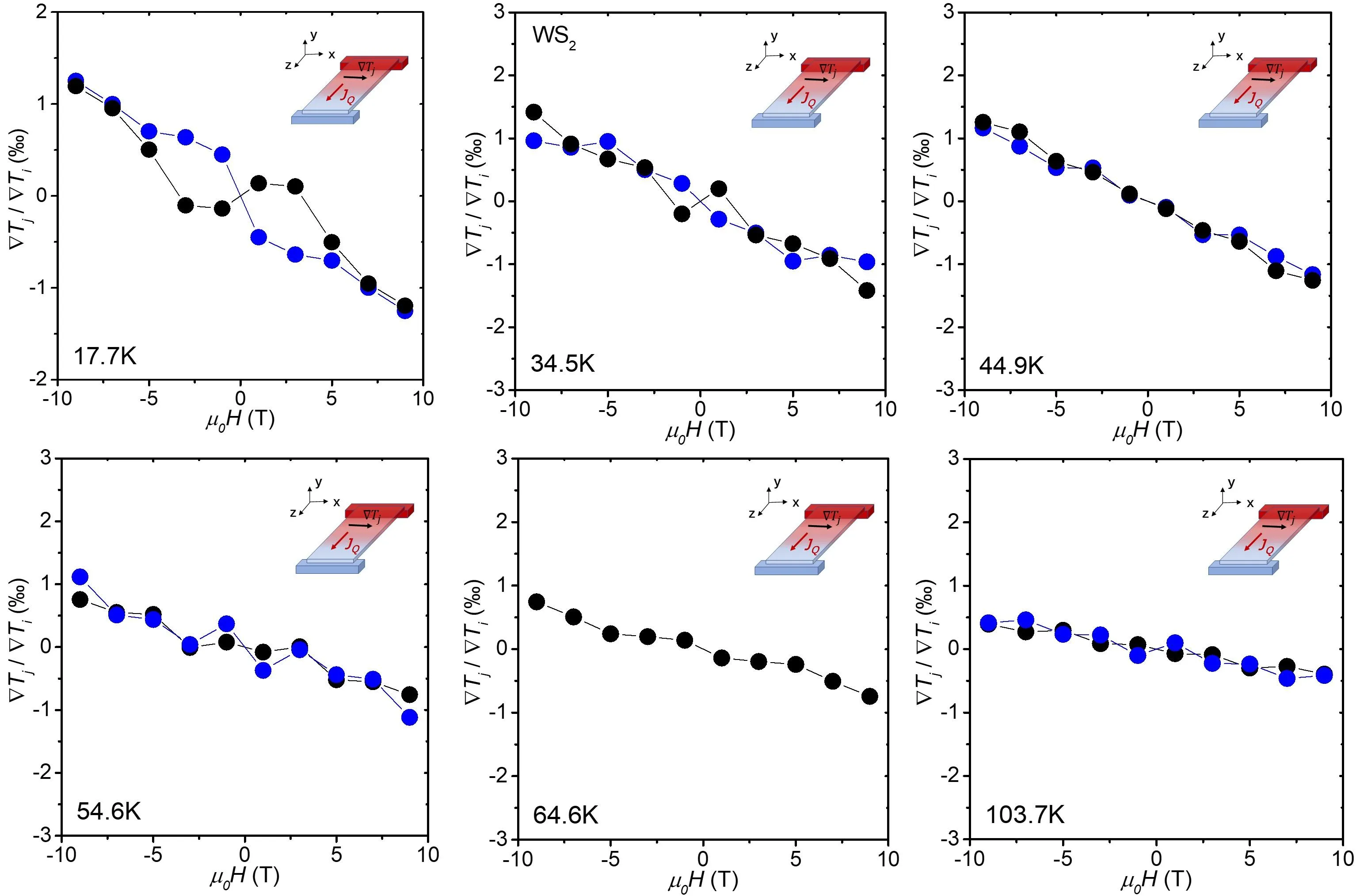
Dans un cristal isolant, la chaleur se propage généralement de l'extrémité chaude vers l'extrémité froide. Mais si l'on active un champ magnétique, une partie du flux thermique dévie sur le côté — comme l'eau qui, en dévalant une pente, est légèrement poussée latéralement par le vent. Ce comportement est appelé effet Hall thermique.
Les chercheurs ont pris un cristal stratifié de WS2 (disulfure de tungstène — un matériau semblable au graphite, mais composé d'atomes de tungstène et de soufre) et ont mesuré comment la chaleur se propage le long des couches et à travers elles. Il s'est avéré que les deux flux atteignent leur maximum presque à la même température. Et leur rapport ne dépasse pas une certaine limite, comme dans d'autres isolants.
Les auteurs ont comparé cela au comportement d'un gaz de molécules de forme non sphérique. Là, le champ magnétique influence la rotation des molécules, et les collisions génèrent un flux de chaleur transversal. Par analogie, dans le cristal, le champ agit sur les phonons via leurs interactions mutuelles. Une estimation simple prenant en compte la force de Berry (un effet lié à la géométrie du mouvement des atomes) décrit bien les mesures pour sept cristaux isolants différents.
Résumé original
tel que rédigé par les auteurs, en anglais arXiv:2604.03644
The amplitude of the Hall response of electrons can be understood without invoking interactions. Most theories of the phonon thermal Hall effect have likewise opted for a non-interacting picture. Here, we challenge this approach. Our study of WS$$_2$$, a transition metal dichalcogenide (TMD) insulator, finds that longitudinal, $$\kappa_{xx}$$, and transverse, $$\kappa_{xy}$$, thermal conductivities peak at almost the same temperature. Their ratio obeys an upper bound, as in other insulators. We then compare transverse thermal transport in a phonon gas and in a molecular gas. In the latter, the Senftleben-Beenakker effect is driven by the competition between molecular collisions and applied magnetic field in setting the distribution of molecular angular momenta. An off-diagonal transport response arises thanks to interactions between non-spherical particles, which do not need to be chiral. By analogy, we argue that in a phonon gas, magnetic field will influence phonon-phonon interactions, and generates a transverse thermal \emph{resistivity}, whose order of magnitude can be accounted for by invoking a Berry force on the drift velocity of the nuclei in the presence of a finite heat. This simple picture gives a reasonable account of the experimentally measured transverse thermal resistivity of seven different crystalline insulators.
L'effet Hall thermique dans les isolants a été observé pour la première fois en 2005 dans un grenat de terbium-gadolinium, et depuis, il a été constaté dans de nombreux cristaux.