Points chauds issus de minuscules trous noirs express
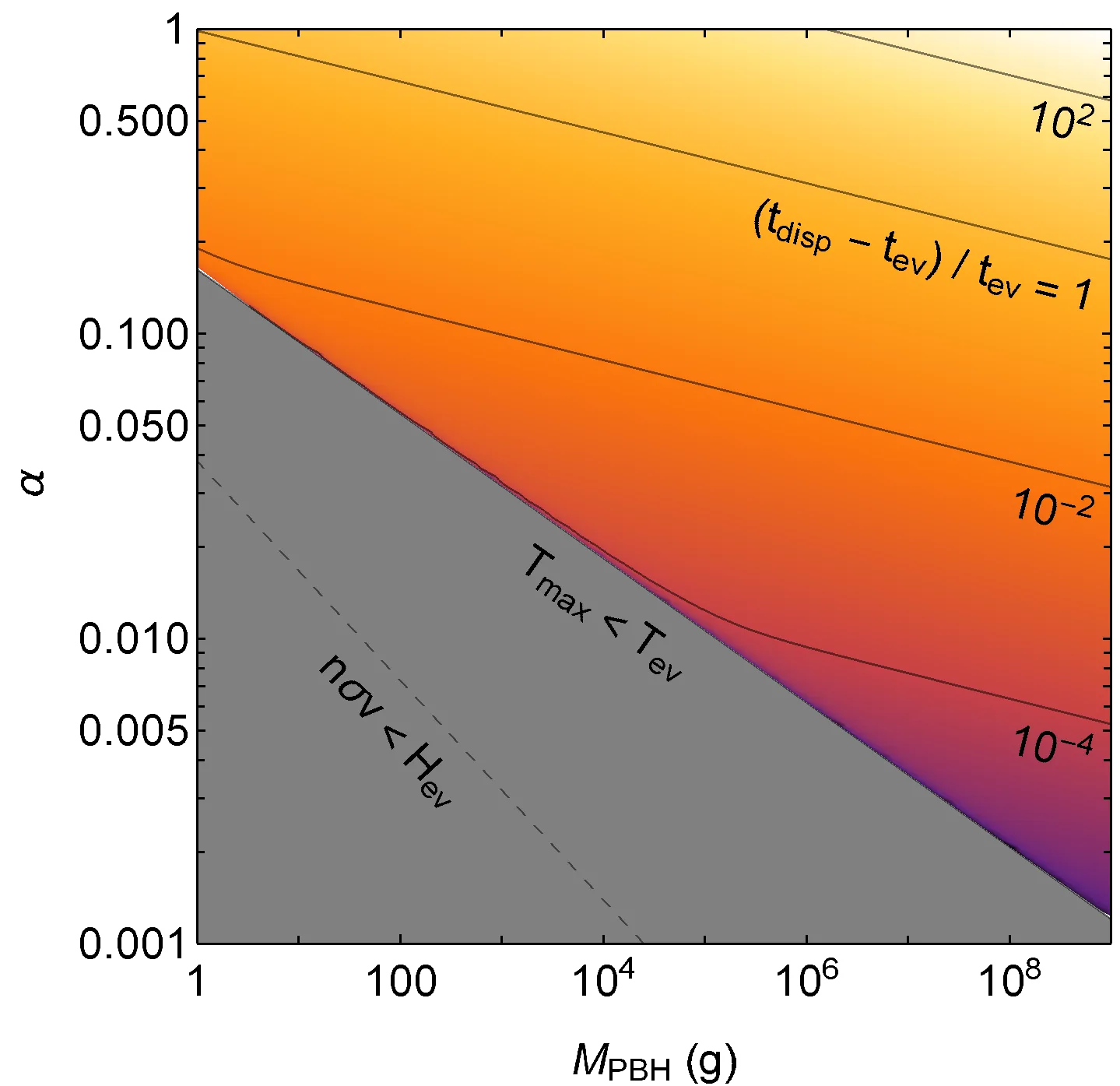
Un minuscule trou noir traverse un nuage de gaz. Il ne l'absorbe pas, mais au contraire le chauffe, comme un fer à repasser laissé sur un tissu humide. Il émet un rayonnement et une tache chaude apparaît autour de lui, une région où la température est des centaines de fois supérieure à celle de l'espace environnant.
On pensait auparavant que ces taches vivaient presque éternellement, refroidissant lentement et selon une loi unique. Mais la nouvelle étude tient compte de l'expansion de l'Univers. L'expansion agit comme un ventilateur : elle emporte la chaleur plus vite qu'elle ne se propage naturellement. Le point chaud perd d'abord rapidement de la température, puis refroidit selon une loi plus abrupte, contrairement à ce qui se passerait dans un monde statique.
En fin de compte, tous les points chauds disparaissent en un temps fini. C'est une conclusion importante : si de tels points ont réellement existé dans l'Univers primordial, leurs traces n'auraient pu survivre jusqu'à nos jours que dans des conditions particulières. On comprend désormais qu'il faut les chercher autrement, non pas comme des balises éternelles, mais comme de brefs éclats qui se sont éteints depuis longtemps.
Résumé original
tel que rédigé par les auteurs, en anglais arXiv:2605.08336
Light primordial black holes heat the surrounding plasma via Hawking radiation, forming localized hotspots whose temperature may far exceed that of the cosmological background. Previous studies of hotspot formation and cooling have treated the subsequent energy transport in flat spacetime, thereby neglecting the expansion of the Universe. We formulate the diffusion equation governing the hotspot evolution, in an expanding universe, and clarify the regime in which the formalism is valid. We find that hotspot formation is robust against cosmological expansion. We show that the critical distance scale, where Hubble expansion overtakes diffusion, coincides with the decoupling radius introduced in earlier work, and the temperature profile $$T\propto r^{-7/11}$$ essentially remains unchanged. However, the cooling stage is substantially modified. We find that the plateau temperature of a cooling hotspot initially undergoes a rapid drop and then follows $$T_{\rm plt} \propto t^{-11/15}$$, steeper than the flat-spacetime scaling $$t^{-7/15}$$. This scaling cannot be obtained by simply redshifting the flat-spacetime solution, because expansion also suppresses diffusive transport. As a consequence, all hotspots disappear within a finite time, as opposed to the flat-spacetime prediction of everlasting hotspots in part of the parameter space.
La température d'un point chaud peut être des milliers de fois supérieure à celle du gaz environnant, comme si de l'eau bouillante se retrouvait soudain dans de l'eau glacée.