Мозг-переводчик: как разные люди слышат один и тот же сигнал экспресс
Человек смотрит на мигающие буквы на экране, а компьютер угадывает, какую он выбрал, по всплеску мозговой активности. Это похоже на переводчика, который ловит не слова, а электрические сигналы мозга. Но у разных людей мозг «говорит» с акцентом: у одного сигнал яркий и чёткий, у другого — тихий и смазанный. Учёные решили разобраться, чем именно отличаются эти акценты.
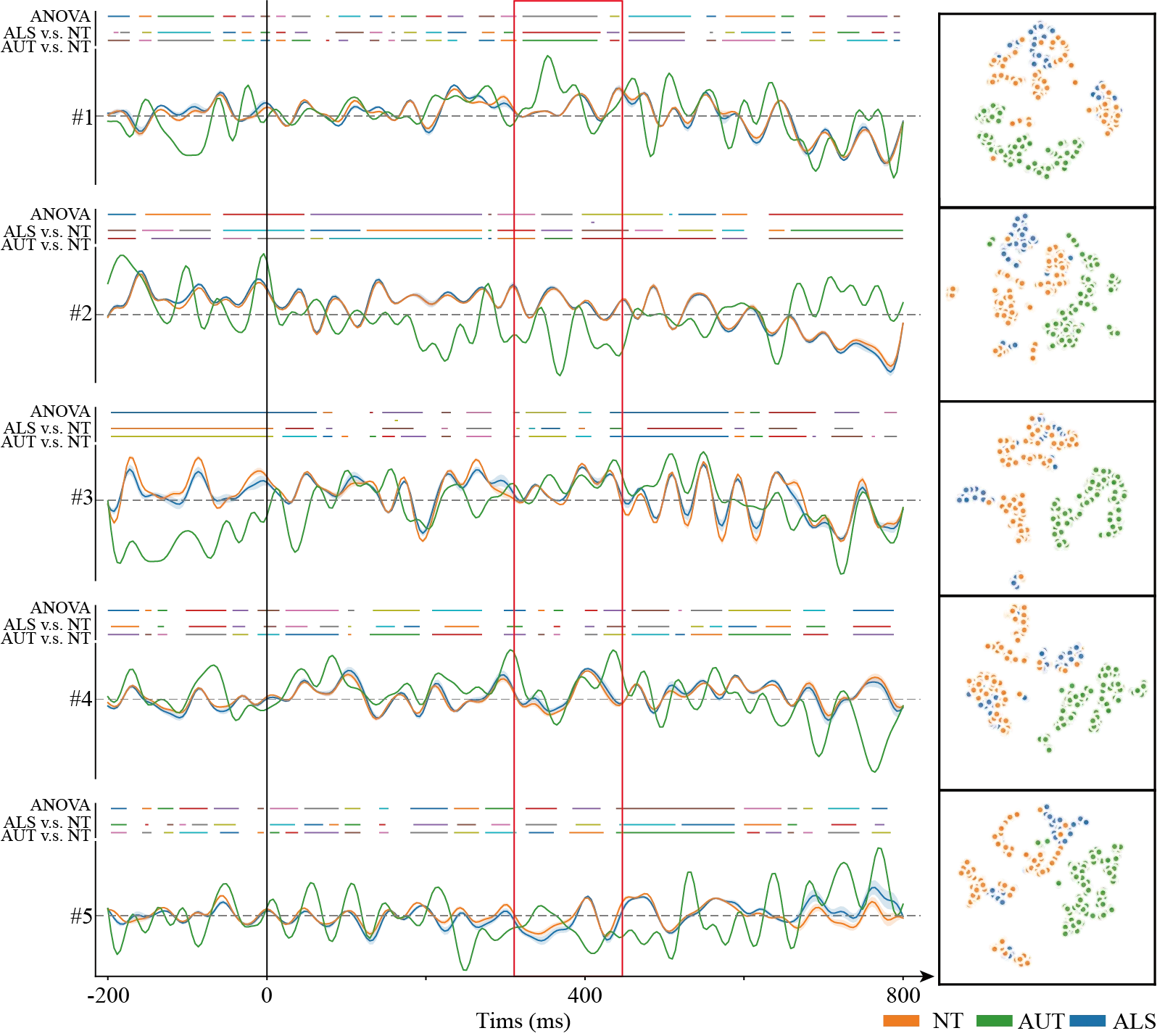
Они собрали записи мозговых волн у трёх групп людей: с боковым амиотрофическим склерозом (болезнь, при которой слабеют мышцы), с аутизмом и без таких особенностей. Для анализа придумали программу, которая не только распознаёт сигнал, но и показывает его «портрет» — как выглядит типичная волна для каждой группы. Оказалось, что портреты действительно разные: у одной группы волна острее, у другой — шире, у третьей — сдвинута во времени.
Это открытие важно для людей, которые не могут говорить или двигаться. Для них мозговые интерфейсы — единственный способ общаться. Если программа будет знать, как выглядит сигнал именно этого человека, она будет реже ошибаться. В будущем такие системы смогут подстраиваться под каждого с первых минут использования, как хороший переводчик, который быстро привыкает к голосу собеседника.
Оригинальная аннотация
как её написали авторы, на английском arXiv:2604.24765
P300-based brain-computer interfaces (BCIs) are widely used for communication, but population heterogeneity may alter the neural patterns available for decoding. Prior work has mainly examined such differences at the signal or performance level, while the representation structure learned by the decoder remains underexplored. In this study, we propose an interpretable fuzzy spatiotemporal framework for P300 classification and use it to analyze population-level differences across amyotrophic lateral sclerosis (ALS), autism (AUT), and neurotypical (NT) cohorts. The model employs spatial and temporal fuzzy filters with learnable prototypes, enabling both classification and reconstruction of cohort-specific fuzzy centers. Experiments were conducted on ALS and NT subsets from bigP3BCI and on the BCIAUT-P300 benchmark in a within-subject setting. The proposed model achieved competitive performance against multiple deep learning baselines. More importantly, the reconstructed fuzzy centers revealed systematic cohort-dependent differences in waveform morphology and representation geometry. Point-wise statistical analysis identified significant temporal differences between cohorts, including intervals overlapping with the canonical P300 window, and low-dimensional embeddings showed partially separated cohort-specific prototype organizations. These results suggest that population heterogeneity in P300-BCI is reflected not only in decoding performance but also in the discriminative structure learned by the model. The proposed framework provides an interpretable route toward population-aware P300-BCI analysis and design.
Сигнал P300 появляется в мозге примерно через 300 миллисекунд после того, как человек заметил что-то важное, — это как мгновенное «ага!» внутри головы.