Свет ловит вскрытие чипа экспресс
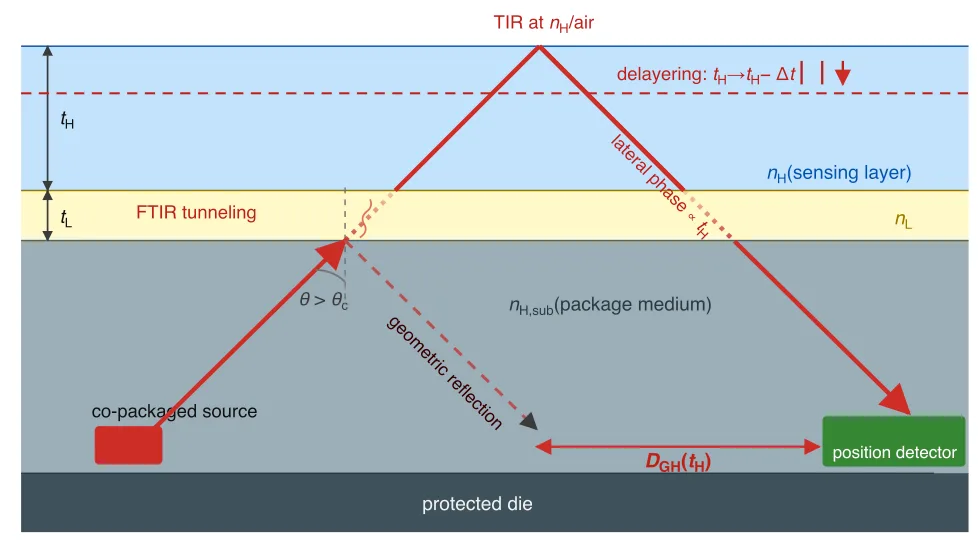
Микросхема похожа на слоёный пирог: сверху защитные слои, внутри — тайны. Злоумышленник может снимать слои один за другим, чтобы добраться до секретов. Новый датчик следит за этим с помощью луча света.
Луч падает на поверхность чипа под углом. Часть света отражается, но не сразу: он слегка «ныряет» в верхний слой, как камешек, скользящий по воде. Если слой становится тоньше, луч выныривает в другом месте — сдвигается на несколько нанометров. Датчик измеряет этот сдвиг.
Этот сдвиг почти невозможно подделать. Он меняется одинаково при любых помехах — будь то колебания температуры или дрожание лазера. Даже если сверлят точечное отверстие, луч честно сообщает: здесь что-то ковыряли.
Оригинальная аннотация
как её написали авторы, на английском arXiv:2608.12243v1
We propose a co-packaged photonic tamper sensor that detects progressive delayering and localized drilling through changes in the Goos-Hanchen (GH) shift of a reflected optical beam. Frustrated total internal reflection (FTIR) couples the beam into a high-index sensing layer, where its transverse-wavevector components acquire a thickness-dependent propagation phase. Numerical simulations show an approximately linear response for sensing-layer thicknesses below 250 nm and a delayering sensitivity of 5.3 nm of beam displacement per nanometer of material removed, nearly three times that of a conventional total internal reflection (TIR) structure. The off-resonant response remains stable under representative refractive-index, wavelength, and incidence-angle variations. Localized drilling also produces a monotonic GH-shift change that increases with drill depth and width. These results establish GH-shift readout as a rapid, spatially encoded, and difficult-to-emulate approach for semiconductor-package tamper detection.
Сдвиг луча, который ловит датчик, в тысячи раз тоньше человеческого волоса.