شطيرة الجرافين تُعجّل الإلكترونات سريع
الجرافين هو غشاء كربوني بسماكة ذرة واحدة، وهو موصل ممتاز. لكن سطحه متجعد مثل مفرش طاولة لم يُكْوَ. صنع العلماء «شطيرة»: طبقتان منه مضغوطتان بإحكام عبر فاصل لا يسمح بمرور التيار. تعملان على تنعيم تجاعيد بعضهما - مثل شريحتي خبز في شطيرة تجعلان السطح مستويًا تمامًا. في هذه الشطيرة الملساء ذريًا، تنزلق الإلكترونات دون أي تأخير يُذكر.
لكن المفاجأة الأكثر غرابة: في هذا الهيكل فائق النقاء، تبدأ الإلكترونات في «الانقسام». مجموعها يُنشئ جسيمات بشحنة أقل بثلاث مرات من المعتاد. هذه ليست خدعة، بل مفتاح لفهم الطبيعة العميقة للمادة، وخطوة نحو إلكترونيات المستقبل.
الملخص الأصلي
كما كتبه المؤلفون، بالإنجليزية arXiv:2601.16015
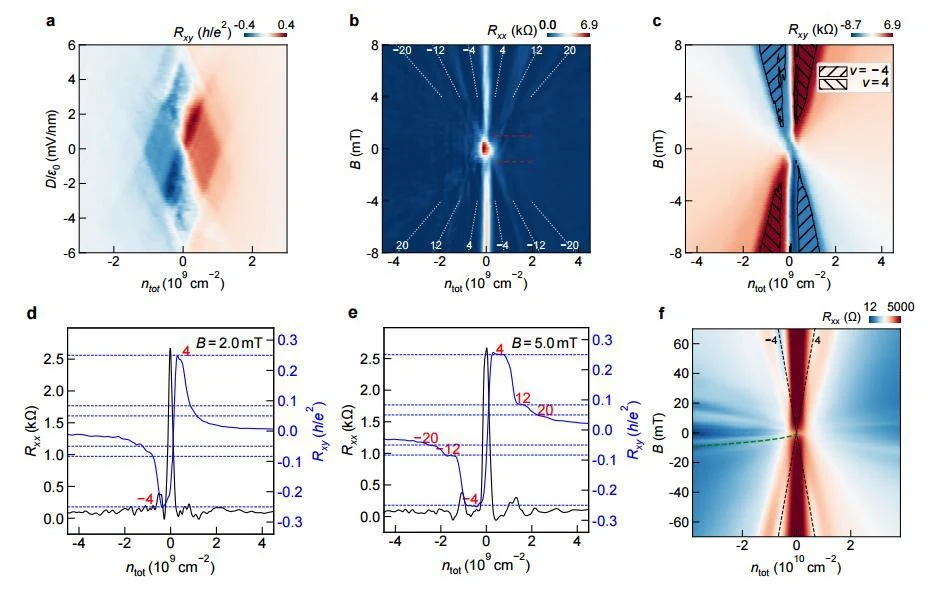
Graphene enables precise carrier-density control via gating, making it an ideal platform for studying electronic interactions. However, sample inhomogeneities often limit access to the low-density regimes where these interactions dominate. Enhancing carrier mobility is therefore crucial for exploring fundamental properties and developing device applications. Here, we demonstrate a significant reduction in external inhomogeneity using a double-layer graphene architecture separated by an ultra-thin hexagonal boron nitride layer. Mutual screening between the layers reduces scattering from random Coulomb potentials, resulting in a quantum mobility exceeding. Shubnikov de-Haas oscillations emerge at magnetic fields below 1 mT, while integer quantum Hall features are observed at 0.002T. Furthermore, we identify a fractional quantum Hall plateau at a filling factor of at 2T. These results demonstrate the platform's suitability for investigating strongly correlated electronic phases in graphene-based heterostructures.
تتصرف الإلكترونات في شطيرة الجرافين وكأن كل منها انقسم إلى ثلاثة أجزاء - هذه الظاهرة الكمومية تفتح الطريق أمام جسيمات بخصائص غير عادية.