لماذا تميل مدارات الكواكب العملاقة إلى الاستطالة قليلاً سريع
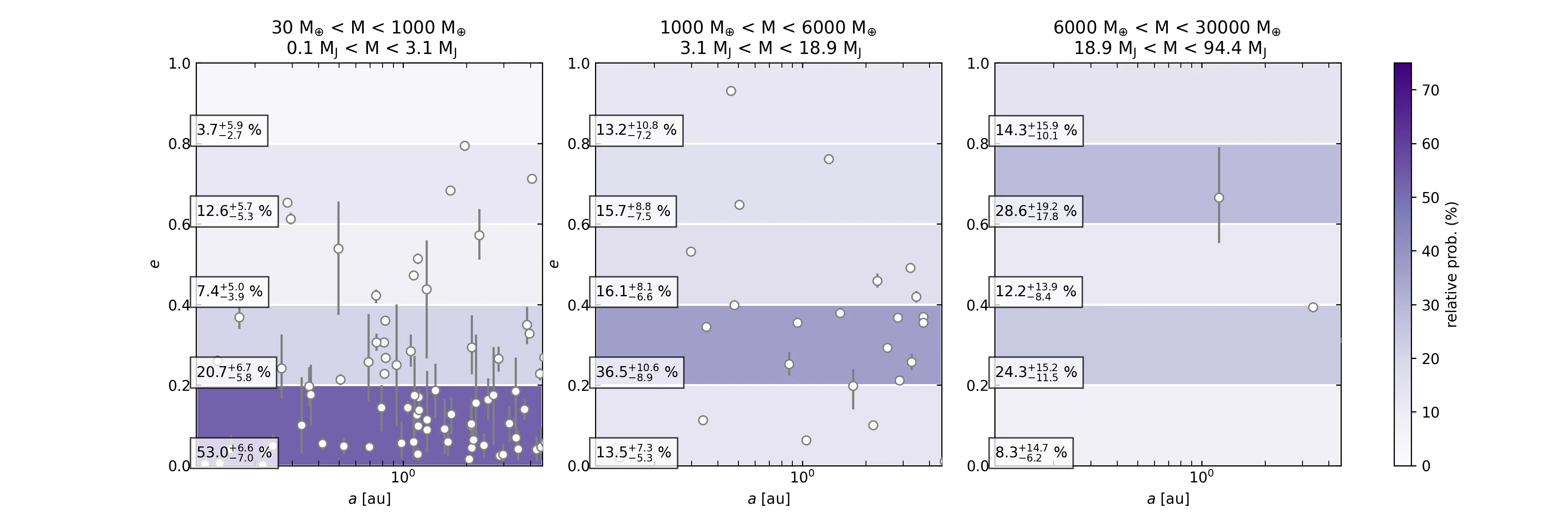
مدار الكوكب هو مساره حول نجمه. إذا كان المسار دائرياً تماماً، يكون الكوكب دائماً على نفس المسافة من النجم. لكن مدارات العديد من الكواكب مستطيلة قليلاً، مثل مضمار الجري في الملعب. درس علماء الفلك مئات الكواكب العملاقة حول نجوم أخرى ووجدوا نمطاً مثيراً للاهتمام.
الكواكب الأكثر ضخامة - تلك التي تزيد كتلتها عن كتلة المشتري بعدة مرات - تتحرك غالباً في مدارات مستطيلة قليلاً. تُقاس الاستطالة برقم من 0 إلى 1: الصفر يعني دائرة، والواحد يعني شكلاً بيضاوياً شديد الاستطالة. بالنسبة لهذه الكواكب الثقيلة، تبلغ الاستطالة غالباً حوالي 0.3. الأمر أشبه بعدّاء في ملعب يجري ليس في دائرة بل في مضمار بيضاوي مفلطح قليلاً.
من أين جاءت هذه الاستطالة؟ يبدو أن هذه الكواكب شهدت أحداثاً عنيفة في شبابها. ربما اصطدمت بأجسام كبيرة أخرى - كما حدث عند تكوين قمرنا، عندما اصطدم جسم بحجم المريخ بالأرض الفتية. قد تكون هذه الاصطدامات قد "مدّت" مدارات الكواكب العملاقة قليلاً.
يساعد هذا الاكتشاف في فهم كيفية نشوء الأنظمة الكوكبية وتطورها. إذا كان لدى النجم كوكب ضخم في مدار مستطيل قليلاً، فقد يكون ذلك أثراً لحادث كوني قديم. وبالتالي، بدراسة المدارات، نقرأ تاريخ عوالم بعيدة.
الملخص الأصلي
كما كتبه المؤلفون، بالإنجليزية arXiv:2601.18877
In this study, we compute completeness-corrected occurrence rates of giant exoplanets as a function of mass, semimajor axis, and eccentricity, using the approximately uniform California Legacy Survey sample of RV-discovered planets published in Rosenthal et al. 2021. We recover the previously-detected rise in occurrence with semimajor axis for both lower- and higher-mass subsets of the population out to $$\sim$$5 au. When restricting to planets with semimajor axes between 0.1 and 4.5 au (roughly speaking, the "peak" of giant planet occurrence), we find evidence for distinct eccentricity distributions for each of two mass sub-populations. Most strikingly, we observe a peak in the eccentricity distribution of super-Jovian planets (3-20~M$$_{\rm J}$$) at 0.3, which is apparent using two different parameterizations of the eccentricity distribution model. A hierarchical histogram model reveals that $$\sim$$92% of posterior samples indicate an elevated occurrence rate of super-Jupiters with modest eccentricities (0.2-0.4) compared to lower or higher eccentricities (i.e. evidence for a moderate eccentricity "peak"), and 99% of samples indicate super-Jupiters with modest eccentricities are more common than those with lower eccentricities (i.e. evidence that moderate eccentricities are more common than low eccentricities). We use a truncated Gaussian model fit to pinpoint the location of the super-Jupiter eccentricity peak with more precision, finding a maximum a posterior (MAP) peak location of $$e=0.3$$. This low but elevated characteristic eccentricity could be the result of dynamically hot histories, perhaps involving a giant impacts phase. All analysis code for this project is publicly available on Zenodo (https://zenodo.org/records/18089157) and GitHub (github.com/sblunt/eccentricities).
استطالة مدار الأرض تبلغ 0.017 فقط - دائرة شبه مثالية. أما بلوتو فتبلغ استطالته 0.25، ولهذا يقترب أحياناً من الشمس أكثر من نبتون.