الاحتكاك في الصدع: كيف يتحول الرمل إلى زلزال سريع
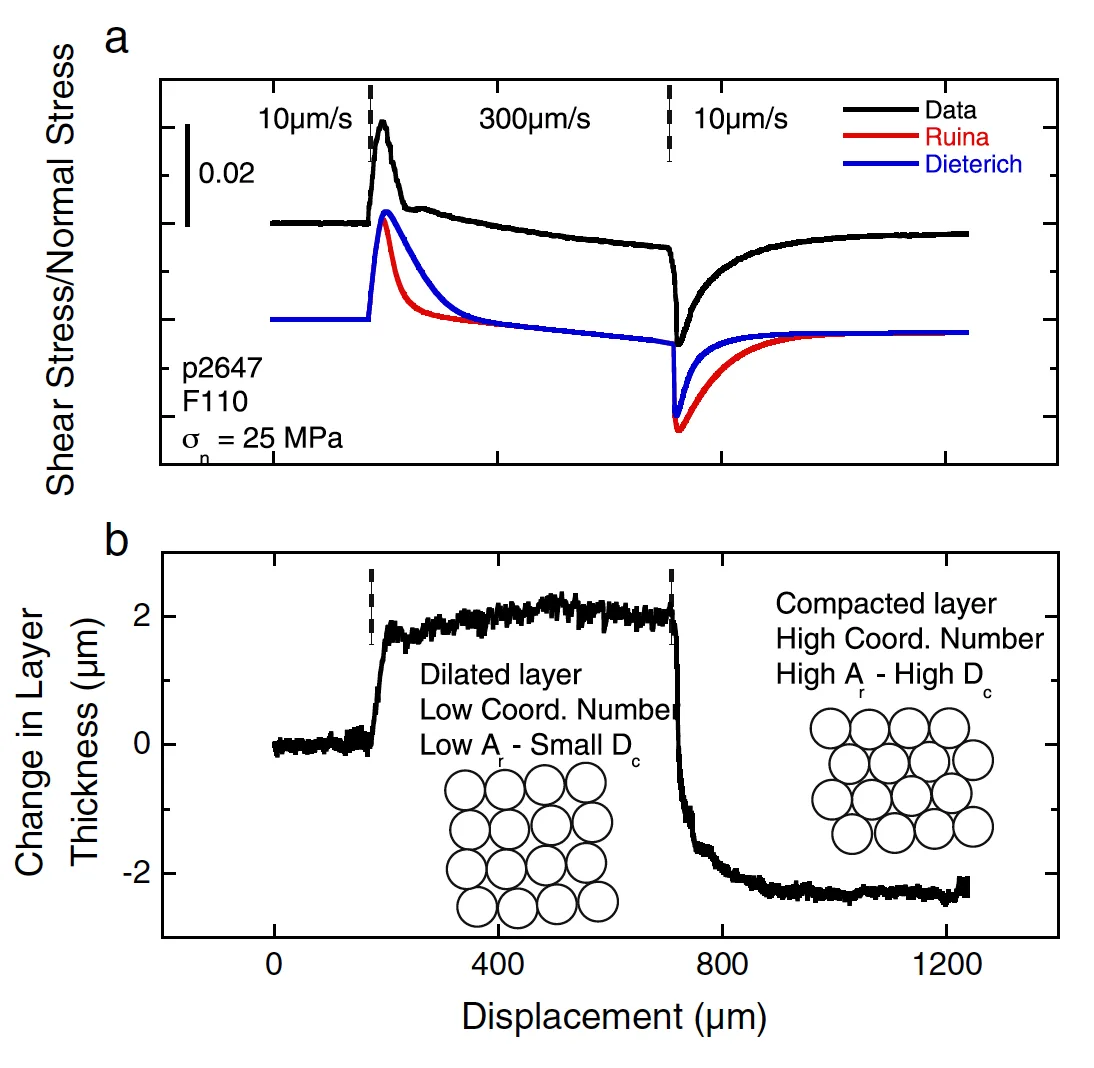
عندما تحتك صفيحتان من القشرة الأرضية ببعضهما، توجد بينهما طبقة من الصخور المطحونة — مثل الرمل بين راحتي اليدين. هذه الطبقة، التي يسميها الجيولوجيون طفلة الصدع، لا تتصرف كصخر صلب، بل كعجينة كثيفة: يمكن أن تنضغط وتتمدد وتنزلق. ومن تقلباتها يعتمد ما إذا كان الصدع سينزلق في زلزال مدمر أو سيزحف ببطء وأمان.
بنى مؤلفو الدراسة الجديدة نموذجًا رياضيًا لهذه الطبقة. وصفوها كمادة لزجة (تتدفق تحت الحمل) وليدة في نفس الوقت (لا تعود إلى شكلها الأصلي). أُدرجت في النموذج خاصية مهمة: هذه المادة تغير حجمها عند القص — مثل الرمل المبلل على الشاطئ، الذي يصبح أكثر كثافة إذا دُعس عليه، لكنه يتفكك إذا حُفر. هذه الخاصية حاسمة للصدوع: انضغاط الطفلة أو تفككها يؤثر مباشرة على قوة الاحتكاك وعلى سرعة انزلاق الصفائح فوق بعضها.
تم اختبار النموذج في تجارب قياسية: تطابقت الحسابات العددية مع البيانات المختبرية. هذا يعني أنه يمكن الآن تقييم متى وكيف يتراكم الصدع ما يكفي من الإجهاد للانزلاق المفاجئ. في المستقبل، قد تساعد هذه النماذج في تحسين التنبؤ بالزلازل — على الأقل على مستوى فيزياء العملية، وليس فقط الإحصاء.
الملخص الأصلي
كما كتبه المؤلفون، بالإنجليزية arXiv:2602.12427
Friction plays a fundamental role in many natural processes, including earthquakes, landslides, and volcanic eruptions. Earthquakes occur when highly compressed fault surfaces accumulate large enough shear stresses, causing the faults to move relative to one another, or slip. The slip is accommodated within a thin layer of comminuted granular material -- called fault gouge -- between the fault surfaces. As a result, characterizing the mechanical behavior of fault gouge in response to shear is a major open problem in earthquake source physics. Modeling gouge is complicated by large deformations, inelasticity, rate dependence, and volumetric changes. As such, researchers typically rely on empirical formulations to capture the effective response. Here, we systematically develop a variational, finite-kinematics framework for fault gouge. We first describe a general theory for a rigid-viscoplastic, pressure-sensitive material, where the plasticity evolution follows from the principle of maximum dissipation. Then, we specialize the governing equations for a Cam-Clay material within a shearing and dilating layer. We rely on convexity considerations and experimental observations from consolidation tests of granular layers to calibrate the model and develop explicit solutions for the rate- and state- dependent response of the model to shear tests under constant compressive normal stress and prescribed shearing rate. To validate the model, we select common rate functions and compare numerical material point tests and theoretical solutions to standard laboratory experiments of shearing granular layers. Lastly, we discuss connections of the model to empirical rate-and-state friction laws.
يمكن أن يبلغ سمك طبقة طفلة الصدع في منطقة الزلزال بضعة ملليمترات فقط، لكن هذه الطبقة الرقيقة تتحكم في حركة صفائح تكتونية بأكملها.