ومضة لم تكن تريد أن تنطفئ سريع
في ليلة 18 أغسطس 2025، رصد التلسكوب الفضائي SVOM ومضة أشعة غاما قصيرة — انبعاث طاقة قوي يستمر أقل من ثانيتين. عادةً ما ترتبط هذه الومضات باندماج النجوم النيوترونية — بقايا نجوم ميتة فائقة الكثافة. وبعد دقائق فقط، وجد التلسكوب الأرضي GOTO في أستراليا توهجًا بصريًا في نفس النقطة من السماء.
أظهرت الملاحظات اللاحقة عند أطوال موجية مختلفة صورة غير عادية. التوهج اللاحق — الضوء الذي يبقى بعد الانفجار نفسه — كان أكثر سطوعًا من معظم ومضات أشعة غاما القصيرة. علاوة على ذلك، لم يخفت وفق السيناريو القياسي. أظهرت النمذجة أن طاقة إضافية تستمر في التدفق إلى موجة الصدمة، كما لو كان شخص ما يضيف وقودًا إلى نار مشتعلة بالفعل.
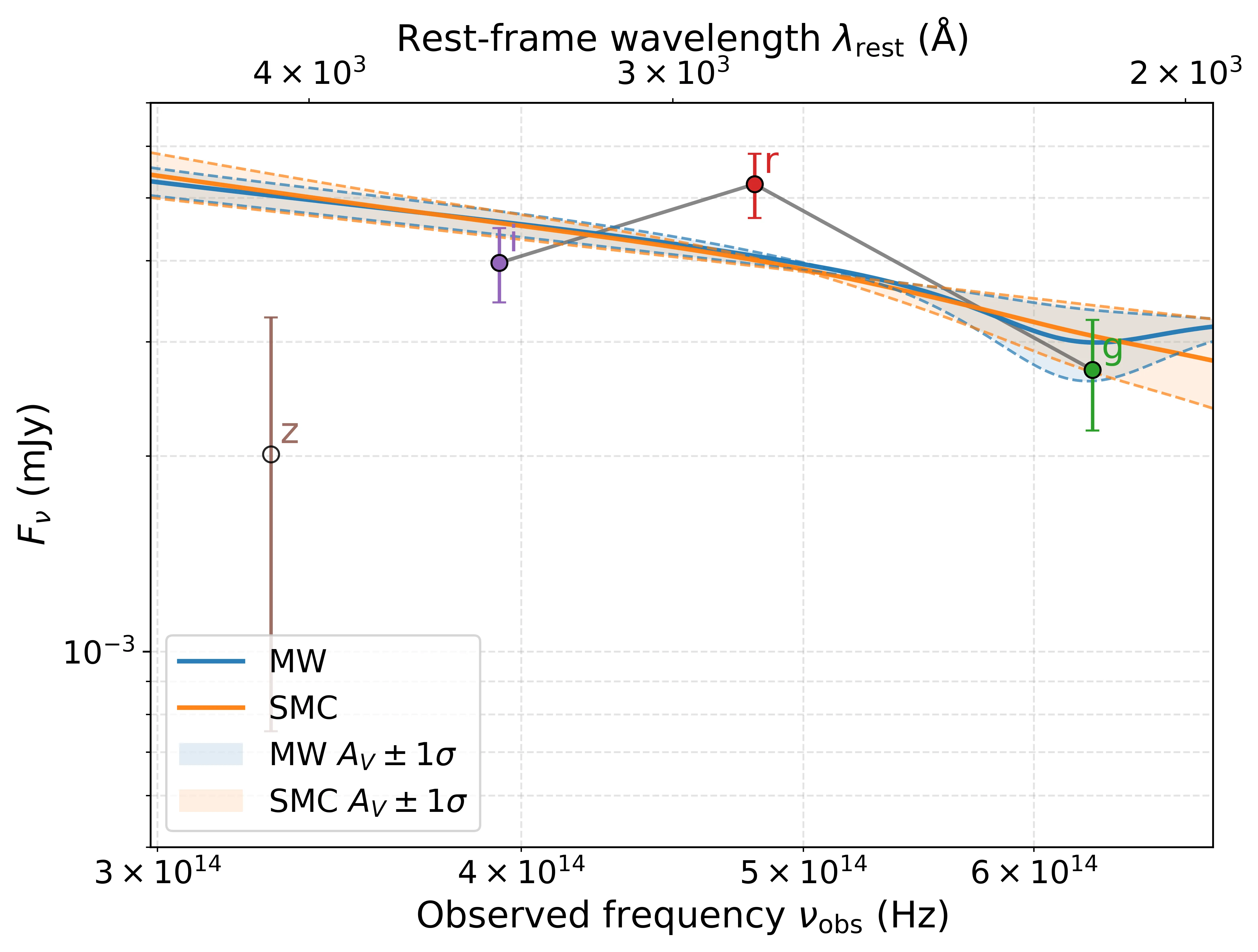
أظهر التحليل الطيفي بتلسكوب كيك خطوط امتصاص للحديد والمغنيسيوم، مما سمح بتحديد الانزياح الأحمر بدقة z=1.216. ومع ذلك، لم يتم العثور على المجرة المضيفة للومضة: أقرب مرشح يبعد حوالي 34 كيلو فرسخ فلكي عن نقطة الانفجار، وهو بعيد جدًا ليكون مرتبطًا بشكل مؤكد. ربما تكون المجرة باهتة جدًا بحيث لا يمكن رؤيتها.
هذا الاكتشاف يوضح أهمية توجيه التلسكوبات بسرعة نحو ومضات أشعة غاما القصيرة. كل حالة من هذا القبيل هي فرصة لفهم ما يحدث عند اندماج النجوم النيوترونية وكيف تولد أقوى الانفجارات في الكون.
الملخص الأصلي
كما كتبه المؤلفون، بالإنجليزية arXiv:2602.16559
Rapid localisation and follow-up of gamma-ray bursts (GRBs) increasingly rely on low-latency triggers from new missions coupled to wide-field robotic optical facilities. We present the discovery and multi-wavelength follow-up of GRB 250818B, detected by the Space Variable Objects Monitor (SVOM) and localised optically by the Gravitational-wave Optical Transient Observer (GOTO). We compile and homogenise X-ray, optical/NIR, and radio data to build broadband light curves and spectral energy distributions. The afterglow is unusually luminous for a nominal short GRB, lying on the bright end of the short-GRB population in X-rays and optical and among the most luminous high-redshift short-GRB afterglows in the radio. MeerKAT detects the source at 3.1 GHz, while ALMA provides deep higher-frequency limits. Keck/LRIS spectroscopy shows continuum and metal absorption (Fe II, Mg II, Mg I), giving $$z=1.216$$. Synchrotron forward-shock modelling favours a constant-density medium and strongly prefers refreshed (energy-injection) emission, well described by a two-component jet with $$E_{K,iso} \sim 4\times10^{52}$$ erg, $$n_0 \sim 3.6$$ cm$$^{-3}$$, $$\theta_j \simeq 0.10$$ rad ($$\sim 5.7$$ deg), and $$p \simeq 1.64$$. The host association is ambiguous: the nearest LS DR10 galaxy candidate ($$r_{AB} \sim 24.7$$) is offset by $$\sim 4$$ arcsec ($$\sim 34$$ kpc) with chance-alignment probability $$P_{cc} \sim 0.2$$, and current imaging does not exclude a fainter, near-coincident host. SED fitting of the candidate host suggests a low-mass galaxy. GRB 250818B highlights the power of rapid wide-field counterpart identification in the SVOM era, while host-association uncertainty can still limit offset-based interpretation.
تقع ومضة أشعة غاما GRB 250818B على بعد كبير جدًا لدرجة أن ضوءها بدأ رحلته عندما كان عمر الكون 4.5 مليار سنة فقط — قبل ولادة الشمس.