كيف نحمي الذاكرة الكمومية: نهج هجين سريع
المعلومات الكمومية هشّة: فأدنى ضجيج يمكن أن يدمرها. لذلك ابتُكرت طريقتان للحماية. الأولى هي الفصل الديناميكي: تُرسل نبضات سريعة إلى الكيوبتات تعمل على متوسط الضجيج حتى يصل إلى الصفر. هذا يشبه هز صندوق يحتوي على أشياء قابلة للكسر لمنعها من الاصطدام بالجدران. الثانية هي تصحيح الأخطاء الكمومية: تُرمَّز المعلومات في عدة كيوبتات، ثم تُجرى فحوصات خاصة تكشف الأخطاء دون تدمير البيانات نفسها.
لكن لا يمكن ببساطة دمج هاتين الطريقتين: فالفصل الديناميكي قد يخل بفضاء الكود، بينما يعمل التصحيح مع الأخطاء المتبقية بعد الفصل. اقترح مؤلفو المقال إجراء الفصل بشكل منطقي — أي باستخدام عمليات تحافظ على فضاء الكود. اشتقوا معادلات تُظهر متى يتفوق هذا الهجين على كل طريقة على حدة.
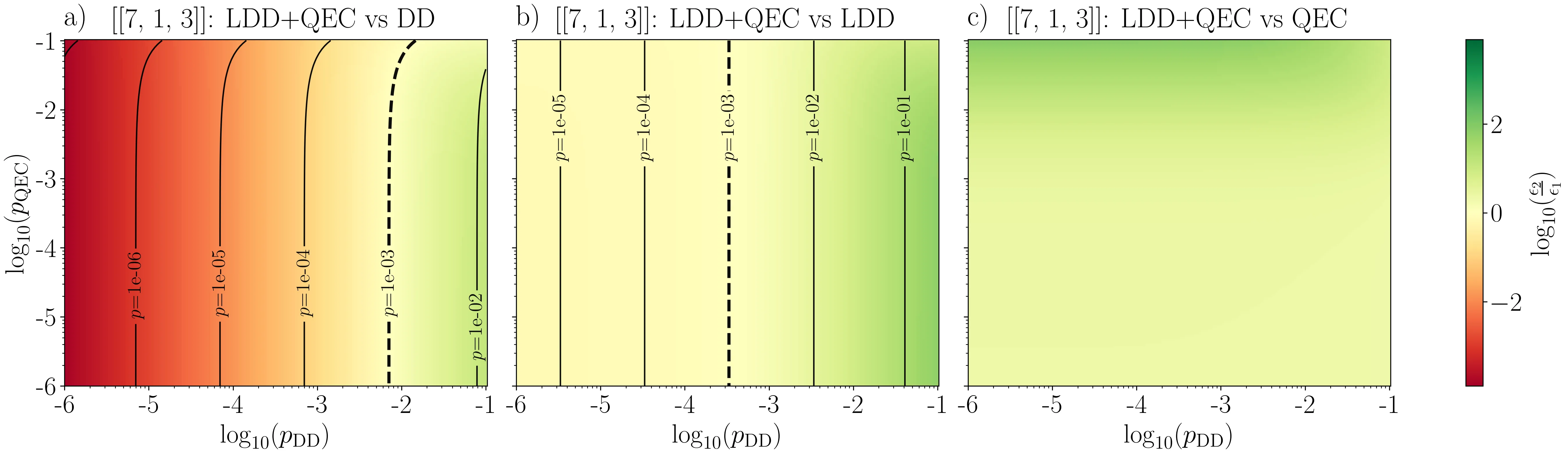
بالنسبة لكود شور [[7,1,3]] وكود [[13,1,3]]، حُددت عدديًا مناطق المعاملات التي يكون فيها الهجين أفضل. هذا يُظهر أن الكود ووحدة فك الترميز ومجموعة الفصل يجب أن تُصمم معًا، وليس بشكل منفصل.
الملخص الأصلي
كما كتبه المؤلفون، بالإنجليزية arXiv:2602.19042
Quantum error correction/detection (QEC/QED) and dynamical decoupling (DD) are tools for protecting quantum information. A natural goal is to combine them to outperform either approach alone. Such a benefit is not automatic: physical DD can conflict with encoded subspace, and QEC performance is governed by the errors that survive decoding, not just those DD suppresses. We analyze a hybrid memory cycle where DD is implemented logically (LDD) using normalizer elements of an $$[[n,k,d]]$$ stabilizer code, followed by a round of syndrome measurement and recovery (or, in the detection setting, postselection on a trivial syndrome). In an effective Pauli model with physical error probability $$p$$, LDD suppression factor $$p_{DD}$$, and recovery imperfection rate $$p_{QEC}$$ (or $$p_{QED}$$), we derive closed-form entanglement-fidelity expressions for QEC-only, QED-only, LDD-only, physical DD, and the hybrid LDD+QEC protocol. The formulas are expressed via a small set of code-dependent weight enumerator polynomials, making the role of the decoder and the LDD group explicit. For ideal recovery LDD+QEC outperforms QEC-only iff the conditional fraction of uncorrectable Pauli errors is larger in the LDD-suppressed sector than in the unsuppressed sector. In the low-noise regime, a sufficient design rule guaranteeing hybrid advantage is that LDD suppresses at least one minimum-weight uncorrectable Pauli error for the chosen recovery map. We show how stabilizer-equivalent choices of LDD generators can enforce this condition. We supplement our analysis with numerical results for the $$[[7,1,3]]$$ Steane code and a $$[[13,1,3]]$$ code, mapping regions of hybrid-protocol advantage in parameter space beyond the small-$$p$$ regime. Our work illustrates the need for co-design of the code, decoder, and logical decoupling group, and clarifies the conditions under which the hybrid LDD+QEC protocol is advantageous.
كود شور هو أحد أشهر الأكواد الكمومية التي تصحح خطأً واحدًا. يستخدم 7 كيوبتات لحماية كيوبت منطقي واحد.
في مسلسل «الفضاء»، تُحمى الحواسيب الكمومية من الضجيج باستخدام أكواد معقدة — وهذا بالضبط ما تبحث فيه هذه الدراسة.