مسحوق يخفق نفسه بنفسه سريع
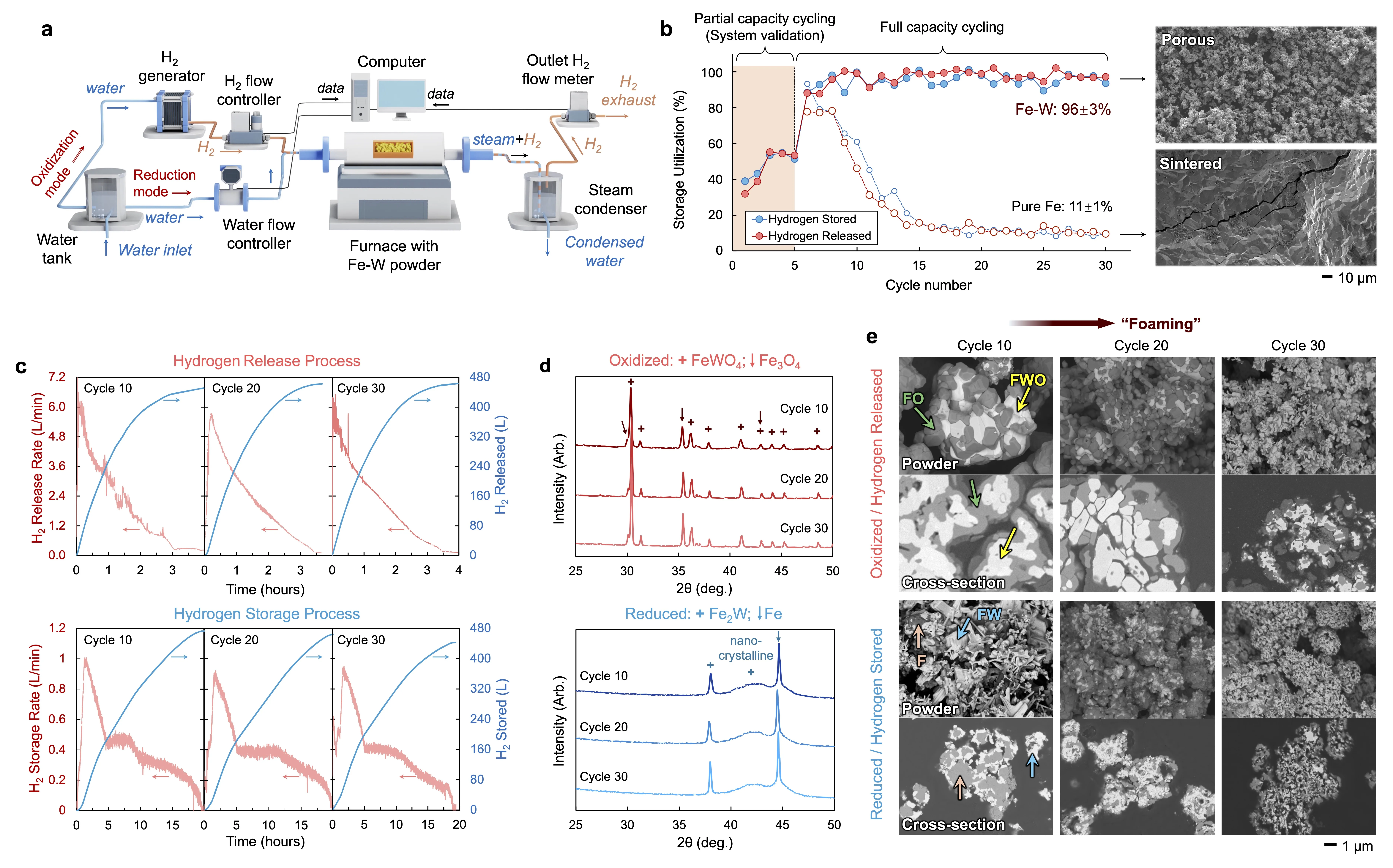
مسحوق الحديد المسخن إلى 650–800 درجة مئوية يمتص الهيدروجين كما تمتص الإسفنجة الجافة الماء. لكن بعد عدة دورات، تلتصق الجزيئات ببعضها في كتلة كثيفة، وتتوقف الإسفنجة عن العمل. إضافة التنغستن تغير الصورة: عند كل تسخين، يخفق المسحوق نفسه بنفسه، فيبقى فضفاضًا ومساميًا.
في مفاعل يحوي كيلوغرامًا من هذا المسحوق، تم تخزين 42 غرامًا من الهيدروجين واستخدام 96% من السعة على مدى 30 دورة. حتى بعد 90 دورة غير كاملة، لم يفقد المسحوق قدرته على امتصاص الغاز. التنغستن يتبخر عند التسخين وينتقل عبر المسام، مانعًا الجزيئات من الالتصاق.
هذه الطريقة في التخزين أكثر أمانًا من الأسطوانات المضغوطة وأقل تكلفة من الخزانات المبردة. مسحوق الحديد مع التنغستن هو "إسفنجة" مدمجة وموثوقة للهيدروجين، يمكن استخدامها في محطات التزود بالوقود أو في مخازن الطاقة.
الملخص الأصلي
كما كتبه المؤلفون، بالإنجليزية arXiv:2602.22807
H2-H2O redox cycling of iron powder beds at 650-800 {\deg}C offers a compact, safe, economical hydrogen storage method, but sintering-induced capacity loss has stalled its scalability for decades. Here, we show that adding redox-active tungsten to Fe powders solves this problem in static powder beds: Fe-25W (at%) alloyed powder self-foams during redox cycling via W gas-phase transport, increasing porosity and preserving capacity. In a custom automated reactor, a kilogram-scale powder bed reversibly stores 42g H2 and sustains 96+/-3% capacity utilization over 30 redox cycles. Temperature-resolved in-situ X-ray diffraction reveals a chemical-vapor-transport-mediated self-foaming mechanism that redistributes W to refine the microstructure, complemented by a contact-barrier stabilization mechanism during high-temperature holds. Partial-capacity cycling up to 90 cycles further confirms sintering resistance under incomplete redox conditions. These results establish Fe-W powder beds as a robust, scalable, and compact platform for safe, stationary hydrogen storage.
التنغستن من أكثر المعادن مقاومة للحرارة: ينصهر عند 3422°م، لكنه في هذه العملية يتبخر عند 650°م وينتقل عبر المسحوق مثل البخار عبر إبريق الشاي.