ثنائي كمومي من القصدير والليثيوم داخل بلورة سريع
داخل بلورة أكسيد الزنك يختبئ ثنائي كمومي: ذرة قصدير وذرة ليثيوم تجلسان جنبًا إلى جنب. رابطهما وثيق لدرجة أن الإلكترون المأسور بواسطة هذا الزوج يعيش كما لو كان على القصدير، بينما الليثيوم يكتفي بالمساندة. لطالما بحث العلماء عن هذا المعقد، لكن الآن فقط تمكنوا من إنشائه عمدًا والتعرف عليه من خلال التوهج المميز.
قوة هذا الارتباط قيست بدقة: 392 ميغاهرتز. للمقارنة، عند المانحين العاديين في السيليكون يكون الارتباط أضعف بعشرات المرات. هذا الزوج القوي يسمح بالتحكم السريع جدًا في اللف النووي — حرفيًا خلال أجزاء من مليار من الثانية. وهذا يعني إمكانية كتابة المعلومات الكمومية في النواة وقراءتها بالضوء.
يُظهر العمل أن ليس فقط الشوائب المنفردة، بل أيضًا أزواجها يمكن أن تكون لبنات بناء للأجهزة الكمومية. يفتح معقد القصدير-الليثيوم اتجاهًا جديدًا في تصميم العيوب الكمومية — مع لف نووي جاهز للحوار مع الفوتونات.
الملخص الأصلي
كما كتبه المؤلفون، بالإنجليزية arXiv:2603.05615
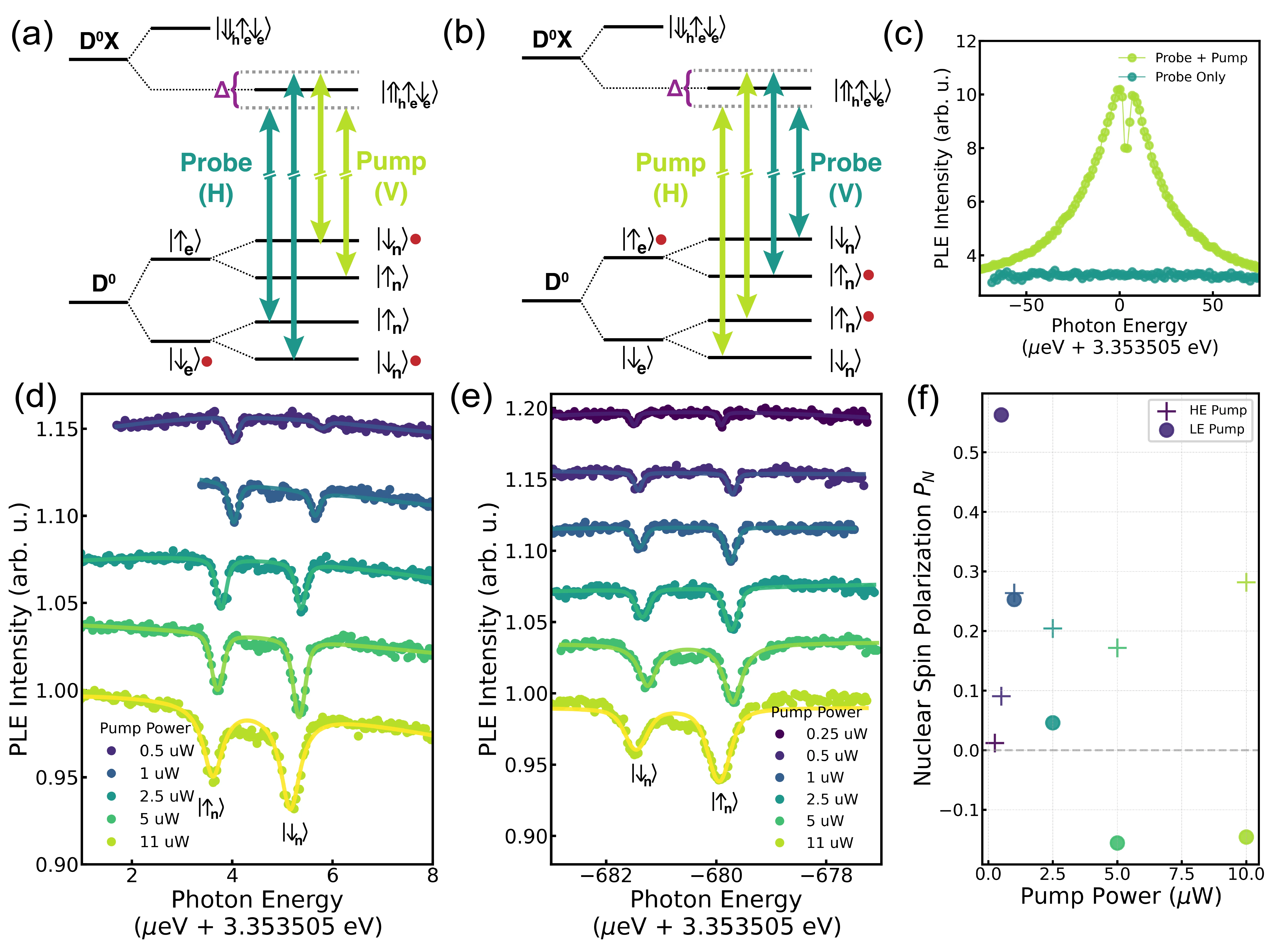
Donor impurities in wide direct band gap semiconductors provide a promising platform for spin--photon quantum technologies by combining a donor spin qubit with optically addressable transitions. In ZnO, the shallow donor with the largest reported binding energy has long been associated with the I$$_{10}$$ bound exciton line, but its microscopic origin has remained unresolved. Here we demonstrate the controlled formation and identification of this donor as a Sn--Li complex through a combination of ion implantation, annealing, optical spectroscopy, and first-principles calculations. Resonant two-laser coherent population trapping measurements reveal an electron--$$^{119}$$Sn hyperfine interaction of $$392 \pm 15$$\,MHz, establishing a coupled electron--spin--1/2, nuclear--spin--1/2 system with one of the largest hyperfine couplings reported for shallow donors in semiconductors. Density functional theory calculations show that a nearest-neighbor Sn$$_{\mathrm{Zn}}$$--Li$$_{\mathrm{Zn}}$$ complex has favorable formation energetics, donor character with the electron localized on Sn, and an extrapolated hyperfine interaction consistent with experiment. The large donor binding energy and excited-state structure indicate enhanced thermal robustness of the optical transition relative to conventional group--III donors, while the strong hyperfine interaction enables fast electron--nuclear spin control and prospects for direct nuclear--spin--photon interfaces. We further observe efficient optically induced nuclear spin polarization, highlighting a path toward nuclear spin initialization. More broadly, our results reveal how a donor--acceptor complex can access previously unexplored regimes of shallow donor physics, extending the design space of quantum defects beyond isolated substitutional dopants.
التفاعل فائق الدقة لهذا المعقد قوي جدًا لدرجة أن تردد الانتقال بين حالات اللف يمكن مقارنته بالترددات التي تعمل بها أفران الميكروويف.