نجم نابض خفي في عنقود كروي سريع
في كرة كثيفة من مئات الآلاف من النجوم، تُعرف بالعنقود الكروي، التقطت التلسكوبات الراديوية إيقاعًا ضعيفًا لكنه واضح جدًا. كل 2.45 ميلي ثانية — أي ما يعادل 408 نبضة في الثانية — يصل منها نبض راديوي. هكذا يعلن عن نفسه نجم نابض ميلي ثانية جديد النجم النابض — نجم ميت بحجم مدينة، يدور أسرع من شفرات المروحية.
هذا النجم النابض، الذي أُطلق عليه اسم PSR J1716-2808A، ليس وحيدًا. فهو يدور في ثنائي مع نجم مرافق خفيف تبلغ كتلته نحو عُشر كتلة الشمس. يستغرق الدوران الكامل حوله 10 ساعات فقط — أسرع من يوم عمل. وفي الوقت نفسه، لا يختفي النجم النابض خلف مرافقه، فإشارته لا تنقطع: لا تُلاحظ أي كسوف.
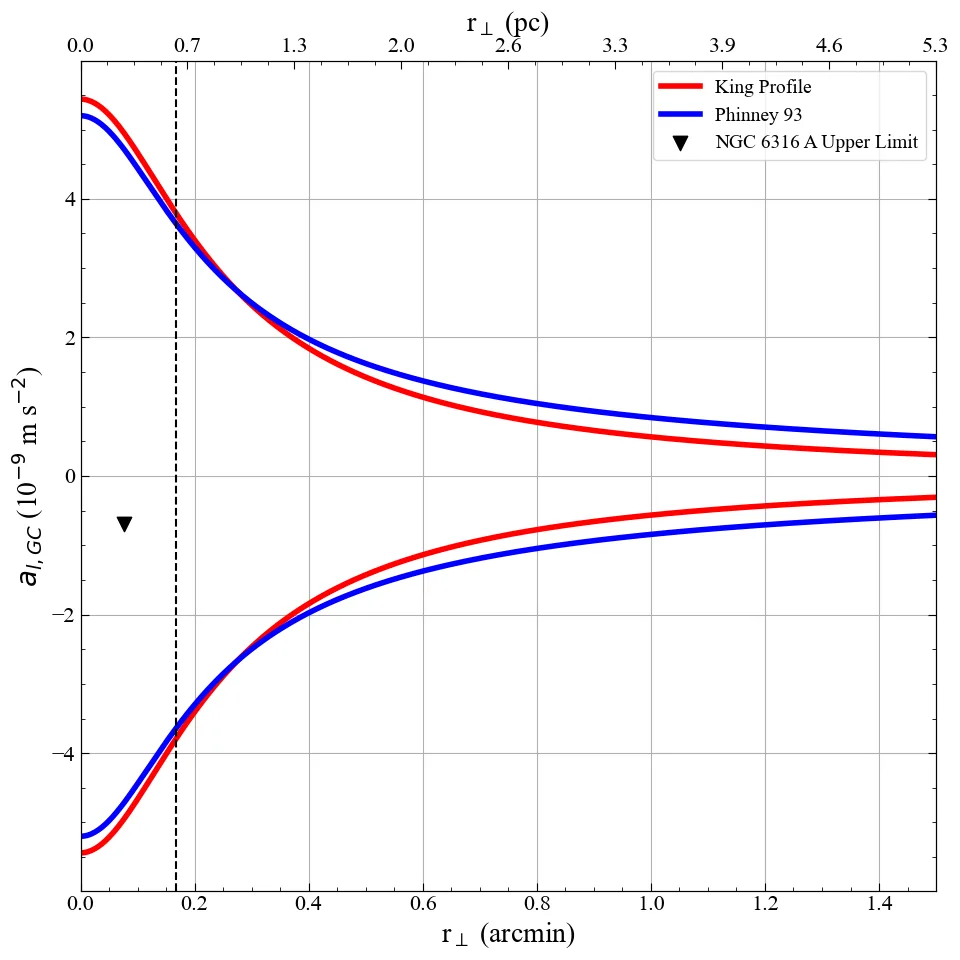
الأمر الأكثر إثارة للاهتمام هو أن النجم النابض "يستعجل" قليلًا. تصل نبضاته بمعدل أعلى قليلًا مما ينبغي لو كان ثابتًا. يحدث هذا عندما يتحرك النجم النابض نحونا: فحركته الذاتية تضغط الفترات بين الإشارات. حسب علماء الفلك أن تسارع النجم النابض يبلغ حوالي 2.3×10⁻¹⁸ في الثانية لكل ثانية. يبدو كصفر، لكن بالنسبة لساعة بهذه الدقة فهو ملحوظ.
هذا التسارع ليس مجرد أمر طريف. فهو يكشف أن النجم النابض يقع فعليًا في عمق العنقود، وليس مجرد مصادفة كونه على خط الرؤية معه. فالعنقود يجذبه إليه مثل نابض خفي. ومن قوة هذا النابض يمكننا تقدير كمية الكتلة المخبأة في العنقود.
الآن، سيراقب علماء الفلك هذا النجم النابض لسنوات. كلما طالت فترة المراقبة، زادت دقة قياس كتلة العنقود وفهم بنيته. وإذا حالفهم الحظ في العثور على المزيد من النجوم النابضة، فسيتوقف NGC 6316 عن كونه لغزًا ويصبح واحدًا من أكثر "المساكن النجمية" دراسة.
الملخص الأصلي
كما كتبه المؤلفون، بالإنجليزية arXiv:2603.06476
NGC 6316 is a poorly studied, distant, and massive globular cluster (GC) with prominent gamma-ray emission detected via the \textit{Fermi} Large Area Telescope (LAT). Based on gamma-ray spectral studies, NGC 6316 is expected to host tens of millisecond pulsars (MSPs). Using the Green Bank Telescope (GBT) and Murriyang, CSIRO's Parkes radio telescope (Parkes), we present the discovery and a 3.1 yr duration timing solution of the first millisecond pulsar found in the cluster. PSR J1716$$-$$2808A has a rotational period of 2.45\,ms and is in a binary with a $$\sim$$0.1 M$$_\odot$$ companion with an orbital period of 0.42 d. This is a typical cluster MSP within a compact orbit with no evidence of eclipses. PSR J1716$$-$$2808A has a dispersion measure DM = 172.26 pc cm$$^{-3}$$, which is lower than predicted NE2001, YMW16 and NE2025 electron density model values. The MSP is located within half a core radius from the cluster center and has a negative period derivative, implying that it is on the back side of the cluster and is being accelerated towards us. Given the negative period derivative, we report an upper limit on the maximum line-of-sight cluster acceleration, $$a_{l,\textrm{GC}}/c \approx -2.3\times10^{-18}$$ s$$^{-1}$$, experienced by the pulsar and constraints on the magnetic field to be $$<\sim$$3$$\times$$10$$^{8}$$ G. The presence of external acceleration strongly supports the pulsar to be within NGC 6316. We can better constrain NGC 6316's properties through longer-term timing of PSR~J1716$$-$$2808A or by finding more pulsars within the cluster. Based on the gamma-ray pulsar estimates and a cluster distance of 11.3 kpc, deeper, more sensitive searches would find many additional pulsars.
النجوم النابضة الميلي ثانية هي أدق الساعات في الكون. بعضها لا يخطئ أكثر من ثانية واحدة خلال مليار سنة.