جمّد لترى العالم الكمومي سريع
المواد الكمومية مثل الزهور المدللة: لا تتفتح إلا في البرد. في درجة حرارة الغرفة، تُخفي خصائصها غير العادية، وعند التبريد الشديد تصبح موصلات فائقة أو تغيّر سلوكها المغناطيسي. لفهم كيفية عملها، نحتاج إلى فحص ذراتها في نفس البرد الذي تعيش فيه هذه الخصائص.
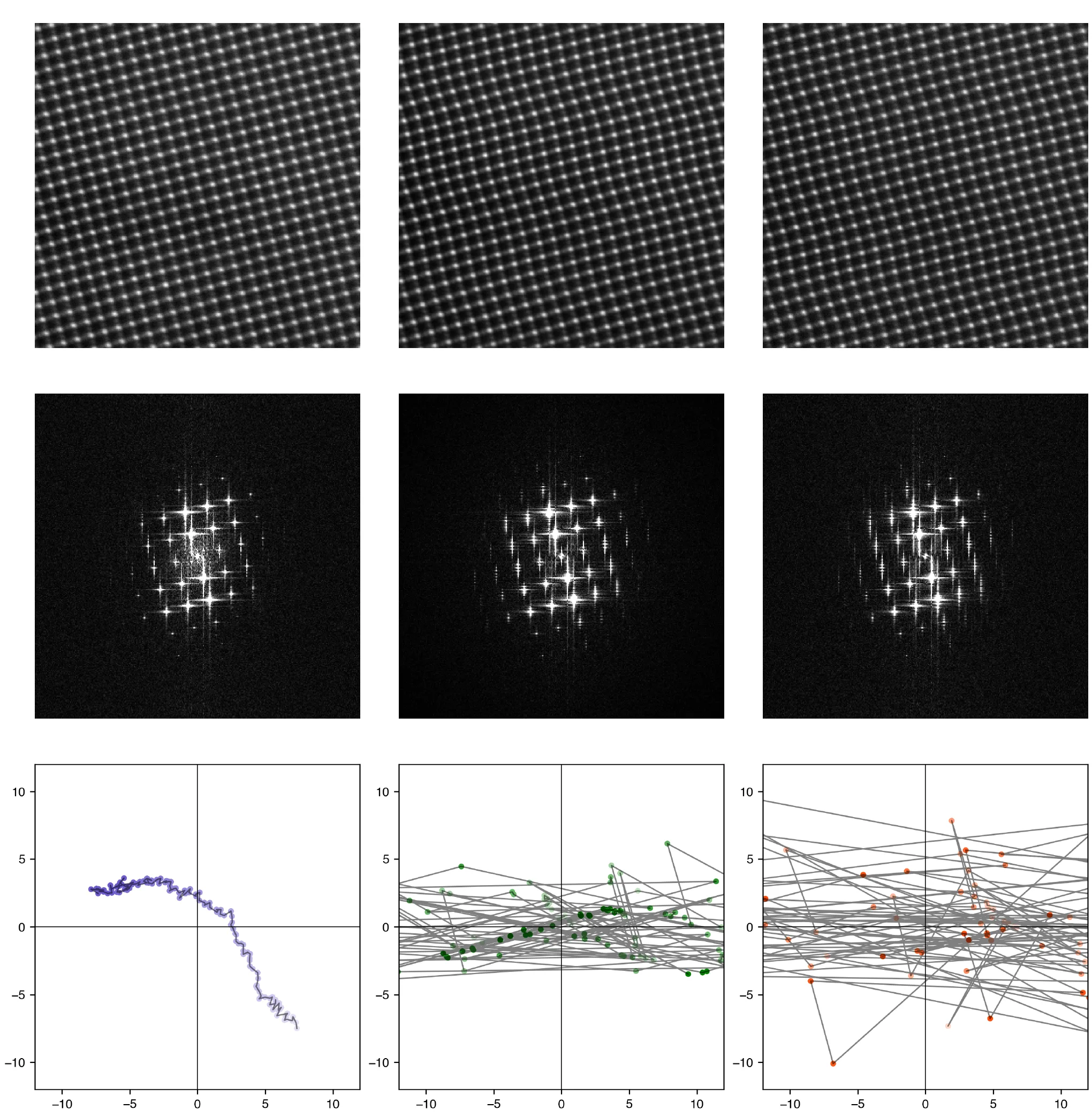
المجهر الإلكتروني العادي لا يصلح لهذا الغرض: الهيليوم السائل الذي يُستخدم لتبريد العينة يهتز ويرتجف. حتى أصغر الاهتزازات تشوّه الصورة، مثل يد مرتجفة تحمل كاميرا بتعريض طويل. تجاوز مؤلفو الدراسة هذه المشكلة: قاموا بمسح العينة بحركات سريعة ثم لصقوا الإطارات معًا، محاذين كل صورة وفقًا لمواقع الذرات.
بالإضافة إلى ذلك، لاحظوا أن عدسة المجهر نفسها تتشوه قليلاً في البرد، وصححوا هذه التشوهات رياضيًا. ونتيجة لذلك، حصلوا على صور واضحة للشبكة الذرية عند 253 درجة مئوية تحت الصفر. الآن يمكننا حرفيًا رؤية كيف تصطف الذرات في الحالة المطلوبة للتقنيات الكمومية.
هذا يفتح الطريق لفهم بنية المواد التي قد تشكل أساسًا للحواسيب الكمومية وأجهزة الاستشعار فائقة الحساسية في المستقبل.
الملخص الأصلي
كما كتبه المؤلفون، بالإنجليزية arXiv:2603.10892
Much of the exotic functionality of prime interest in quantum materials emerges from structural and electronic ground states that can only be accessed at cryogenic temperatures. Understanding device operation therefore requires structural characterization under the same low-temperature conditions at which these functional phases exist, as room-temperature measurements often probe a different structural state. Achieving atomic-resolution in scanning transmission electron microscopy imaging and particularly 4D-STEM electron ptychography at liquid helium temperature has remained extremely challenging because even small amounts of drift, vibration, and thermal instability associated with the cryogen can disrupt the stringent stability requirements of atomic-resolution STEM. In this work we demonstrate atomic-resolution STEM and multislice electron ptychography at temperatures as low as 20 K using a commercial helium cooled holder. We find that rapid scans and a multi-stage registration workflow are critical to reducing artifacts associated with cryogenic instability for atomic-resolution imaging, while for ptychography scan position correction including compensation for coupling between probe aberrations and position refinement is necessary for successful reconstructions. Together these results establish a pathway for reliable atomic-resolution STEM and ptychography at low temperature, enabling direct visualization of structural ground states relevant to quantum technology.
درجة حرارة 20 كلفن أبرد من سطح بلوتو، حيث يبلغ متوسط درجة الحرارة 223 درجة مئوية تحت الصفر.