بلورة طبقية تتعلم التقاط الضوء سريع
بلورة سيلينيد البزموت (Bi₂Se₃) في حد ذاتها متناظرة، مثل شطيرة مرتّبة بدقة: اقلبها فلن يتغير شيء. ولكن بمجرد إمالة طبقة قليلاً بالنسبة للأخرى، ينكسر التناظر. تبدأ المادة في «الإحساس» من أي جهة يسقط الضوء، وتستجيب بتيار كهربائي.
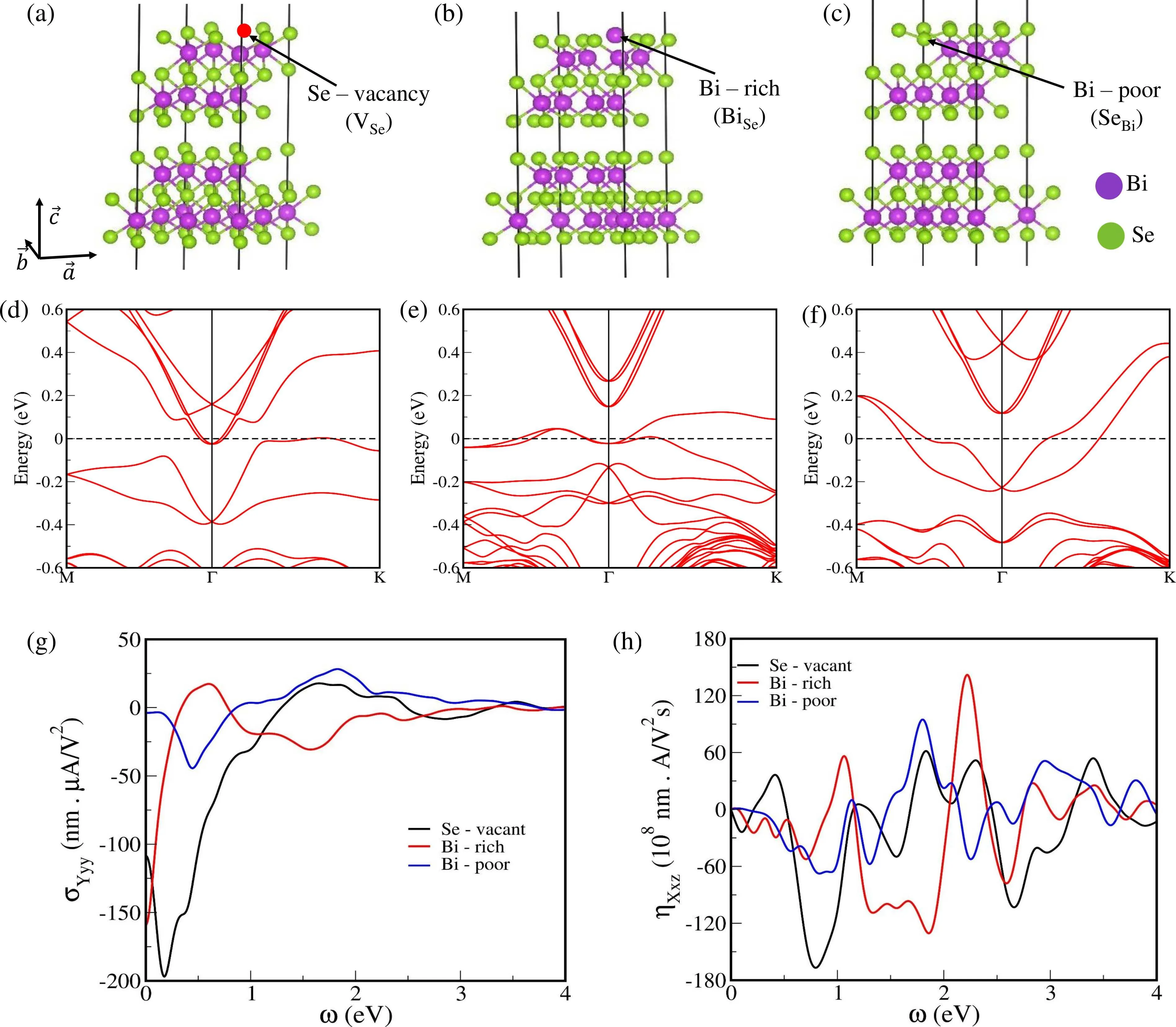
اختبر مؤلفو العمل ثلاث طرق لكسر التناظر: تدوير الطبقات بزاوية 21.78 درجة، إضافة عيب نقطي (إزالة ذرة سيلينيوم)، وتطبيق مجال كهربائي خارجي. في جميع الحالات، نشأ ما يسمى بالتيار الانزلاقي (shift current) — وهو تيار مستمر يتدفق طالما كان الضوء مضاءً. وتبين أن مقداره مماثل لأفضل المواد ثنائية الأبعاد، مثل GeS.
هذا التيار مثير للاهتمام بشكل خاص في نطاق التيراهرتز — بين الموجات الدقيقة والضوء تحت الأحمر. هناك عدد قليل من المصادر والكاشفات البسيطة، وهنا يمكن للمادة نفسها أن تعمل كهوائي يحول الضوء إلى تيار. في المستقبل، قد يؤدي هذا إلى خلايا شمسية جديدة وإلكترونيات ضوئية سريعة.
الملخص الأصلي
كما كتبه المؤلفون، بالإنجليزية arXiv:2603.24834
Paucity of naturally occurring noncentrosymmetric materials is stimulating growing interest in engineered two-dimensional systems for nonlinear optical applications. Here, we show that breaking inversion symmetry in centrosymmetric bilayer Bi$$_2$$Se$$_3$$ through twisting, point-defect insertion, or the application of an external electric field unlocks rich nonlinear optical responses. In twisted bilayer Bi$$_2$$Se$$_3$$ at the first commensurate angle of 21.78$$^\circ$$, we find peak shift and injection current conductivities of -14 $$ nm.\mu AV^{-2}$$ and 104 $$\times 10^8$$ $$nm.A V^{-2}s^{-1}$$, respectively, which lie in the visible spectrum and enable efficient THz applications. The external electric field and point-defect insertion both transform the bilayer into C$$_ {3v}$$ symmetry, with the selenium vacancy (V$$_{Se}$$) achieving peak shift and injection current conductivities of -190 nm.$$\mu AV^{-2}$$ and -170 $$\times 10^8$$ $$nm.A V^{-2}s^{-1}$$. In all three cases, the peak nonlinear optical responses are found to be comparable to those of benchmark 2D materials such as GeS, and the broadband responses, including helicity-dependent current generation, make these engineered bilayers viable candidates for next-generation 2D photovoltaics.
الزاوية 21.78 درجة ليست عشوائية: عندها تتراكب الطبقتان لأول مرة في شبكة فائقة دورية، مثل سياجين بخطوات مختلفة لا يتطابقان إلا بعد عدة امتدادات.