هالة المجرة: كيف تزن ما لا يُرى سريع
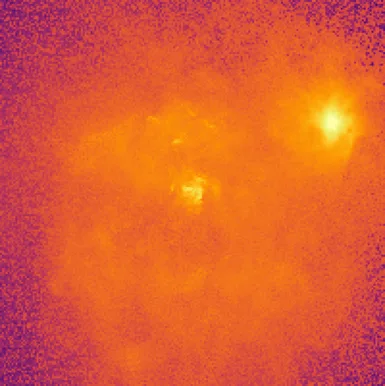
حول كل مجرة يوجد غلاف غير مرئي من الغاز الساخن، مثل البخار فوق قدرٍ من الماء المغلي. هذا الغاز بالكاد يُصدر ضوءًا في نطاق الأشعة السينية، لذا من الصعب جدًا قياسه. لكنه يحمل في طياته ذاكرة انفجارات النجوم وكيفية نمو المجرة.
تستخدم الطريقة الجديدة الضوء الصادر من المركز الساطع للمجرة. عندما تمر الأشعة السينية عبر الطبقات الخارجية للغاز، يتشتت جزء منها على ذرات الأكسجين، تمامًا كما يتشتت شعاع مصباح يدوي في الضباب. بمقارنة سطوع المركز مع الضوء المنعكس عن الضباب، يمكن حساب كمية الأكسجين في الغلاف، ومن ثم معرفة كمية الغاز الكلية.
اختُبرت الطريقة على نموذج حاسوبي للمجرات يُدعى TNG50. اتضح أنها تعطي خطأً يبلغ 10% فقط لمعظم المجرات، وكأنك تزن كيس بطاطس وتخطئ بحبة واحدة فقط. حتى عندما تكون المجرات غير متماثلة أو يتحرك الغاز داخلها، تظل الطريقة تعمل، باستثناء الحالات الأكثر غرابة.
هكذا يصبح غير المرئي قابلاً للقياس: الضوء المنعكس عن الغاز يخبرنا بما هو مخفي عن الأعين.
الملخص الأصلي
كما كتبه المؤلفون، بالإنجليزية arXiv:2603.25600
The circumgalactic medium (CGM) regulates galaxy growth and retains the imprint of feedback from supernovae and supermassive black holes. However, the bulk of the hot CGM produces little X-ray emission and is challenging to study with X-ray telescopes. We propose a novel method for evaluating the CGM mass using resonant scattering of the helium-like oxygen (\ovii) resonant line at $$E=574$$ eV. In a spherically symmetric and static CGM halo with a sharp central X-ray peak, the number of \ovii\ ions within an outer radial shell can be calculated from the ratio of the two directly observable quantities: the \ovii\ flux from the bright inner region and the scattered \ovii\ flux from the shell (where the scattered flux can be much higher than the intrinsic emission). To evaluate the accuracy of this geometric estimate for realistic galaxies -- with satellites, asymmetries, and gas velocities -- we use a sample of galaxies from the TNG50 cosmological simulation. We find that, when the most irregular systems are excluded based on their X-ray observables, we accurately predict the \ovii\ mass in the outer halo (e.g., in an $$r=R_{\rm 500c}-R_{\rm 200c}$$ shell) from the ratio of the fluxes in the corresponding annulus and the central peak region ($$r<0.2R_{\rm 500c}$$), with only a 10\% bias and an rms scatter of $$\sim 0.2$$ dex. As \ovii\ mass strongly correlates with the total oxygen and gas mass, this direct \ovii-counting method enables indirect estimates of those quantities by future X-ray microcalorimeter missions, such as {\em NewAthena}\/ and {\em HUBS}.
قد يحتوي الغلاف الخارجي للمجرة على كمية من المادة العادية أكبر من تلك الموجودة في المجرة نفسها، مثل مخزن خفي لا نعرف عنه إلا من خلال الضوء المنعكس.