صفارات الإنذار الكونية: كيف تكشف ومضات غاما عن اندماج النجوم سريع
يصطدم نجمان نيوترونيان، فيرتجف الفضاء من حولهما مثل سطح بركة تضربها حصاة. تلتقط هذه الاهتزازات كواشف ضخمة للموجات الثقالية. وإذا أطلق الاصطدام شعاعاً ضيقاً من أشعة غاما، تراه التلسكوبات الفضائية على أنه وميض غاما قصير.
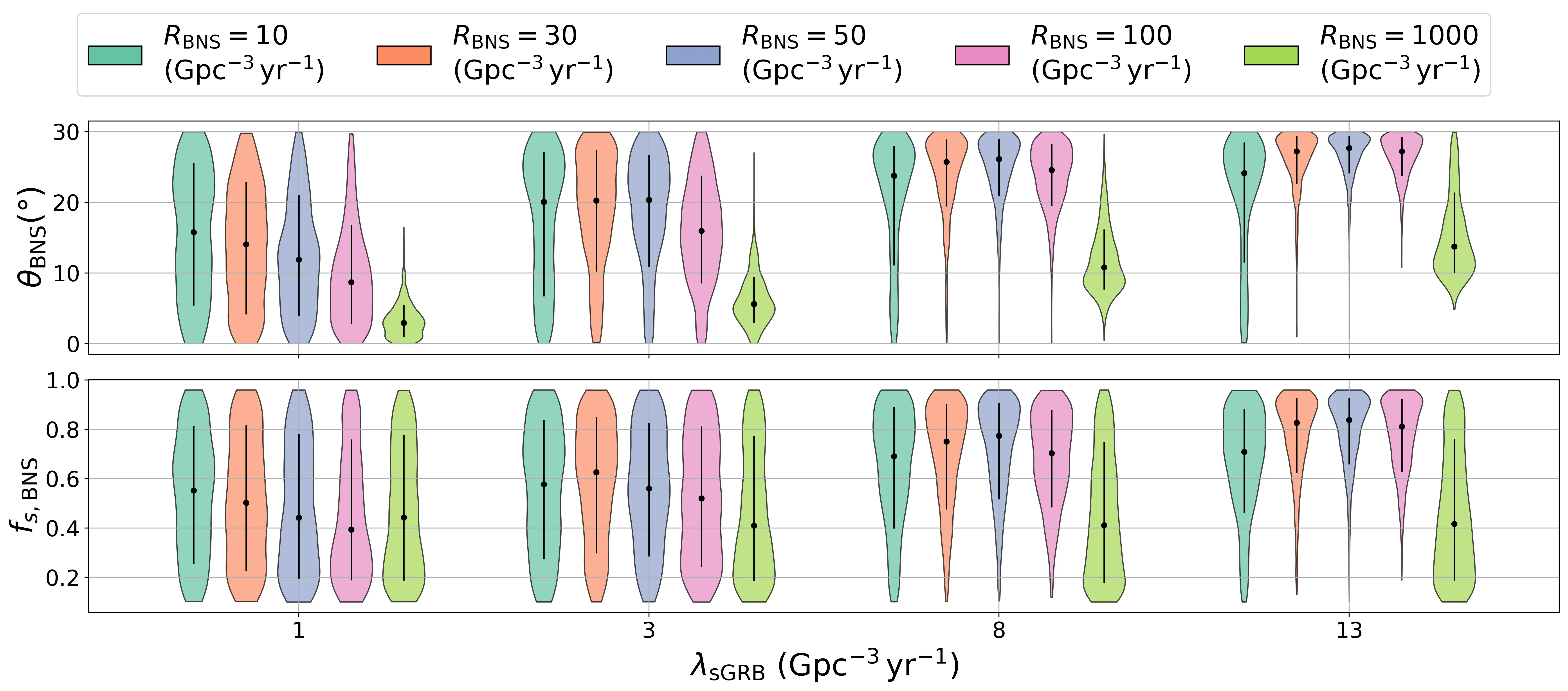
كلا الإشارتين ترويان الحدث نفسه، لكنهما لا تتطابقان دائماً في العدد. أظهرت البيانات الحديثة من كواشف LIGO وVirgo وKAGRA عدد اندماجات نيوترونية أقل مما كان متوقعاً بناءً على عدد ومضات غاما. فحص الفيزيائيون الفلكيون ما إذا كان يمكن تفسير الفرق إذا كانت نفاثات البلازما عند الاندماج لا تنطلق في كل الاتجاهات، بل بزاوية معينة فقط.
اتضح أنه إذا كان أكثر من نصف اندماجات النجوم النيوترونية يطلق نفاثة بزاوية فتح لا تقل عن 10 درجات، فإن عدد ومضات غاما والإشارات الثقالية يتقارب. أما بالنسبة للنفاثات الضيقة بزاوية 6 درجات، فسيلزم أن يكون عدد ومضات غاما أقل مما تظهره بعض التقديرات.
اندماجات النجوم النيوترونية مع الثقوب السوداء تساهم أيضاً، لكن بنسبة صغيرة تتراوح بين 6% و16% من جميع ومضات غاما القصيرة. وهي لا تفسر أعلى التقديرات لتكرار الومضات، لكنها لا تتعارض مع الصورة العامة.
إذن، البيانات الحالية لا تتعارض مع بعضها. تبقى اندماجات نجمين نيوترونيين المصدر الرئيسي لمضات غاما القصيرة، ونفاثاتها غالباً ما تكون واسعة أكثر منها ضيقة.
الملخص الأصلي
كما كتبه المؤلفون، بالإنجليزية arXiv:2604.05046
Gravitational wave (GW) and short Gamma Ray Burst (sGRB) observations provide us with complementary views of compact object mergers. The paucity of binary neutron star merger (BNS) detections in the latest LIGO/Virgo/KAGRA (LVK) observing run raises the question of whether the GW merger rates are sufficient to explain the observed sGRB rate with compact object mergers alone. We investigate this connection using the latest merger rate constraints from the fourth LVK observing run (O4) and published estimates of the local sGRB rate density. For an observed sGRB rate density of $$ \sim 1-7~\mathrm{Gpc^{-3}\,yr^{-1}}$$, if $$>55\%$$ of BNS mergers can successfully launch a jet, we find that the current LVK BNS merger rate can be reconciled with a sGRB merger population containing a significant fraction of relatively wide jets with core half-opening angles $$\theta_j \geq 10^\circ$$. Meanwhile, a narrow jet population ($$\theta_j \sim 6^\circ$$) can only be matched with the O4 neutron star merger rate estimates for an observed sGRB rate density of $$\lesssim 1~\mathrm{Gpc^{-3}\,yr^{-1}}$$, which is broadly consistent with several of the latest available estimates. We also find that neutron star-black hole mergers (NSBH) are expected to be a subdominant component of the sGRB population compared to BNS mergers, and they cannot help reconcile some of the highest available sGRB rate ($$ >7~\mathrm{Gpc^{-3}\,yr^{-1}}$$) with the GW rate estimates. However, they can still substantially contribute to the sGRB population, comprising $$\sim 6-16\%$$ of it for an observed sGRB rate density of $$\sim 1-3~\mathrm{Gpc^{-3}\,yr^{-1}}$$. Overall, our results indicate that present GW and sGRB observations remain broadly consistent with BNS mergers as the main progenitors of sGRBs.
يستمر وميض غاما القصير أقل من ثانيتين، لكنه يطلق في هذه المدة طاقة تعادل ما ستبعثه الشمس طوال حياتها.
في فيلم «Interstellar»، يسبب اندماج ثقبين أسودين موجات ثقالية يستخدمها الأبطال للتواصل — مبدأ مشابه يكمن وراء رصد اندماجات النجوم النيوترونية.