الماء في المسام النانوية: طبقات أم دفعة واحدة؟ سريع
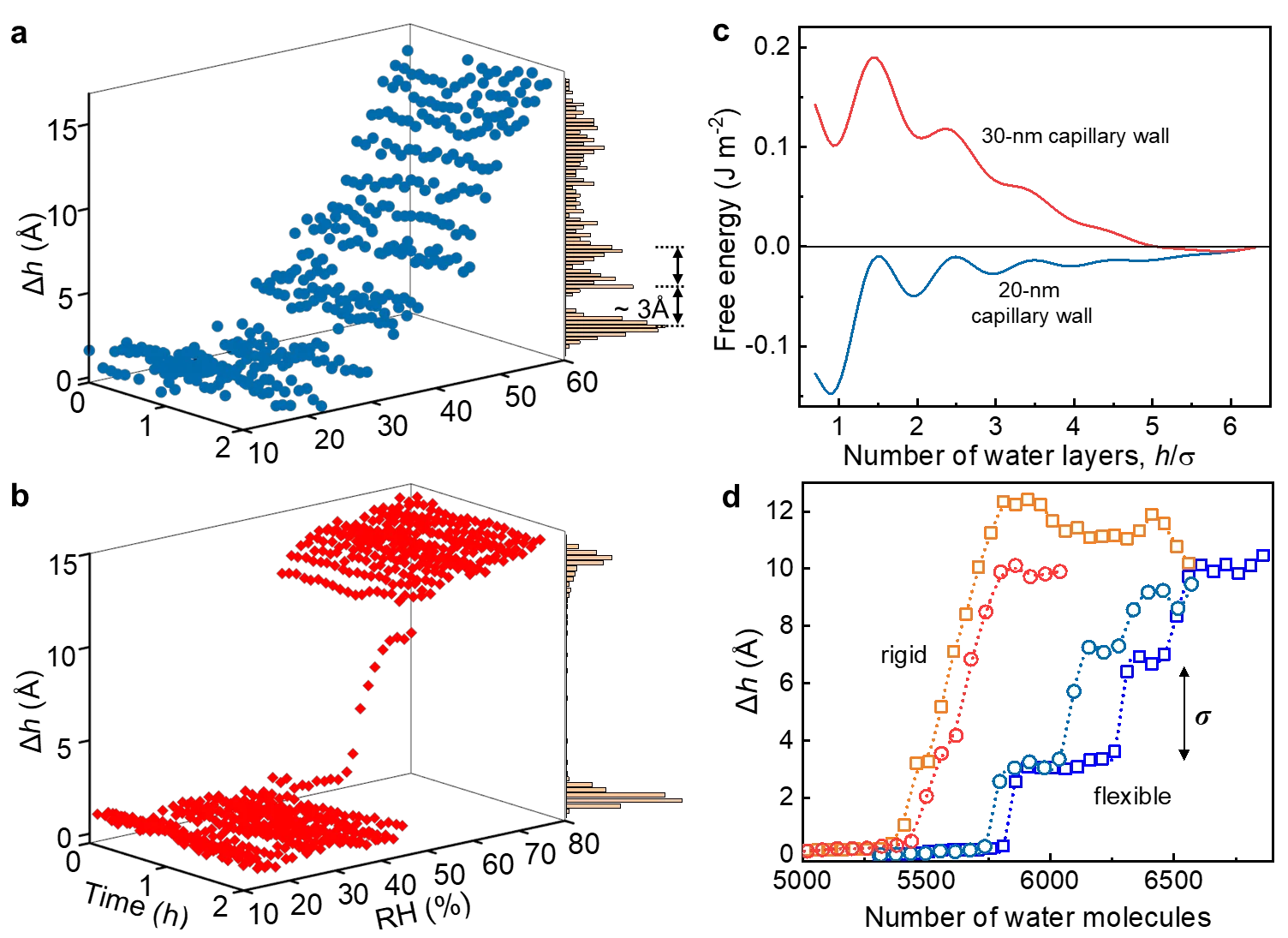
في شق ضيق بين لوحين، يتجمع الماء من الهواء الرطب تلقائيًا — وهذا هو التكاثف الشعري (capillary condensation). إذا كان عرض الشق بضعة نانومترات فقط، فإن الماء لم يعد يتصرف كسائل متصل: كل جزيء له أهميته. ولكن كيف يمتلئ هذا الشق بالضبط — طبقات أم دفعة واحدة؟ — ظل غير واضح حتى الآن.
صنع الباحثون شعيرات دموية من طبقات مادة بسماكة ذرة واحدة، وباستخدام مجهر القوة الذرية (atomic force microscope) تابعوا كيف تنحني الجدران عند دخول الماء. الجدران المرنة أدخلت الماء تدريجيًا: كل طبقة جديدة من الجزيئات أضافت حوالي 0.3 نانومتر إلى سمك غشاء الماء. أما الجدران الصلبة، على العكس، فامتلأت فجأة، دفعة واحدة.
يُفسَّر الاختلاف بصراع قوتين: الطاقة اللازمة لثني الجدار، وتفاعل الماء مع الجدار الذي يتغير حسب المسافة. عندما ينحني الجدار بسهولة، يكون من الأفضل له إدخال الماء طبقة واحدة في كل مرة، متبعًا التضاريس المتموجة للتفاعل. أما الجدار الصلب فلا يمكنه الانحناء، لذلك يندفع الماء دفعة واحدة بمجرد أن يتجاوز الربح من الامتلاء المقاومة.
يكشف هذا الاكتشاف أن الطبيعة الجزيئية للماء قادرة على تغيير الظواهر الشعرية المألوفة جذريًا — من ترطيب التربة إلى عمل الأجهزة الدقيقة (microfluidic devices). والاختيار بين الامتلاء السلس والمتدرج يعتمد فقط على مرونة الجدران.
الملخص الأصلي
كما كتبه المؤلفون، بالإنجليزية arXiv:2604.07946
Under ambient humidity, water spontaneously condenses in pores only a few nanometers in size, making nanoscale capillarity central to numerous natural phenomena and technological applications. At these dimensions, water may no longer be treated as a continuous fluid, yet the consequences of molecular discreteness for capillary condensation and filling remain poorly understood. Here we study nanocapillaries fabricated by van der Waals assembly and, using atomic force microscopy, monitor their wall deformations during humidity-driven water uptake. We observe two distinct regimes: layer-by-layer filling of flexible capillaries and abrupt filling of rigid ones. Flexible walls deform in steps of ~3 {\AA}, corresponding to the sequential entry of individual water molecular layers. The different filling regimes are explained by the competition between deformation energy and oscillatory wall-water interactions. Our findings show that the molecular discreteness of water can profoundly affect ubiquitous capillary phenomena, with wall compliance selecting between discrete and abrupt filling.
سماكة طبقة واحدة من جزيئات الماء حوالي 0.3 نانومتر. وهذا أنحف بعشرة آلاف مرة من شعرة الإنسان.