الحرير والكبريت يشحنان الهاتف سريع
احتكاك المشط بالصوف يولّد شرارة. مبدأ مشابه يعمل في المولدات النانوية الاحتكاكية (triboelectric nanogenerators) — وهي أجهزة تحوّل اللمسات الميكانيكية إلى كهرباء. المشكلة أن المواد العادية تعطي شحنة ضعيفة.
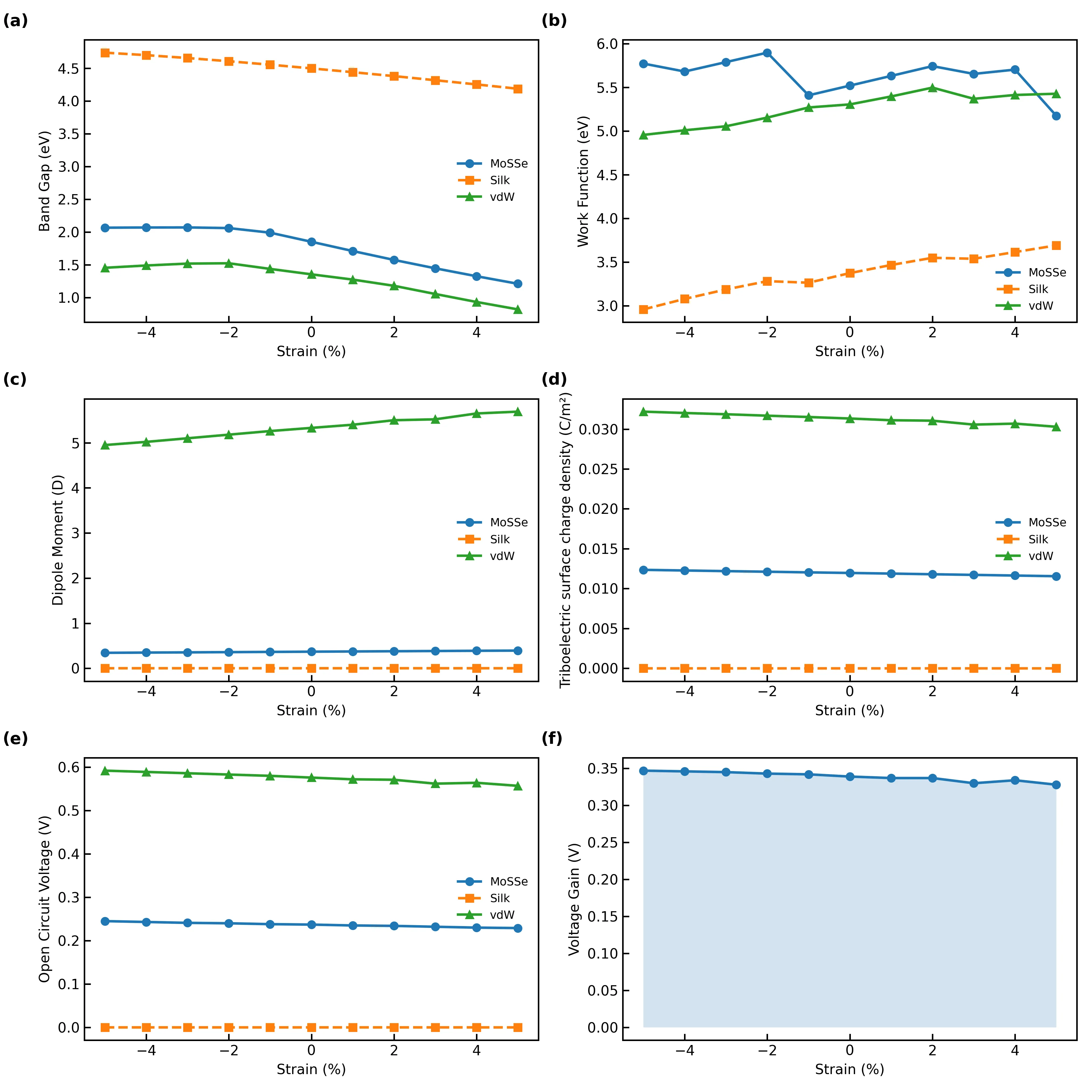
درست مجموعة من الباحثين المادة الطبقية Janus MoSSe — حيث يُغطى سطحها من جهة بالكبريت ومن الجهة الأخرى بالسيلينيوم، مثل شطيرة بحشوتين مختلفتين. أُضيف إليها الحرير، وهو بروتين من شرانق دودة القز التوتية. أظهرت الحسابات أن تمدد هذا المركّب يضيّق فجوة النطاق الممنوع للإلكترونات أكثر من كل مادة على حدة. وهذا يعني أن الإلكترونات تنتقل بسهولة أكبر بين الطبقات.
ونتيجة لذلك، يزداد جهد الخرج عند جميع مستويات التشوه. يمكن أن يصبح الغشاء الرقيق المصنوع من الحرير وMoSSe أساسًا لأجهزة استشعار قابلة للارتداء أو لشحن الأجهزة من حركة الجسم.
الملخص الأصلي
كما كتبه المؤلفون، بالإنجليزية arXiv:2604.10581
Understanding and engineering interfacial electrostatics in hybrid two-dimensional (2D) and biomolecular material systems is essential for advancing high-performance triboelectric nanogenerators (TENGs). In this work, we systematically investigate the strain-dependent electronic structure and triboelectric response of Janus MoSSe, silk fibroin, and their van der Waals (vdW) heterostructure using first-principles calculations. Tensile strain induces a pronounced band-gap reduction in the MoSSe/silk interface, exceeding that of the isolated constituents and indicating enhanced interlayer electronic coupling. The vdW heterostructure exhibits a significant work-function shift and a substantially larger dipole moment compared to MoSSe and silk alone, revealing strong interfacial charge redistribution driven by Fermi-level alignment and asymmetric polarization. This enhanced polarization directly amplifies the triboelectric surface charge density, producing values more than double those of pristine MoSSe and several orders of magnitude higher than silk. Consequently, the open-circuit voltage and overall triboelectric output are markedly improved across all strain levels. These results demonstrate that synergistic interfacial polarization and strain engineering can effectively elevate charge separation, storage, and transfer efficiencies, establishing the MoSSe/silk vdW heterostructure as a promising material for next-generation high-efficiency TENGs.
الحرير مادة كهرضغطية طبيعية: عند ضغطه أو تمدده يولّد جهدًا صغيرًا بنفسه، لذلك يُضاف إلى الملابس الذكية.