موصلية فائقة في بلورة تغيّر نوعها سريع
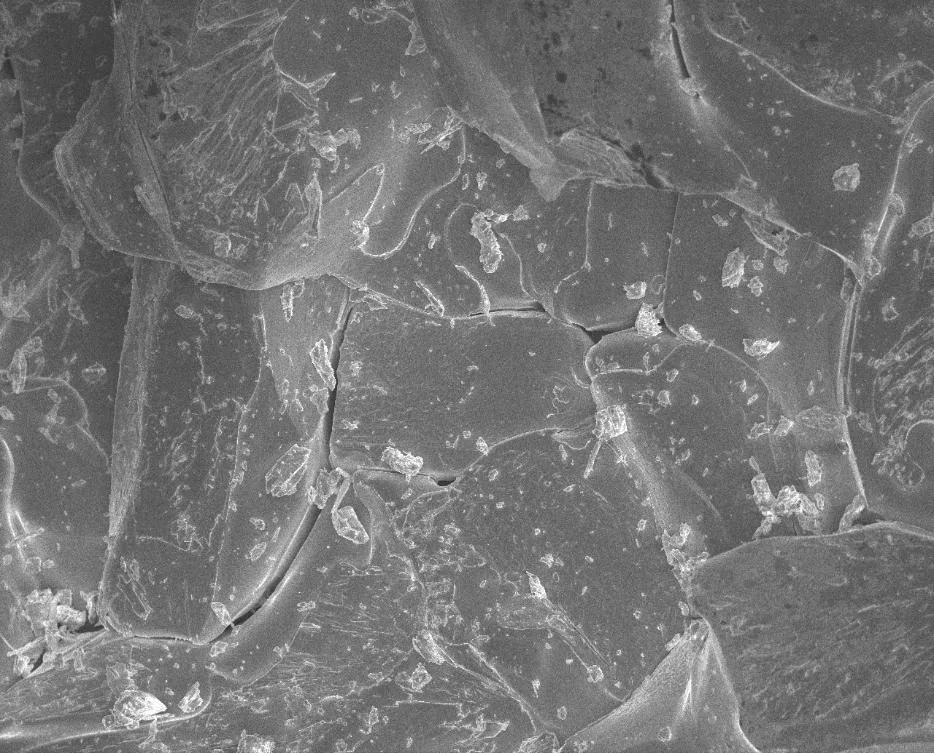
الموصل الفائق هو مادة تفقد مقاومتها الكهربائية عند التبريد الشديد: يمر التيار فيها دون فقدان. أخذ العلماء بلورة طبقية من PdTe2، تشبه كومة من أوراق، وبرّدوها إلى درجة حرارة أقل من 1.8 كلفن (أي حوالي -271°م). في هذه الظروف يصبح PdTe2 موصلًا فائقًا.
كان يُعتقد سابقًا أن PdTe2 موصل فائق من النوع الأول: المجال المغناطيسي يُطرد منه تمامًا، مثل الماء من الإسفنج عند عصره. لكن في تجارب جديدة على بلورات فسيفسائية (مكوّنة من قطع متعددة ملتفّة قليلًا) تبيّن أمر مختلف. المجال المغناطيسي يخترق المادة على شكل خيوط رفيعة — دوامات. هذه علامة على موصل فائق من النوع الثاني. الانتقال من النوع الأول إلى الثاني يُعزى غالبًا إلى الاضطراب في البلورة — عيوب صغيرة وحدود بين القطع.
قياسات عمق اختراق المجال المغناطيسي أظهرت أن فجوة الموصلية الفائقة (الطاقة اللازمة لكسر زوج من الإلكترونات) متساوية في جميع الاتجاهات. هذا ما يُسمى بالتناظر الموجي s — مثل كرة دائرية مثالية، دون نتوءات. هذا النوع من الموصلية الفائقة شائع في المعادن البسيطة، لكنه هنا يتعايش مع طوبولوجيا غير اعتيادية للحالات الإلكترونية في PdTe2.
هذا الاكتشاف يجعل PdTe2 منصة مناسبة لدراسة كيفية تفاعل الموصلية الفائقة والطوبولوجيا والتأثيرات السطحية في مادة واحدة. ربما، بتغيير الاضطراب، يمكن إنشاء مواد ذات موصلية فائقة قابلة للتبديل لأجهزة كمومية مستقبلية.
الملخص الأصلي
كما كتبه المؤلفون، بالإنجليزية arXiv:2604.11047
We report on the microscopic superconducting properties of the Dirac semimetal PdTe2. In this study, we have focused on mosaic crystals of PdTe2, and used detailed zero field and transverse field muon spin relaxation/rotation ($$\mu$$SR), ac-magnetic susceptibility, and resistivity measurements to investigate their superconducting properties. The magnetic susceptibility measurements reveal two superconducting transition temperatures at 1.8 and 1.6~K, respectively, in agreement with earlier reports. In contrary to these reports, we find that these mosaic PdTe2 crystals, are not type-I, but rather type-II superconductors. In fact, we observe the clear manifestation of a flux line lattice through a clear diamagnetic shift and Gaussian broadening of the Fourier spectra in the superconducting state. This behavior is likely caused by the disorder in the mosaic crystals of PdTe2 studied here. Our analysis of the superconducting order parameter by the means of temperature dependent magnetic penetration depth $$\lambda(T)$$ reveals a fully gapped superconducting state that can be well-fitted using an s-wave symmetric gap. We find that PdTe2 is a promising model system for the investigation and interplay of non-trivial topology, surface superconductivity, and type-II bulk superconductivity in a van-der-Waals material. Moreover, our results indicate that the superconductivity in this material can be easily modified from type-I to type-II by disorder in the system.
PdTe2 موصل فائق، لكن درجة حرارته الحرجة 1.8 كلفن فقط. هذا أبرد من درجة حرارة الإشعاع الخلفي للكون (2.7 كلفن)، الذي تبقى من الانفجار العظيم.