القاضي الكمومي: حكم بلا أدلة سريع
يدخل القاضي قاعة المحكمة دون أن ينظر إلى الأدلة — ويصدر الحكم فوراً. هكذا يعمل المستشعر الكمومي الجديد: فهو لا يقيس الإشارة بل يقرر مباشرة إلى أي صنف تنتمي.
في الاستشعار الكمومي التقليدي، الأمر يشبه التحقيقات: أولاً تجمع الأدلة (تقيس الإشارة)، ثم تحللها. لكن العلماء اقترحوا مساراً مختلفاً — دمج القياس الكمومي والحوسبة الكمومية في دائرة واحدة. الدائرة المكونة من كيوبت فائق التوصيل (بت كمومي) ومذبذب (رنان) تُضبط بحيث بعد قياس واحد للكيوبت تصدر الإجابة فوراً: «نعم» أو «لا».
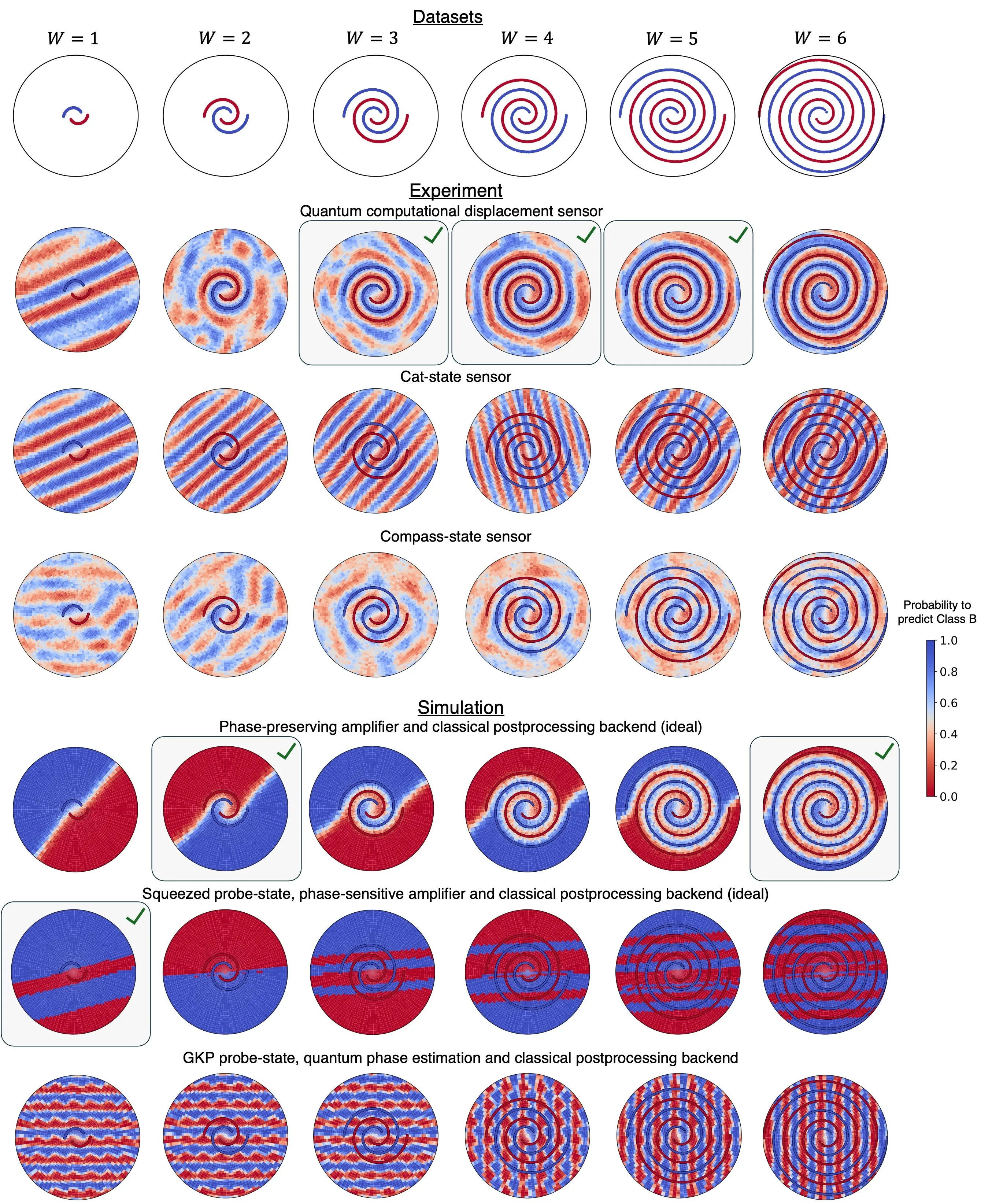
أظهرت التجربة: كلما زادت الطبقات في الدائرة، زادت دقة التصنيف. في مهام معينة، تفوق النهج الكمومي على البديل التقليدي بـ 15 نقطة مئوية. الأمر كما لو أن قاضياً، متجاوزاً دراسة الأدلة، يخمن المذنب بدقة أكبر من المحقق بعد تحليل طويل.
القاضي الكمومي لا يزال يعمل على مهام بسيطة بمعدات مشوشة، لكن من الواضح بالفعل: أحياناً لا تحتاج إلى معرفة كل شيء لاتخاذ القرار الصحيح.
الملخص الأصلي
كما كتبه المؤلفون، بالإنجليزية arXiv:2604.13177
Quantum computational sensing (QCS) combines quantum sensing with quantum computing to extract task-relevant information from the physical world. QCS can in principle achieve an accuracy advantage for specific tasks versus the alternative of raw-signal estimation using conventional quantum sensing followed by task-specific classical postprocessing. Here we report the experimental demonstration of quantum computational displacement sensing (QCDS) with a superconducting circuit comprising a qubit coupled to an oscillator. We consider binary classification sensing tasks, where the goal is to predict the class label of a single complex-valued displacement sensed once by the oscillator. Rather than estimating the displacement, our computational-sensing protocol -- using parameterized quantum circuits before and after sensing -- attempts to determine the binary class label using quantum processing and map it onto the ground or excited state of the qubit. A single measurement of the qubit directly outputs the prediction. We implemented circuits with up to 24 entangling gates and 38 free parameters, which were trained in silico. We show that increasing the circuit depth systematically improves expressivity and classification accuracy. We experimentally obtained an accuracy advantage over a suite of protocols that first use conventional quantum sensing to estimate the displacement before using classical postprocessing to perform prediction. For certain tasks, our protocol achieves a 15-percentage-points higher classification accuracy than the best conventional approach considered. Our results establish the feasibility of quantum computational sensing with noisy superconducting hardware and illustrate how integrating quantum computation with quantum sensing can enhance performance when the goal is to estimate a property or function of a signal rather than to estimate the signal.
تم تدريب الدائرة على الكمبيوتر (in silico)، ثم نُقلت إلى جهاز فائق التوصيل حقيقي — مثل طيار يتدرب على المناورات في جهاز محاكاة قبل الرحلة.
في مسلسل «الفضاء»، يستخدم المحقق ميلر حدسه للعثور على فتاة مفقودة دون أدلة مباشرة — يشبه ذلك كيف يصدر المستشعر الكمومي حكماً دون قياس كامل للإشارة.