كيف نُخمد سخونة الجسيمات النانوية؟ سريع
حبيبة ذهبية بحجم مئة ذرة تقع تحت شعاع ضوء فترتفع حرارتها. في الحياة العادية لا يشكل هذا الأمر خطراً، لكن في عالم تقنية النانو يمكن لهذا التسخين الضئيل أن يفسد مستشعراً حيوياً أو يحرق شريحة إلكترونية. لا يمكن وضع مروحة هنا: ففي هذه المقاييس الصغيرة، تحتبس الحرارة كما تحتبس في سترة شتوية سميكة.
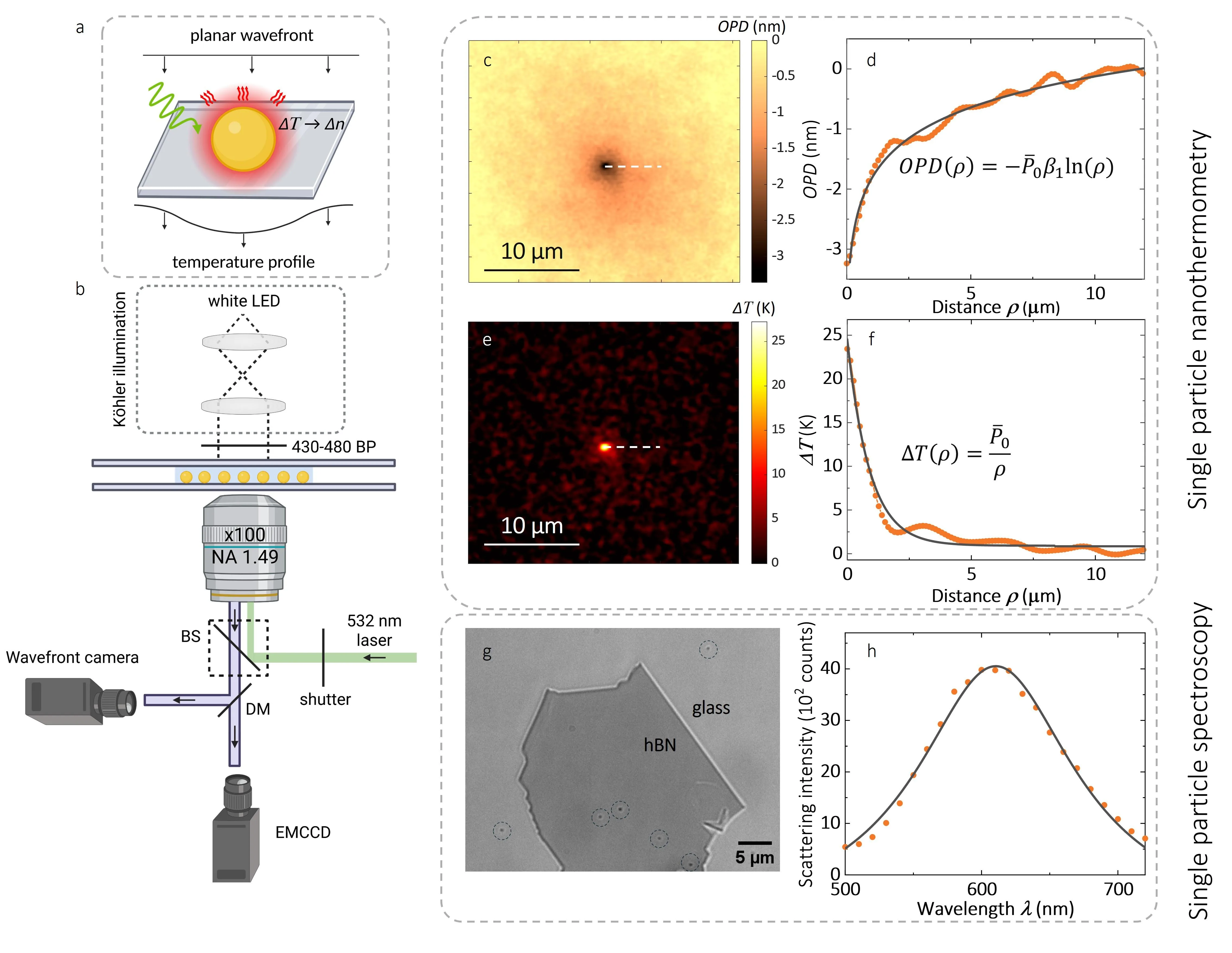
يأتي الحل من غشاء رقيق شبه شفاف من نيتريد البورون السداسي، وهي مادة تشبه الغرافيت لكنها شفافة ومقاومة للصهر. في التجارب، وُضعت كرات نانوية ذهبية على رقائق من هذه المادة، ثم سُخّنت بالضوء ورُصدت حرارتها باستخدام الفحص المجهري الموجي، وهي تقنية تلتقط أدق التغيرات في انكسار الأشعة. اتضح أن نيتريد البورون يعمل كإسفنجة حرارية: فهو يمتص الحرارة من الجسيم ويوزعها على سطحه، مانعاً ارتفاع حرارة النقطة.
المثير للاهتمام أن الحرارة تنتقل عبر مسارين: مباشرة من الجسيم إلى الرقاقة، وبطريق غير مباشر عبر الماء المحيط. معاً، تعمل هاتان القناتان على خفض التسخين بنسبة تصل إلى 60 بالمئة مقارنة بالزجاج العادي. لا يتطلب هذا الأسلوب معدات معقدة، وهو مناسب للفحص السريع للمواد ثنائية الأبعاد الجديدة.
الملخص الأصلي
كما كتبه المؤلفون، بالإنجليزية arXiv:2605.00587
Optical heating of plasmonic nanostructures is a critical challenge in nanoscale systems. Although plasmonic effects enable enhanced optical functionalities, the associated temperature rise can degrade performance in heat-sensitive applications such as biosensing, nanophotonics, and microelectronics. Conventional cooling strategies fail at these scales due to limited heat transport and high interfacial thermal resistance, motivating the integration of advanced materials for thermal management. Here, we investigate hexagonal boron nitride (hBN) thin flakes as heat spreaders to mitigate plasmonic heating of gold nanospheres immobilized on hBN deposited on glass and surrounded by water. Using finite-element simulations, we quantify the influence of hBN thickness, in-plane thermal conductivity, and interfacial thermal conductance on cooling efficiency. Complementary experiments employ cross-grating wavefront microscopy (CGM) for nanothermometry to map the temperature around optically heated gold nanoparticles and quantify the cooling effect of hBN. We extend the application of CGM for rapid, non-invasive, and all-optical characterization of non-absorbing 2D materials. Our results reveal a strong thickness dependence, where heat dissipation in thin flakes is limited by the heat capacity of hBN and in thick flakes by interfacial thermal conductance. Including hBN, we obtain a reduction in temperature rise by up to 60% compared to glass. In addition, the presence of two main heat dissipation pathways emerges: a direct one from the nanoparticle to the hBN and an indirect one from the particle via water to the hBN. This combined simulation-experiment framework offers a versatile approach to improve thermal management in plasmonic systems and beyond, establishing design guidelines for integrating 2D materials into thermally sensitive platforms such as biosensors and integrated circuits.
يُطلق على نيتريد البورون السداسي أحياناً اسم «الغرافين الأبيض» بسبب بنيته الطبقية المشابهة، لكنه على عكس الغرافين لا يوصل الكهرباء، بينما يوصل الحرارة بشكل ممتاز.