الاحتكاك في الكون المبكر: كيف يتم إنقاذ التضخم سريع
فكرة التضخم — التوسع فائق السرعة للفضاء بعد ولادته مباشرة — طرحها آلان غوث عام 1980. وقد أوضحت لماذا عالمنا متجانس للغاية. لكن الصور الحديثة لـالانفجار العظيم من تلسكوب ACT أظهرت نمطًا لا يتطابق تمامًا مع تنبؤات نموذجين رئيسيين.
وُجد الحل بإضافة «احتكاك» إلى المعادلات. المجال الذي أطلق التوسع تصرف كدواسة الوقود: كلما ضغطت أكثر، زادت المقاومة. عادةً، تعتمد طاقة الحركة على سرعة المجال ببساطة، كما هو الحال مع كرة متدحرجة. لكن العلاقة هنا أكثر تعقيدًا: كلما تسارع المجال أكثر، زاد كبحه لنفسه. هذا التعديل هدأ التوسع وأعاد النظريات إلى التوافق مع الأرصاد.
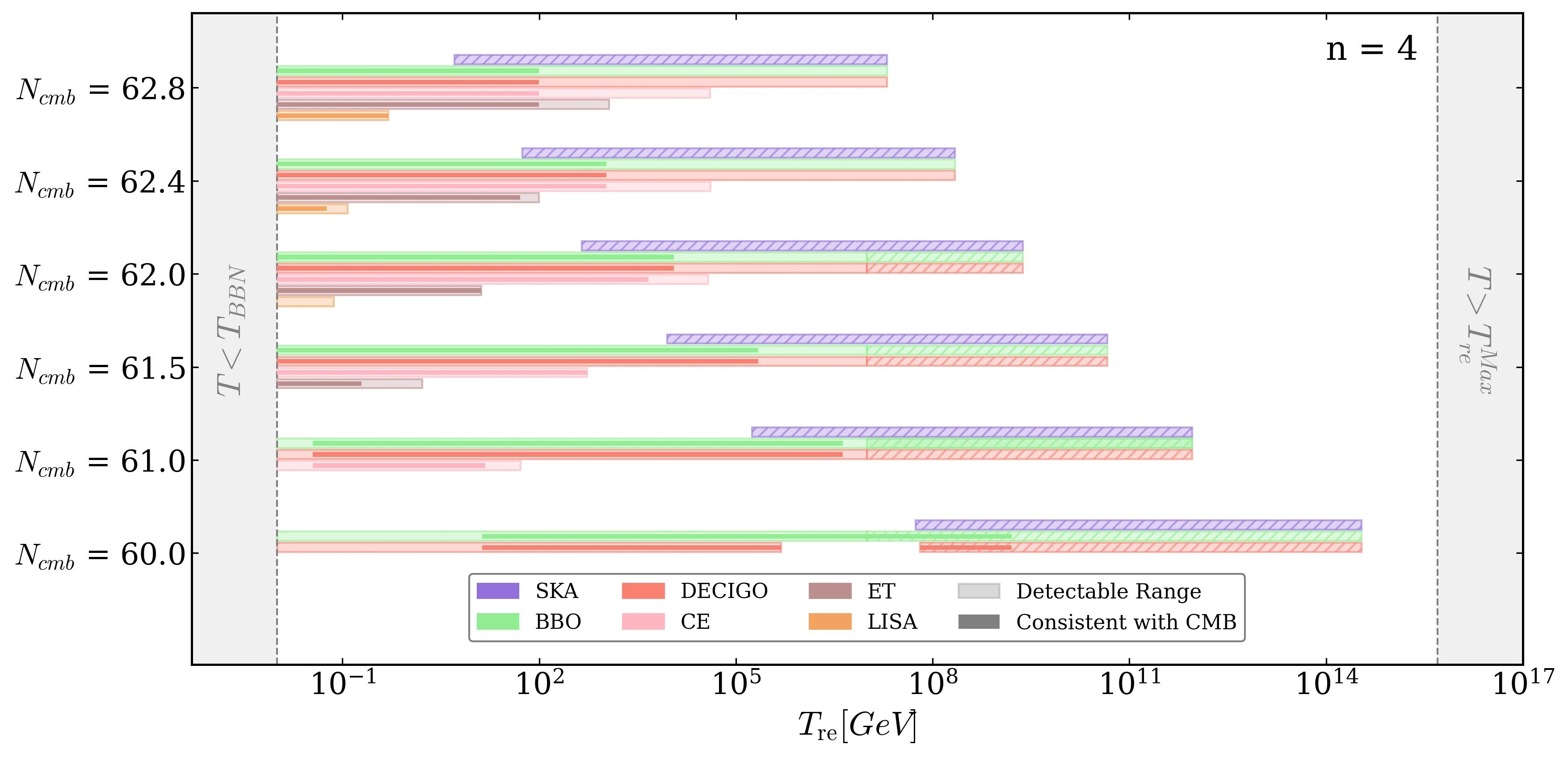
مكافأة غير متوقعة: هذا الاحتكاك يولّد خلفية مميزة لـموجات الجاذبية. في أحد النموذجين، يكون هذا الضجيج غالبًا بترددات عالية، وفي الآخر بترددات منخفضة. كواشف المستقبل مثل LISA قد تلتقط صدى توسع الفضاء هذا وتكشف أي النظريتين صحيحة. تبيّن أن الاحتكاك لا ينقذ التضخم فحسب، بل يتوافق تمامًا مع متطلبات نظرية الأوتار — المرشحة لتكون «نظرية كل شيء».
الملخص الأصلي
كما كتبه المؤلفون، بالإنجليزية arXiv:2605.01992v1
Recent ACT data favor a higher scalar spectral index $$n_s$$, placing models such as $$\alpha$$-attractor T-models and natural Inflation in tension with current observations. We propose a K-inflation framework with a field-dependent non-canonical kinetic term $$G(\phi)$$ that reconciles these models with the latest Planck-ACT-LB-BK18 constraints. Our analysis includes a refined calculation of the reheating equation-of-state parameter $$w_{\rm re}$$, avoids standard power-law approximations, and tests consistency with the Swampland Distance and de Sitter Conjectures. We find that the additional friction from the non-minimal kinetic coupling shifts both models into the favored observational regions. For the $$\alpha$$-attractor T-model with $$n=2$$, viable solutions occur for $$\beta\sim \mathcal{O}(10)$$, with Swampland consistency favoring $$\alpha\gtrsim \mathcal{O}(10^{-3})$$. This case predicts matter-like reheating and a red-tilted gravitational-wave background that is unlikely to be detected soon. In contrast, natural Inflation with $$n=4,5$$ is compatible with CMB constraints for $$\alpha\lesssim 7,8$$ and $$\beta\lesssim -1$$, respectively, leading to stiff reheating and a blue-tilted gravitational-wave background potentially observable by LISA, Cosmic Explorer, Einstein Telescope, DECIGO, and BBO while satisfying BBN and $$\Delta N_{\rm eff}$$ bounds. Combining gravitational-wave probes with Swampland criteria may therefore help distinguish possible UV completions of inflation.
حتى عمر 380,000 سنة، كان الكون معتمًا كضباب كثيف. الضوء الذي نراه في صور الإشعاع الخلفي الكوني هو أول «صورة» له، التُقطت عندما انقشع الضباب.
ماذا لو أن خلفية موجات الجاذبية لا تضم فقط تفاصيل التضخم، بل أيضًا همسات أكوان أخرى تسللت عبر الاحتكاك الكوني؟