كيف يضللنا الدوران والنجوم المزدوجة في تقدير أعمار النجوم سريع
شخص في صورة قديمة يقف وسط حشد ويدور في نفس الوقت — شبه مستحيل تخمين عمره. هكذا تقريبًا يحدد علماء الفلك عمر وكتلة النجوم البعيدة، وكثيرًا ما يخطئون. بالنسبة للنجوم الأثقل قليلًا من الشمس (من 1.4 إلى 2.5 كتلة شمسية)، فإن الطرق المعتادة مثل "الساعات" القائمة على التركيب الكيميائي لا تعمل جيدًا. بدلًا من ذلك، يبني العلماء مخططات لحياة النجوم — خطوط تساوي العمر (isochrones) (خطوط حيث النجوم لها نفس العمر والتركيب ولكن كتل مختلفة) — ويطابقونها مع بيانات الرصد. لكن هذه المخططات لا تأخذ في الحسبان تشوهين مهمين: الدوران السريع واحتمال أن النجم ليس وحيدًا بل في ثنائية مع رفيق غير مرئي.
مؤلفو الدراسة الجديدة بنوا "مصنعًا افتراضيًا للنجوم". أنشأوا آلاف النماذج النجمية بسرعات دوران مختلفة، وكتل، وميول محورية، واحتمالات وجود رفيق. ثم "رصدوا" هذه النجوم بنفس طريقة التلسكوبات، ونظروا إلى مدى خطأ الشبكات القياسية لخطوط تساوي العمر. اتضح أنه بالنسبة للنجوم الفتية التي دخلت للتو النسق الرئيسي (مثل شمسنا ولكن في بداية حياتها)، يُقلَّل العمر إلى النصف أو أكثر. أما بالنسبة للنجوم التي عاشت أكثر من 10% من عمرها، فإن العمر يُبالغ فيه بحوالي 31%، مع تباين يصل إلى 27%. أما الكتلة فتُخلط في المتوسط بعُشر كتلة شمسية — قد يبدو هذا قليلًا، لكنه حاسم بالنسبة للكواكب.
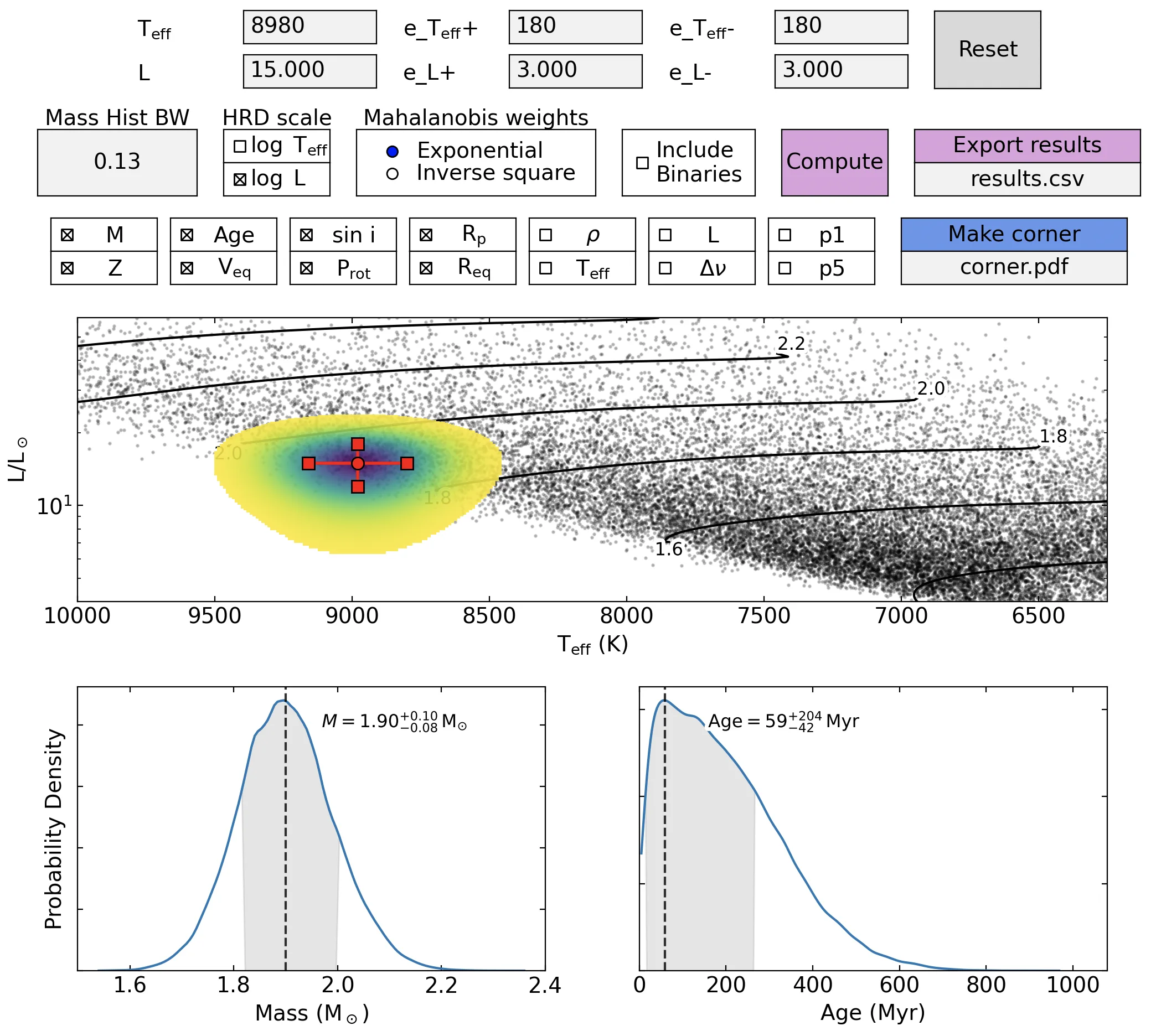
الكواكب الخارجية — كواكب حول نجوم أخرى — تعتمد مباشرة على خصائص نجمها. إذا أخطأنا في العمر والكتلة، فسنقيم بشكل خاطئ ما إذا كان الكوكب صالحًا للسكن، وكيف يتطور، وحتى ما إذا كنا سنرصده أصلًا. الأداة RAPID التي طورها المؤلفون تسمح، من بيانات الرصد، بتقييم سريع لمدى احتمالية كتلة وعمر معينين للنجم، مع أخذ الدوران والثنائية المحتملة في الحسبان. هذا مثل الحصول ليس على صورة واحدة بل على ألبوم كامل مع تصحيحات للحركة والرفقة.
الملخص الأصلي
كما كتبه المؤلفون، بالإنجليزية arXiv:2606.09485
Accurate stellar ages and masses are essential for interpreting the demographics and physical properties of exoplanets, particularly for intermediate-mass, early-type stars where conventional age indicators are ineffective. Isochrone fitting remains the primary tool for characterising such stars, yet its uncertainties are often underestimated, especially in the presence of rapid rotation and unresolved binarity. We present a population-synthesis framework designed to quantify realistic mass and age uncertainties for intermediate-mass stars (1.4-2.5 M$$_{\odot}$$), incorporating distributions in rotation rate, mass, metallicity, binarity, inclination, and observational error. Rotational and geometric effects are applied a posteriori to stellar evolutionary models, enabling a continuous treatment of rotation and its impact on effective temperature and luminosity. By comparing synthetic populations against commonly used isochrone grids, we demonstrate that rotation and unresolved companions systematically bias inferred masses and ages, particularly for young stars, and introduce random uncertainties at the $$\sim$$0.1-M$$_{\odot}$$ and $$\sim$$180-Myr level, often exceeding formal fitting errors. The effect is strongest near the zero-age main sequence, where ages are underestimated by a factor of $$\geq2$$, while for older A stars ($$>$$10% of their main-sequence lifetime), ages are overestimated by 31% with 27% scatter. Our findings carry important consequences for planet detectability, characterisation, and population studies. We provide a publicly available tool, RAPID, for probabilistic inference of stellar parameters from these synthetic populations, and we demonstrate its application to known exoplanet hosts.
النجم الذي يدور بسرعة كبيرة يمكن أن يكمل دورة كاملة حول محوره في بضع ساعات — بينما تستغرق شمسنا ما يقرب من شهر لفعل ذلك.