أداة نقش شعاعية للدوائر فائقة التوصيل سريع
الخزّاف ينقش نقشًا على بلاطة طينية ما زالت رطبة باستخدام أداة حادة. حركة خاطئة واحدة — فينزلق الخط وتتشقق البلاطة. هكذا تقريبًا يتعامل الفيزيائيون مع أغشية الموصل الفائق عالي الحرارة YBCO (مركب من الإيتريوم والباريوم والنحاس والأكسجين). لكن أداتهم هي حزمة رفيعة جدًا من أيونات الهيليوم، والبلاطة هي طبقة سيراميك بسماكة مئات الذرات.
مؤلفو العمل الجديد راقبوا ما يحدث لهذا الغشاء عندما يتم قصفه لفترة طويلة بأيونات الهيليوم بطاقة 30 ألف إلكترون فولت. قاموا بقياس المقاومة الكهربائية والتقطوا أطياف الأشعة السينية وأطياف رامان. اتضح أنه عند الجرعات المنخفضة تظهر عيوب نقطية في البلورة — ذرات الأكسجين تخلع من أماكنها لكنها لا تغادر المادة، بل تستقر في الفراغات المجاورة. هذا العيب يسمى زوج فرنكل. عدد حاملات الشحنة لا يتغير تقريبًا، لكن حركتها تنخفض — الإلكترونات تصطدم كثيرًا بالاضطراب.
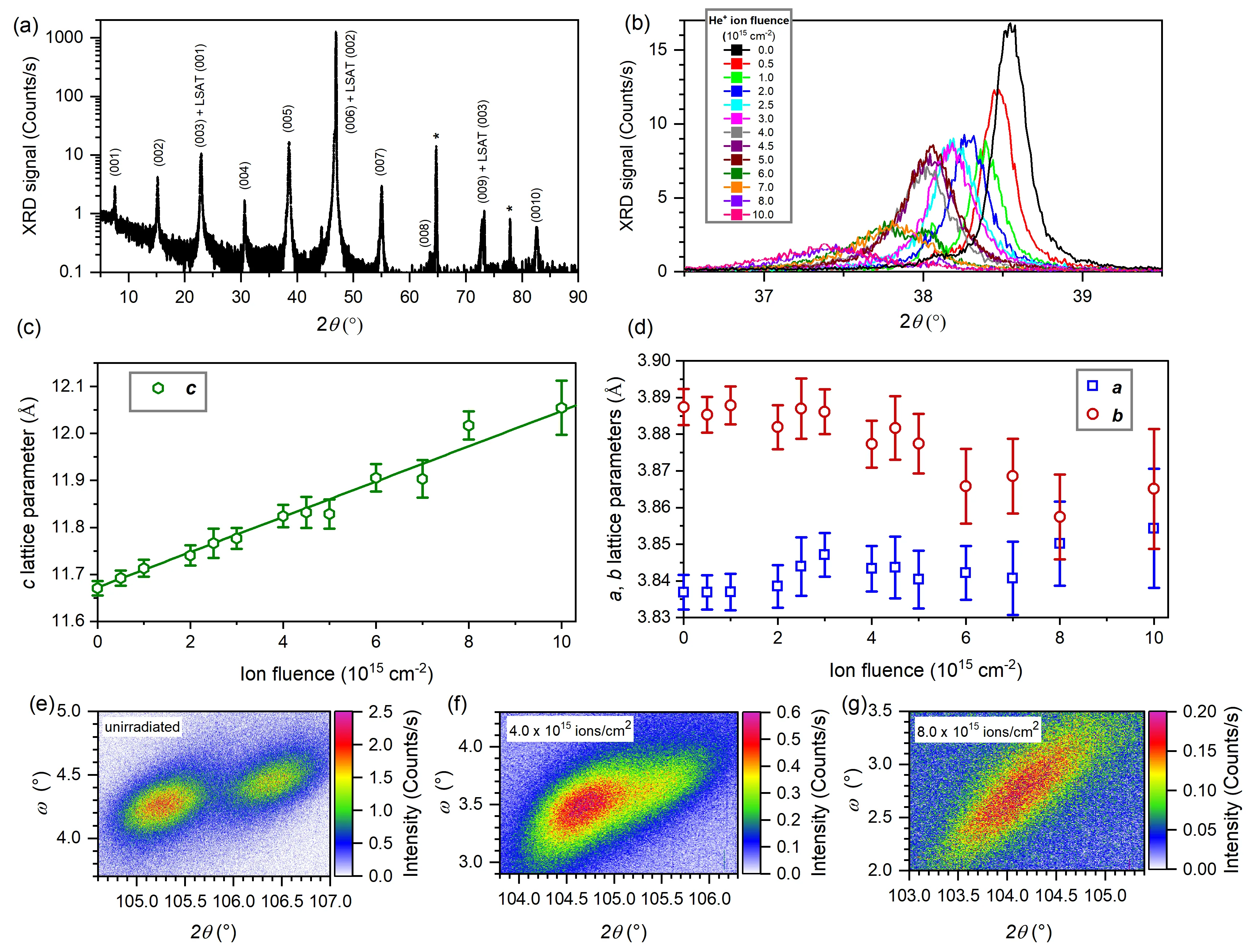
مع زيادة الجرعة تفقد الشبكة البلورية انتظامها: الأشعة السينية تُظهر أن الطبقات تتباعد، والخلية تتحول من مستطيلة إلى مربعة، وعند 10¹⁶ أيون لكل سنتيمتر مربع يتحول الغشاء إلى زجاج غير متبلور. المقاومة الكهربائية في الحالة العادية ترتفع بشكل حاد، ودرجة الحرارة الحرجة تنخفض وفق قانون اشتقه قبل نصف قرن أبريكوسوف وغوركوف لتفكك أزواج كوبر بسبب الشوائب المغناطيسية. المثير للاهتمام أن التباين — الفرق في الخصائص على طول الطبقات وعرضها — يقل هنا، بينما في حالة نقص الأكسجين البسيط يزداد. إذن، الحزمة لا تخلع الأكسجين فحسب، بل تخلق اضطرابًا أكثر تعقيدًا.
هذا العمل ليس مجرد فيزياء من أجل الفيزياء. إنه يعطي المهندسين أرقامًا دقيقة: كم يمكن أن نُشعع لقمع الموصلية الفائقة في الأماكن المرغوبة وإنشاء دائرة كمومية دون تدمير الركيزة. بدون هذه المعرفة تبقى الأداة عمياء والنقش غير موثوق.
الملخص الأصلي
كما كتبه المؤلفون، بالإنجليزية arXiv:2606.14588
Focused helium ion beam (He-FIB) irradiation with 30 keV ions is a key tool for nanoscale patterning and defect engineering in high transition temperature (Tc) cuprate superconducting devices, yet its usable fluence window is constrained by the competing requirements of reliable superconductivity suppression and minimal structural degradation. In this work, we provide a comprehensive dataset on the effects of large-area 30 keV He+ ion exposure on the electric transport and superconducting properties of epitaxial YBa2Cu3O7 (YBCO) thin films. X-ray diffraction shows a fluence-driven loss of crystalline order accompanied by an out-of-plane lattice expansion and an orthorhombic-to-tetragonal transition, culminating at predominant amorphization at the highest fluence of 1 x 10^16 cm^-2. Raman spectra exhibit increasing disorder while lacking signatures of oxygen depletion, indicating that irradiation mainly generates oxygen-related Frenkel defects rather than changing the carrier concentration. Consistently, with increasing fluence, the normal-state resistivity \rho_N(T) at temperature T above Tc increases strongly, while d \rho_N/d T remains nearly unchanged at moderate fluence. The suppression of Tc is accurately described by Abrikosov-Gor'kov pair breaking and reaches complete quenching of superconductivity at 4.5 x 10^15 cm^-2. The anisotropic upper critical fields decrease approximately exponentially with increasing fluence, the vortex activation energy is reduced, and the anisotropy drops, in contrast to oxygen-depleted YBCO. Hall-angle analysis confirms a nearly constant carrier density but a systematic increase in defect scattering and reduced mobility, consistent with a crossover toward the dirty limit at high fluence. These results establish quantitative fluence thresholds and a practical operational window for He-FIB nanopatterning of YBCO quantum circuits.
حزمة أيونات الهيليوم تُركّز في بقعة قطرها أقل من عشرة نانومترات — أي أنحف بآلاف المرات من شعرة الإنسان.