مقايضة الوقت بالوقود سريع
الجرّار الفضائي المزود بمحرك أيوني يتسارع ببطء، لكنه يستهلك وقوداً قليلاً جداً. للانتقال من مدار إلى آخر، يجب حل مسألة صعبة: كم من الوقت يجب تشغيل المحرك وإلى أين يجب توجيهه؟ عادةً ما يُبحث عن أسرع رحلة بكتلة معينة للمركبة. مؤلفو الدراسة الجديدة قلبوا الشرط: فهم يسألون ما هي الكتلة الابتدائية القصوى إذا كان زمن الرحلة محدداً مسبقاً.
سُمي هذا النهج بمسألة الكتلة الابتدائية العظمى. رياضياً، يشبه البحث عن أسرع رحلة، لكن بإشارة مختلفة. اتضح أن لكل مسار أسرع نسخة مقابلة محدودة بالكتلة، والعكس صحيح. وهذا يسمح باستخدام الحلول المعروفة لبناء مسارات جديدة — بشكل أكثر سلاسة وموثوقية.
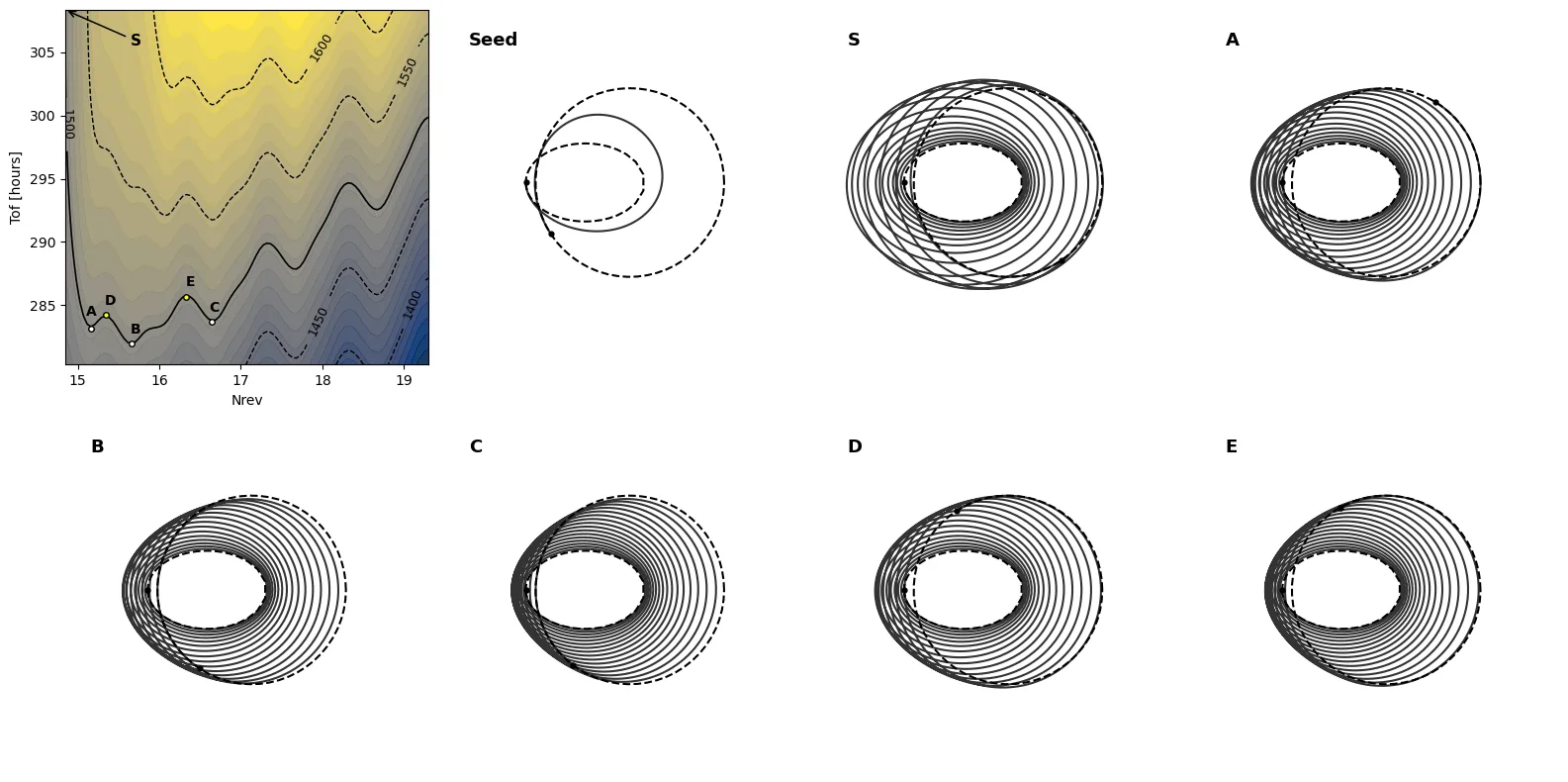
اختُبرت الطريقة على مثال كلاسيكي: نقل قمر صناعي من مدار إهليلجي مرتفع إلى المدار الجغرافي الثابت (مدار دائري على ارتفاع حوالي 36 000 كم). لم تؤكد الحسابات المسار الأسرع المعروف فحسب، بل وجدت أيضاً فروعاً إضافية للحلول. بعضها كان يُعتقد سابقاً أنه الأسرع، لكنه في الواقع تبين أنه الأبطأ بين الممكنة عند نفس الكتلة الابتدائية.
الملخص الأصلي
كما كتبه المؤلفون، بالإنجليزية arXiv:2606.29289
We introduce the maximum-initial-mass problem as a standalone optimal-control formulation for low-thrust trajectory design and analyze its structure within Pontryagin's framework. For fixed transfer time and final state, the formulation seeks the largest initial mass from which the transfer is feasible, and its necessary conditions imply a full-throttle control law in the nondegenerate case together with the standard primer-vector steering direction. We then establish a correspondence between extremals of the maximum-initial-mass and minimum-time problems, showing that each minimum-time extremal induces a maximum-initial-mass extremal on the associated time interval, and conversely. This viewpoint also clarifies the role of the terminal Hamiltonian condition in indirect formulations of minimum-time problems, which we interpret as a gauge choice rather than an independent necessary condition in the setting considered. Finally, we show that the maximum-initial-mass framework provides a smooth and effective continuation strategy for multiple-revolution low-thrust transfers. Applied to a benchmark GTO-to-GEO transfer, the approach recovers the global minimum-time solution, reveals additional extremal branches, and makes explicit that some trajectories previously reported in the literature correspond to local maxima of transfer time along iso-M curves rather than to local minima.
المحرك الأيوني ينتج الدفع عن طريق تسريع الجسيمات المشحونة بحقل كهربائي. قوة الدفع ضئيلة — تقريباً مثل وزن ورقة على راحة اليد، لكنه يعمل لأشهر ويوفر الوقود بعشرات المرات أفضل من المحركات الكيميائية.
في رواية «المريخي» لأندي وير، يعمل المحرك الأيوني لسفينة «هيرميس» لسنوات، مسرعاً المكوك بين الكواكب ببطء ولكن بثبات — وهي الحالة التي تكون فيها الكتلة وتوفير الوقود أكثر أهمية من السرعة.