الضوء يكشف محاولات فتح الشريحة سريع
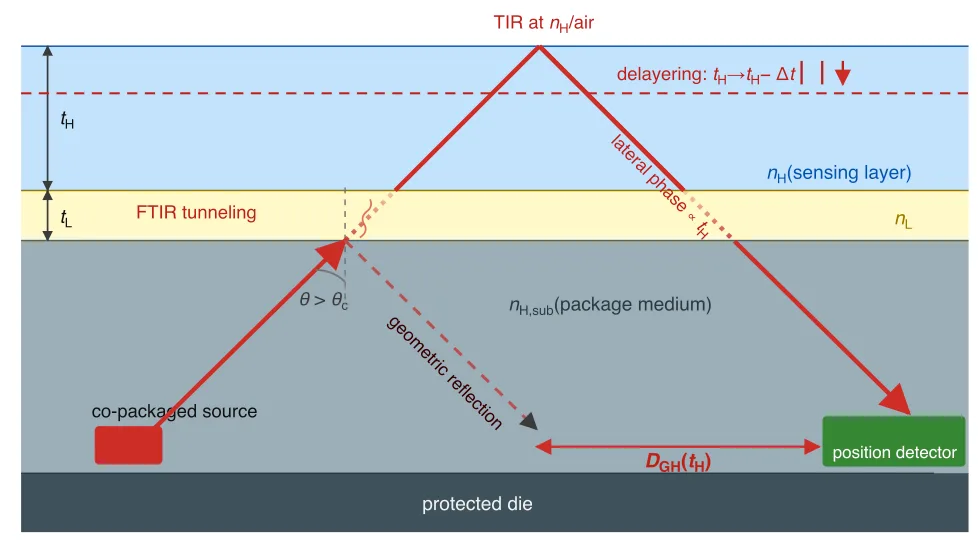
الشريحة الإلكترونية تشبه كعكة متعددة الطبقات: في الأعلى طبقات واقية، وفي الداخل أسرار. قد يحاول المخرب إزالة الطبقات واحدة تلو الأخرى للوصول إلى الأسرار. المستشعر الجديد يراقب ذلك باستخدام شعاع ضوئي.
يسقط الشعاع على سطح الشريحة بزاوية معينة. ينعكس جزء من الضوء، لكن ليس فوراً: فهو "يغوص" قليلاً في الطبقة العلوية، مثل حصاة تنزلق على سطح الماء. إذا أصبحت الطبقة أرق، يخرج الشعاع في مكان مختلف - أي ينزاح بضعة نانومترات. يقيس المستشعر هذا الانزياح.
يكاد يكون من المستحيل تزييف هذا الانزياح. فهو يتغير بنفس الطريقة مهما كانت الاضطرابات - سواء كانت تقلبات في درجة الحرارة أو اهتزاز الليزر. حتى لو حُفر ثقب صغير جداً، يخبرنا الشعاع بصدق: هنا عُبث بالشيء.
الملخص الأصلي
كما كتبه المؤلفون، بالإنجليزية arXiv:2608.12243v1
We propose a co-packaged photonic tamper sensor that detects progressive delayering and localized drilling through changes in the Goos-Hanchen (GH) shift of a reflected optical beam. Frustrated total internal reflection (FTIR) couples the beam into a high-index sensing layer, where its transverse-wavevector components acquire a thickness-dependent propagation phase. Numerical simulations show an approximately linear response for sensing-layer thicknesses below 250 nm and a delayering sensitivity of 5.3 nm of beam displacement per nanometer of material removed, nearly three times that of a conventional total internal reflection (TIR) structure. The off-resonant response remains stable under representative refractive-index, wavelength, and incidence-angle variations. Localized drilling also produces a monotonic GH-shift change that increases with drill depth and width. These results establish GH-shift readout as a rapid, spatially encoded, and difficult-to-emulate approach for semiconductor-package tamper detection.
انزياح الشعاع الذي يلتقطه المستشعر أنحف بآلاف المرات من شعرة الإنسان.