Explosion vs. Clot: Liquid Metal in Oil Clears Vessels in Under a Minute express
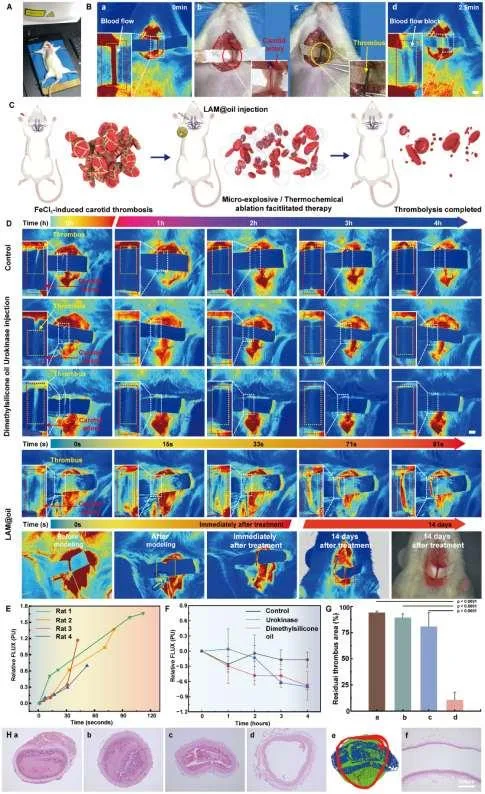
A blood clot in a vessel is like a cork stuck in a narrow pipe. Standard drugs dissolve it slowly, like hot water melting a sugar cube. But while the drug works, the cork can shift and block blood flow entirely.
The new approach works differently. Instead of slow dissolution, the clot is attacked with micro-explosions. A tiny droplet of liquid sodium or potassium, wrapped in silicone oil, like a yolk in a plastic pouch, is injected into the clot. The oil prevents the metal from reacting prematurely. But once the droplet hits blood, water seeps through the oil coating and triggers a violent chemical reaction. The metal instantly heats to high temperatures, releases caustic alkali, and expands — producing a series of tiny explosions that simply blast the clot apart.
After the reaction, only sodium and potassium ions remain — the same ones already present in blood and cells. They are non-toxic and easily excreted by the kidneys. No harmful waste, no risk of bleeding.
In animal experiments, this method cleared the vessel of a clot ten times better than the standard drug urokinase. While the conventional drug leaves nearly the entire clot intact (about 80% of the area), the explosive therapy destroys almost everything — leaving only about 11%.
The idea is simple: instead of waiting for the clot to dissolve, you shatter it from within with rapid, targeted blows. It's like using a miniature jackhammer instead of soaking stubborn dirt, the pipe is clear again.
Original abstract
as written by the authors arXiv:2605.05924
Thrombotic vascular diseases contribute to significant global mortality, yet current therapeutic strategies face persistent challenges including bleeding risks, suboptimal efficiency, and procedural complexity. Here, we report a micro-explosive thermochemical thrombolysis (METCT) therapy via injectable liquid alkali metal (LAM) encapsulated in dimethyl silicone (LAM@oil), which enables prompt, efficient and safe vascular recanalization within an ultrafast timeframe (< 90 seconds). This LAM@oil system effectively disrupts thrombus tissue through a synergistic triple-action mechanism: Mechanical micro-explosions forces, alkaline ablation due to highly localized exothermic chemical reactions, and thermal thrombolysis mediated by elevated temperature. Upon thrombolysis completion, the non-toxic reaction byproducts (sodium and potassium ions) exhibit physiologically biocompatible and metabolizable effects. Critically, the LAM@oil demonstrates significantly higher thrombolytic efficacy compared to clinically available thrombolytic drugs (residual thrombus area percent 10.87%+-7.16% for LAM@oil vs. 80.86%+-13.32% for urokinase), with no associated bleeding risks. This strategy opens a byproduct-free, cost-effective, and high-efficiency alternative to conventional thrombolytics, holding big potential for clinical translation in acute thrombosis management.
Sodium and potassium are so reactive that in pure form they are stored under kerosene or oil, otherwise they would ignite in air. In the body, they react instantly with water, and it is this violent reaction that the method's authors have put to medical use.