An ion is an atom or molecule that has gained or lost one or more electrons, giving it a net positive or negative electric charge. This charge makes ions responsive to electric and magnetic fields, which is why they are used as qubits in trapped-ion quantum computers. In such systems, ions are held in place by electromagnetic traps and manipulated with lasers to perform quantum operations.
History
The term 'ion' was coined by Michael Faraday in 1834, based on the Greek word for 'going', because ions move toward electrodes in an electric field. The use of trapped ions as qubits was proposed by Ignacio Cirac and Peter Zoller in 1995, and the first demonstrations followed shortly after.
How it works
When an atom loses an electron, it becomes a positively charged ion; when it gains one, it becomes negatively charged. The charge allows ions to be confined using electric fields in a Paul trap, where they form a crystal-like structure. Lasers are then used to excite the ions into different quantum states, and their internal energy levels serve as the 0 and 1 states of a qubit. The ions interact with each other through their Coulomb repulsion, enabling entangled operations.
In practice
Trapped ions are used in quantum computers for research and small-scale computation, as well as in mass spectrometry for chemical analysis and in ion thrusters for spacecraft propulsion.
Fun fact
The first trapped-ion quantum computer was built in 1995, and today's versions can maintain quantum coherence for over a minute, which is remarkably long for a quantum system.
Two pendulums on a shared string trade motion: push one, and the second starts swinging, and a moment later the first gets a push back. In a thorium-229 atom, energy flows nearly loss-free between the electron shell and the nucleus.
Three charged ytterbium atoms are arranged in a triangle inside an electromagnetic trap. Normally, they all communicate with each other, like three people at a table constantly exchanging remarks. But if one of them steps into the next room, the conversation continues between the remaining two.
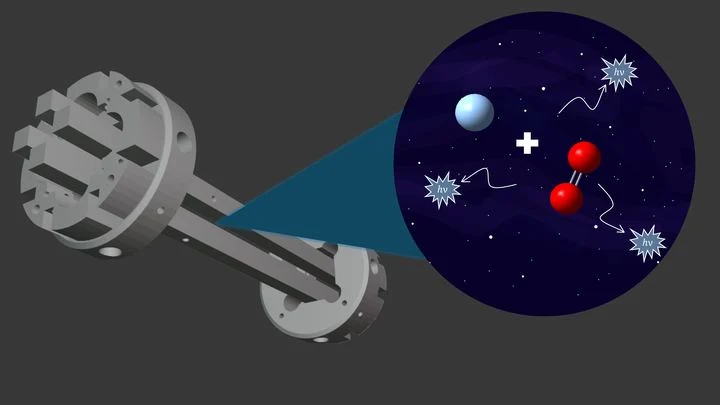
In the cold, sparse clouds of space, particles rarely meet, but sometimes an ion and a neutral molecule pass close enough to stick together. As they do, they emit light, like a muted flash carrying away excess energy. This process is called radiative association, and it is responsible for the formation of many molecules in interstellar space.