A chemical reaction is a process in which substances (reactants) are transformed into new substances (products) through the breaking and forming of chemical bonds. This involves the rearrangement of atoms, ions, or molecules, but the total mass and number of atoms remain conserved. Chemical reactions are central to all of chemistry, from the combustion of fuels to the synthesis of pharmaceuticals, and they underpin biological processes like metabolism and photosynthesis. The study of reaction mechanisms—the step-by-step sequence of bond breaking and forming—is crucial for controlling and optimizing reactions.
History
The modern concept of a chemical reaction emerged in the late 18th century with Antoine Lavoisier's law of conservation of mass and his work on combustion. John Dalton's atomic theory (1803) provided the framework for understanding reactions as rearrangements of atoms, and later, the development of thermodynamics and kinetics in the 19th century refined the understanding of reaction energetics and rates.
How it works
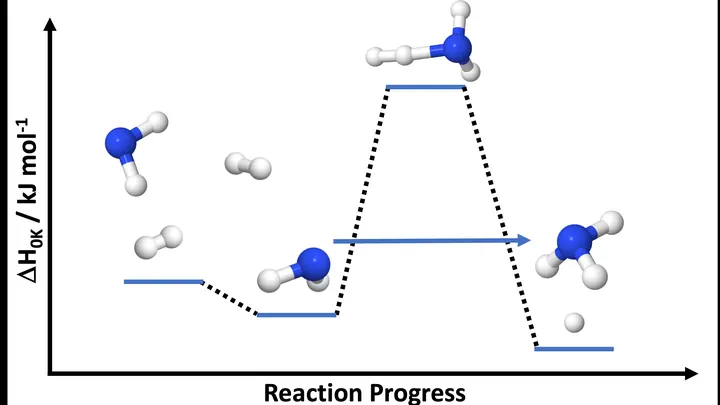
During a chemical reaction, reactant molecules collide with sufficient energy and proper orientation to overcome the activation energy barrier. Bonds in the reactants break, and new bonds form in the products, often through intermediate species. The reaction rate depends on factors like temperature, concentration, and the presence of catalysts, which lower the activation energy without being consumed. The overall energy change (exothermic or endothermic) is determined by the difference between the bond energies of reactants and products.
In practice
Chemical reactions are used in virtually every industrial process, including the Haber process for ammonia synthesis, combustion engines, battery operation, and the production of plastics and medicines.
Fun fact
Some chemical reactions, like the Belousov-Zhabotinsky reaction, exhibit oscillating color changes over time, demonstrating that reactions can be far from equilibrium and show complex, wave-like behavior.
Write down a recipe, then check it an hour later: if the proportions are off by even a gram, the taste is gone. Chemical reactions in open systems behave much the same way: the slightest difference in initial concentrations grows over time into completely different states.
The liver is an orchestra in which every cell plays its part from a shared score. Males and females have different scores: in males, the genes responsible for detoxifying foreign substances and steroid hormones sound louder, while in females, the genes for fat metabolism and bile acids do.
A cookbook without a shopping list: that's what a scientist faces when looking at a scheme of chemical reactions. The arrows and formulas on paper look neat, but once you start hunting in the lab for molecules that will actually behave that way, a real quest begins.
A mountain pass connects two valleys. In one, the protein is folded; in the other, it is unfolded. To get from one to the other, you must cross the saddle — the highest point on the path. In protein science, this point is called the transition state, and the coordinate that shows the distance to it is the committor.
Predicting the yield of a chemical reaction is a bit like trying to guess the harvest knowing only the soil composition. Traditionally, chemists have relied on long columns of numbers, quantum descriptors, that describe electron energies but say nothing about molecular shape.
A kitchen mixer runs at a single speed, but start jabbing the button and the mixture whips up differently. Chemical reactions behave much the same way when the rates of their individual steps are not constant but pulse over time.
Cooking a complex dish requires a clear recipe: first chop, then sauté, add spices at just the right moment. Chemical transformations also follow step-by-step recipes — mechanisms where atoms of carbon and hydrogen rearrange in a strict order.
Previously, neural networks often invented nonexistent steps, like a whimsical cook swapping salt for sugar.
Inside every cell, construction never stops: molecules constantly cluster together and drift apart. Sometimes they form dense droplets, like oil in water, but without a membrane. These droplets act as temporary storage: they hold proteins, gene copies, or DNA repair tools.
Molecules float in a test tube. Their abundance (say, the concentration of some protein) becomes the input signal. And the output isn't just a cloudy solution but a clear yes-or-no answer.
The authors build a chemical cascade that does exactly that.
The Standard Model is a set of rules for all known particles. But it says nothing about dark matter, which makes up a quarter of the Universe. To find it, you don't need to build city-sized colliders. Radioactive molecules act like sniffer dogs: their incredible 'scent' picks up the faintest traces of unknown forces that slip past giant machines.
In a crystal of water and caustic cesium, oxygen and cesium atoms sit in place like beads in a rigid lattice. Hydrogen atoms behave differently: they are like passengers constantly changing seats. In this layered material, each oxygen is linked to three neighbors via hydrogen bridges, forming a honeycomb-like pattern.
A ball rolls up a hill, but it doesn't have enough energy, so it rolls back down. That's classical mechanics for you. But in the quantum world, a tiny particle can sometimes pass right through the hill, as if the barrier weren't there. This trick, tunneling, is business as usual for a light atom like hydrogen.
In cold clouds between the stars, dust grains are coated with ice, like windows covered with frost in winter. On this icy crust, chemical reactions take place that do not occur in gas. One such reaction is the encounter between a carbon atom and a nitrogen molecule.
Gold on carbon is a classic pairing in chemistry. Such materials speed up important reactions, like producing vinyl chloride for plastics. But until now, no one had seen in detail how gold atoms behave on a graphite surface when the whole thing is immersed in a liquid.
When chemists see how concentrations of substances change, they need to figure out which reactions are behind those changes. It's like trying to reconstruct a recipe from photos of plates at different stages of a meal. Previously, this often involved derivatives — instantaneous rates of concentration change.
An ordinary chemical reaction is like a ball rolling down a hill: it has one natural path. But if you place molecules in a tiny mirrored box, an optical microresonator, the light inside starts to interfere with the ball's motion. It can nudge it, hold it back, or even split its trajectory.
In a new study, physicists traced exactly how this happens.
A cosmic dust grain is covered in ice, and on this ice, like in a tiny kitchen, molecules are cooked. One of them is methanol, an alcohol that serves as a building block for more complex compounds in space. Previously, it was thought that methanol only forms when hydrogen atoms stick one by one to a carbon monoxide molecule.