Catalysis is the increase in the rate of a chemical reaction under the action of a substance that is not part of the final products. The catalyst lowers the activation energy (energy barrier), opening an alternative reaction pathway. It can be homogeneous (in the same phase as the reactants) or heterogeneous (usually a solid in a liquid or gaseous medium).
History
The term 'catalysis' was introduced by Swedish chemist Jöns Jacob Berzelius in 1836 to describe reactions accelerated in the presence of substances that themselves do not change. In 1895, Wilhelm Ostwald gave a quantitative definition of a catalyst as a substance that accelerates a reaction but does not shift equilibrium. In the early 20th century, Paul Sabatier discovered hydrogenation on metallic nickel, for which he received the Nobel Prize. Fritz Haber and Carl Bosch developed catalytic synthesis of ammonia, revolutionizing agriculture. Further development of enzymatic catalysis is associated with the names of Michaelis, Menten, Briggs and Haldane. Today, catalysis permeates petrochemistry, energy, and environmental protection.
How it works
The catalyst provides an alternative reaction pathway with a lower activationenergy. In heterogeneous catalysis, chemisorption plays a decisive role — the formation of chemical bonds between the reactants and the active sites on the surface. This weakens certain interatomic bonds in the reactant molecules, facilitating their breaking. Then the adsorbed particles interact, forming products that desorb, freeing the sites. For example, in ammonia synthesis on an iron catalyst, N₂ and H₂ molecules dissociate into atoms, which requires high energy without a catalyst. The reaction rate is often described by the Arrhenius equation: k = A exp(-Ea/RT), where Ea is the activation energy. The catalyst lowers Ea. In enzymes, an additional role is played by the complementarity of the active site to the substrate (lock-and-key model) and stabilization of the transitionstate.
In practice
Catalytic converters in cars transform toxic exhaust gases into safe nitrogen and water.
Fun fact
The same catalyst can accelerate both the forward and reverse reactions — it does not shift the equilibrium, only helps to reach it faster.
Plasma is a gas in which electrons are stripped from atoms and roam freely. Sometimes, regions where electrons are almost absent spontaneously appear in such a gas; they are called holes. It is like a whirlpool forming in a stream, pulling everything around it in. But exactly how such a whirlpool is born has long remained a mystery.
Turn off the stove, and water stops boiling almost instantly. In the world of catalysis, researchers expected a similar picture: stop the reaction, and all intermediate particles vanish right away. But fresh observations of platinum nanoparticles tell a different story.
In a glass of water, oil gathers into droplets: that's equilibrium separation dictated by chemistry. But there are systems where order arises not from rest but from a constant flow of energy.
A kitchen mixer runs at a single speed, but start jabbing the button and the mixture whips up differently. Chemical reactions behave much the same way when the rates of their individual steps are not constant but pulse over time.
In the vast clouds of rarefied gas that fill the space between stars, something is always churning. Supernova explosions, colliding streams — all of it shakes the plasma. And in this rippling, as it turns out, hides the mechanism that gives birth to magnetic fields.
Plasma is a gas in which electrons are stripped from atoms.
A cell is like a library where thousands of books are copied every day. Molecular machines, polymerases and ribosomes, slide along a template chain and assemble a copy, link by link. These machines have several states: they can slow down, make mistakes, or switch. Previously, calculating such a process took hours.
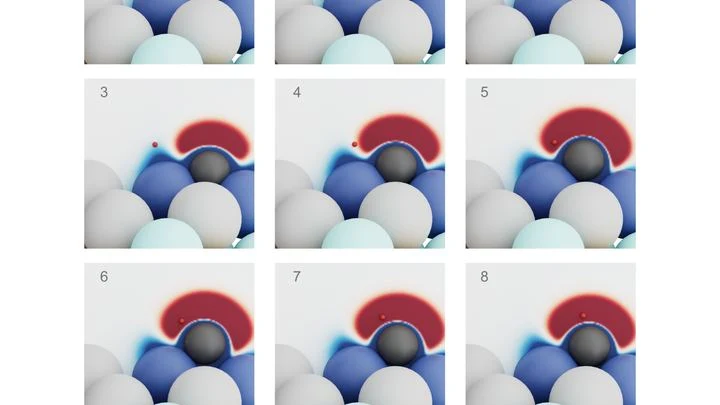
A kitchen sponge soaked in syrup: in some spots there's more syrup, and your finger sticks right away; in others, it barely touches. That's roughly how a catalyst surface works. Molecules don't react everywhere but at especially sticky points — active sites.
A factory laser that cuts and welds metal on production lines has been made to work as a particle accelerator for the first time. Physicists took a standard ytterbium laser, its heart is a crystal the size of a palm, and turned its flashes into a tool for accelerating electrons to nearly the speed of light.
Space is full of invisible sprinters — particles racing nearly at the speed of light. They are caught in the solar wind, near neutron stars, and even in the intergalactic void between galaxies. But what accelerates them where there are no shock waves or magnetic reconnections?
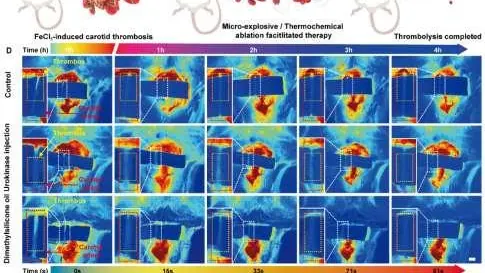
A blood clot in a vessel is like a cork stuck in a narrow pipe. Standard drugs dissolve it slowly, like hot water melting a sugar cube. But while the drug works, the cork can shift and block blood flow entirely.
The new approach works differently. Instead of slow dissolution, the clot is attacked with micro-explosions.
A balloon inflates on its own, even though no one is blowing it up. That's roughly how the accelerated expansion of the universe looks, and to explain it, scientists usually invoke dark energy, an invisible and poorly understood force. But what if the balloon expands because new air molecules are continuously appearing inside it?
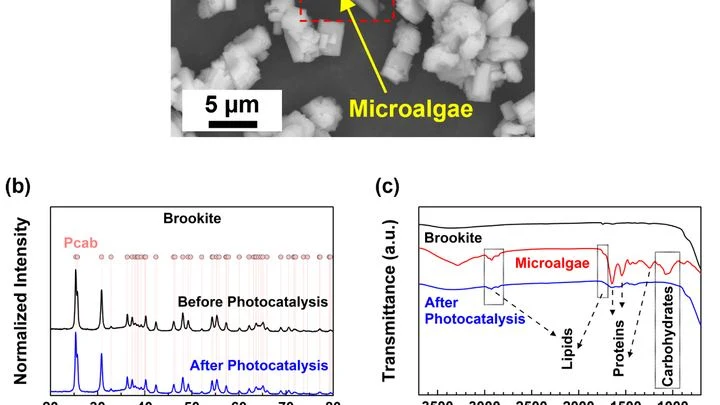
Conventional solar panels convert light into electricity, but here light splits water into hydrogen and oxygen. Hydrogen is a clean fuel, but the process is slow. To speed it up, helper substances that donate electrons are added. Often this is alcohol, but it's a shame to waste it.
Inside large particle accelerators, there are hollow metal chambers where beams are accelerated. Over time, grime settles on their walls, like in an old pan. This grime prevents the accelerator from running at full power.
To restore the accelerator's strength, plasma, a glowing gas of argon or neon with a bit of oxygen, is sent into the chamber.
A laser strikes a target, and a cloud of plasma, accelerated to hundreds of kilometers per second, shoots into the chamber. The chamber isn't empty: it's filled with a tenuous gas that plays the role of the cosmic medium. The plasma slams into this gas like a speedboat hitting still water, shoving it aside.
In a jeweler's workshop, gold is never mixed with ruthenium: one is soft and shiny, the other refractory and brittle. But at the nanometer scale, these metals merge into a single alloy that, when heated, begins to separate like oil and water in a cooling broth.
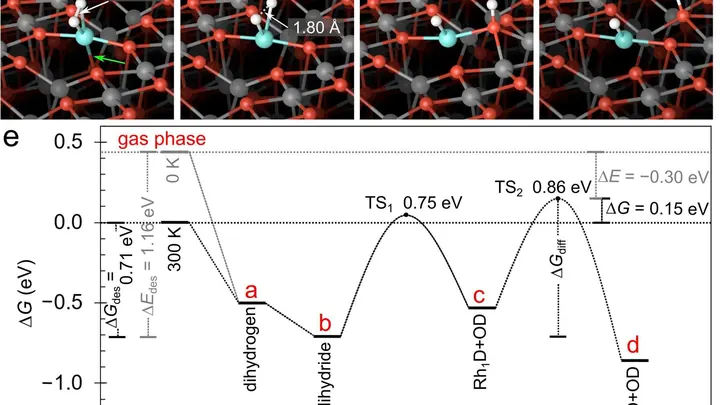
Chemistry has two worlds: in one, the catalyst is a solid particle and the reaction happens on its surface; in the other, it's a dissolved molecule where everything occurs around a single metal center. These worlds rarely meet. But in a new study, they collide.
The researchers took iron oxide, a black powder used in magnetic tapes, and scattered single rhodium atoms across its surface.
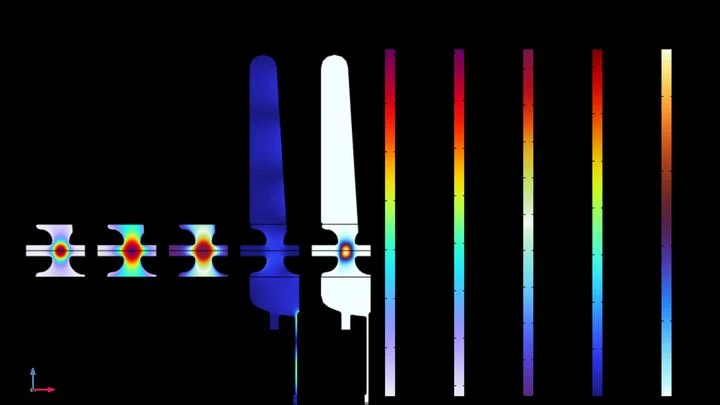
An ordinary chemical reaction is like a ball rolling down a hill: it has one natural path. But if you place molecules in a tiny mirrored box, an optical microresonator, the light inside starts to interfere with the ball's motion. It can nudge it, hold it back, or even split its trajectory.
In a new study, physicists traced exactly how this happens.
A catalyst is a substance that speeds up a chemical reaction without being consumed itself. The best catalyst is one where every metal atom counts: the finer the particles, the more atoms are on the surface and the more active the material.