Roots from the Abyss: The Secret Growth of Supermassive Black Holes ✦
Original: "Hidden-sector accretion and warped black-string seeds for high-redshift supermassive black holes"
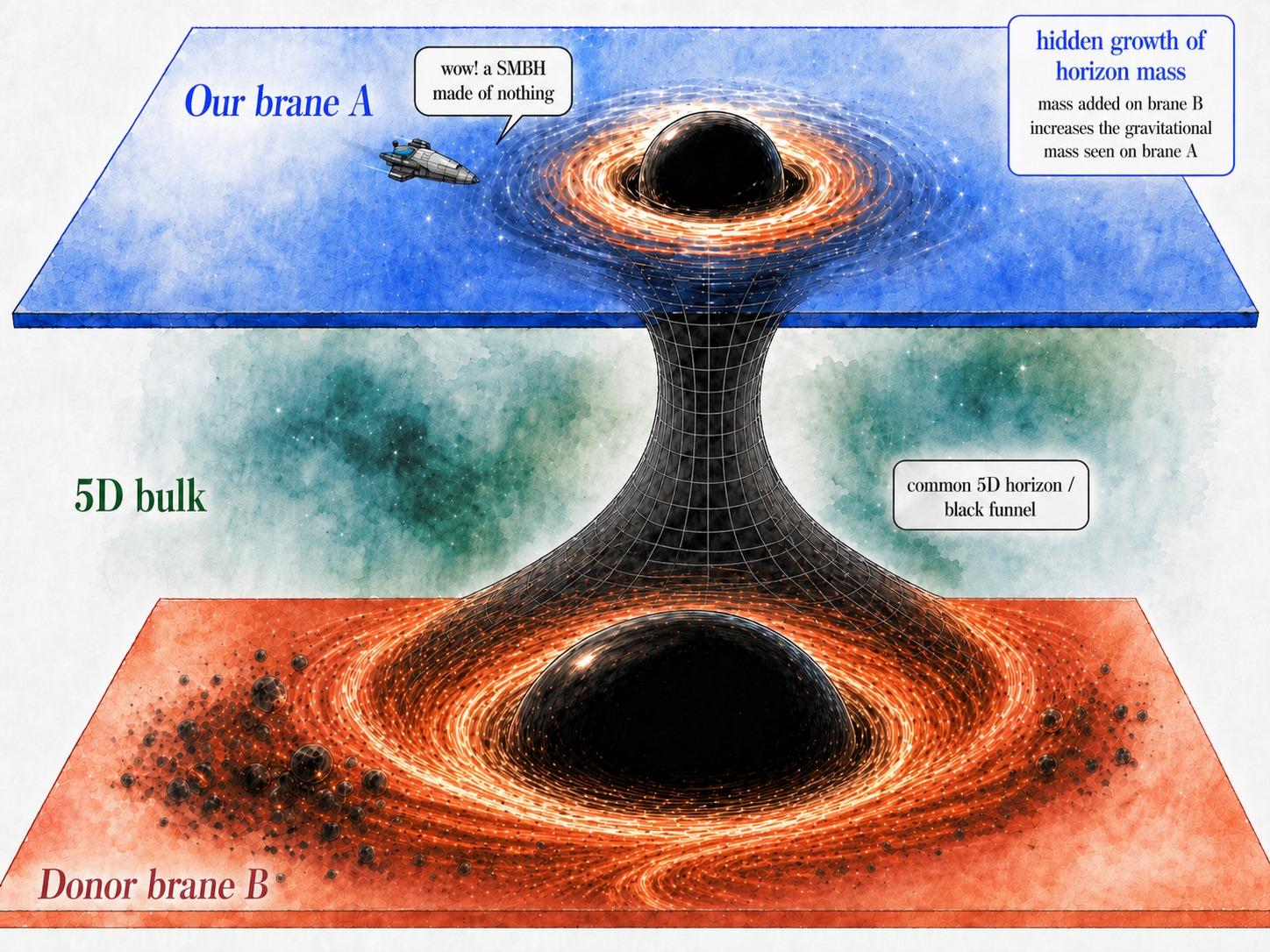
Five-dimensional geometry gives black holes invisible roots that draw matter from a parallel brane—allowing them to grow to inexplicable sizes even in the young universe.
Links in the knowledge graph 1
The visible crown of a massive black hole in our universe is deceptive: its true roots go down into the invisible substrate of a parallel brane. There, in the fifth dimension, lies the source of the giant's growth. The LISA detector is preparing to hear the gravitational noise of these roots, turning theory into an audible symphony of spacetime.
🎯 Some of these hollow black holes could be so massive that their event horizon wouldn't fit inside Pluto's orbit.
\frac{dM_A}{dT_A} = e^{-2d/\ell} \frac{dM_B}{dT_B}
The mass growth rate on our brane (A) is exponentially related to that on the donor brane (B): the distance between branes and the curvature determine how efficient the invisible feeding is.
f_{\text{ISCO}} \approx \frac{c^3}{6^{3/2}\pi G M (1+z)} \approx 4.0 \,\text{mHz} \left(\frac{10^5 M_\odot}{M}\right)\left(\frac{11}{1+z}\right)
Frequency of gravitational waves from the merger of black holes of a given mass at redshift z — the 'music' that LISA will listen to.
Scientists
Alan GuthAndrei LindeGeorges LemaîtreJames PeeblesAdam RiessBrian Schmidtblack hole
gravitational waves
spacetime curvature
quasar
galaxy
expansion of the universe
JWST
cosmic microwave backgroundLaws
Friedmann equationsHubble's lawHawking radiationgravitational lensingBekenstein-Hawking entropyEinstein field equations